Okuma vs DMG Mori CNC Machines: Complete Comparison
Okuma and DMG Mori represent two of the most respected names in CNC machining. Both companies build machines capable of holding micron-level tolerances, running unattended, and lasting decades in production environments. Yet they take fundamentally different engineering philosophies to achieve these goals. After 50+ years of selling and supporting both brands, Meadoworks offers this detailed comparison to help machine shops choose the right platform for their needs.
Used CNC machines in stock now
Browse all 93 used CNC machines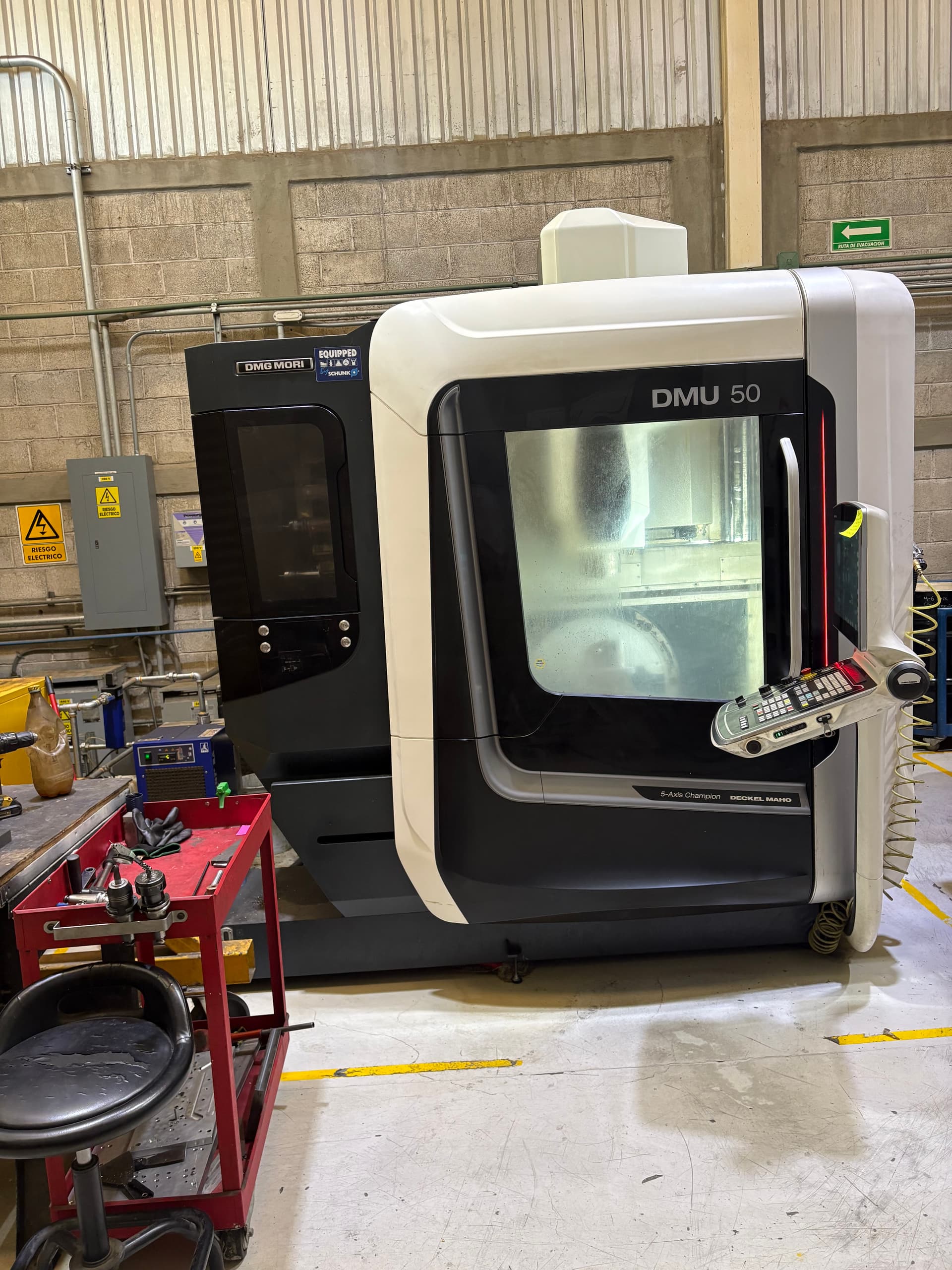
2018 DMG Mori DMU 50 5-Axis
Mexico
Lot 14
MSC Vertical Knee Mill
Wilmington, MA
Ends Tue, Oct 13, 10:00 AM CT
Lot 43A
Milwaukee Lot of Portable Bandsaw, Right Angle Drill and Fish Tape
Naperville, IL
Live auction · Tue, Oct 27, 10:00 AM CT
Lot 38
OTC Lot of (2) Stinger Bearing Separator / Push-Puller Sets
Naperville, IL
Live auction · Tue, Oct 27, 10:00 AM CT
Company Heritage
Okuma
Okuma is a Japanese manufacturer founded in 1898, making it one of the oldest machine tool builders in the world. Okuma is unique in the CNC industry as the only major builder that manufactures its own CNC controls (OSP), servo drives, spindle motors, encoders, and machine structures under one roof. This single-source philosophy means every component is engineered to work together — there are no integration compromises. Okuma operates primarily from its headquarters in Oguchi, Japan, and its Americas headquarters in Charlotte, North Carolina.
DMG Mori
DMG Mori was formed through the 2013 partnership (and subsequent merger) of German builder Deckel Maho Gildemeister (DMG) and Japanese builder Mori Seiki. This merger created the largest machine tool builder in the world by revenue, combining German precision engineering with Japanese manufacturing efficiency. DMG Mori offers the broadest product range in the industry — over 150 CNC models spanning lathes, mills, 5-axis machines, multi-tasking centers, and additive manufacturing systems. The company operates major facilities in Germany, Japan, China, and the United States (Davis, California).
CNC Controls: OSP vs CELOS
The control system is where Okuma and DMG Mori diverge most dramatically, and it often becomes the deciding factor for buyers.
Okuma OSP Control
Okuma's OSP (Okuma Sampling Path) is a fully proprietary CNC control designed, manufactured, and supported exclusively by Okuma. It is the only control available on any Okuma machine — there are no Fanuc or Siemens options.
- Integration: The control, servo amplifiers, spindle drives, and feedback systems are all Okuma-designed — eliminating compatibility layers and communication overhead between third-party components
- Programming: Supports standard G-code (ISO) plus Okuma's conversational programming (IGF — Interactive Graphic Function) for easy shop-floor programming
- Thermo-Friendly integration: The control actively monitors and compensates for thermal growth in real-time — directly communicating with embedded temperature sensors throughout the machine
- Collision Avoidance System (CAS): 3D simulation runs in real-time on the control, preventing crashes before they happen — checks tool, workholding, spindle, and machine structure simultaneously
- Machining Navi: Monitors cutting conditions (vibration, load) and suggests optimal spindle speeds to avoid chatter
- Interface: Large touchscreen with clean layout — operators who learn OSP generally appreciate its logical organization
DMG Mori CELOS with Siemens/Fanuc
DMG Mori's CELOS is a proprietary user interface and application platform that runs on top of industry-standard CNC controls — primarily Siemens SINUMERIK 840D sl on European-origin machines and Fanuc on Japanese-origin machines. Some models also offer Heidenhain controls.
- Control options: Siemens SINUMERIK 840D sl (most European DMG models), Fanuc 0i/31i (most Japanese Mori Seiki-origin models), Heidenhain TNC (select 5-axis models)
- CELOS interface: Tablet-style touchscreen with app-based navigation — provides job management, tool management, maintenance scheduling, and status monitoring
- Advantage — industry standard controls: Operators with Siemens or Fanuc experience can transfer skills directly. Third-party CAM software supports these controls natively. Replacement parts and service for Siemens/Fanuc are globally available
- 3D quickSET: Kinematic measurement and correction for 5-axis accuracy
- Machine Protection Control (MPC): Vibration-based monitoring to detect tool breakage and overload conditions
- Messenger: Remote monitoring and notification system
Control Comparison
| Factor | Okuma (OSP) | DMG Mori (CELOS) |
|---|---|---|
| Control source | 100% Okuma proprietary | Siemens, Fanuc, or Heidenhain |
| G-code compatibility | Standard ISO G-code | Standard ISO G-code |
| Conversational programming | IGF (built-in) | ShopMill/ShopTurn (Siemens) or Manual Guide i (Fanuc) |
| Operator skill transfer | OSP-specific learning required | Siemens/Fanuc skills transfer directly |
| Thermal compensation | Integrated (Thermo-Friendly) | Available but not as deeply integrated |
| Collision avoidance | CAS (real-time 3D) | 3D quickSET + MPC |
| Third-party CAM support | Excellent (standard G-code) | Excellent (native Siemens/Fanuc posts) |
| Service/parts availability | Okuma only | Siemens/Fanuc global networks + DMG Mori |
Machine Construction and Rigidity
Both manufacturers build premium machines, but their construction philosophies have distinct characteristics.
Okuma Construction
- Castings: Okuma casts its own bases, columns, and structural components in-house — single-piece box-way construction on most models for maximum rigidity
- Way systems: Box ways on heavy-cutting machines (LB, MB, MA series), linear guides on high-speed models (GENOS series)
- Spindles: Designed and built by Okuma — tightly integrated with OSP for optimal performance
- Philosophy: Extremely rigid, thermally stable machines designed for heavy material removal and long-term accuracy
- Weight: Okuma machines tend to be heavier than comparably sized competitors — more mass means more vibration damping
DMG Mori Construction
- Castings: High-quality cast iron or polymer concrete (GILDEMEISTER Casting Technology) depending on the model line
- Way systems: Linear guides on most models — roller-type guides on heavy-cutting machines. Some models offer box way options
- Spindle options: Multiple spindle configurations per model — speed-oriented, torque-oriented, or balanced options let buyers optimize for their application
- Philosophy: Broad product range with machines optimized for specific applications — from high-speed finishing to heavy roughing
- coolCore / greenMode: Energy-efficient features including intelligent cooling, auto power-down, and regenerative drives
Thermal Stability
Thermal growth is the number one enemy of dimensional accuracy in CNC machining. As a machine runs, heat from spindle bearings, servo motors, cutting forces, and ambient temperature changes causes the machine structure to expand unevenly, shifting the tool-to-workpiece relationship.
Okuma Thermo-Friendly Concept
Okuma's Thermo-Friendly Concept is widely regarded as the most advanced thermal compensation system in the CNC industry.
- Approach: Rather than fighting thermal growth with complex cooling systems, Okuma designs its machine structures to grow predictably and then compensates in real-time through the OSP control
- Sensors: Temperature sensors embedded throughout the spindle, column, base, ballscrews, and environment continuously feed data to the control
- Compensation: The OSP control applies position corrections in real-time based on a thermal model of the specific machine — unique to each unit
- Result: Dimensional accuracy within ±5 microns regardless of warm-up time or ambient temperature fluctuations of ±8°C
- Practical benefit: No warm-up cycle required — the first part off the machine is as accurate as the hundredth
DMG Mori Thermal Management
DMG Mori addresses thermal stability through a combination of machine design and active cooling.
- Cooling systems: Spindle chillers, ballscrew cooling, and structural cooling circuits on premium models
- Sensor-based compensation: Available on select models but not as universally integrated as Okuma's system
- Machine design: Symmetrical construction and thermally balanced designs reduce differential growth
- Result: Excellent thermal stability on premium models (NTX, NLX, CMX U series) — good stability on standard models with proper warm-up procedures
In head-to-head thermal stability tests, Okuma's Thermo-Friendly Concept consistently demonstrates a measurable advantage — particularly in environments without climate control, where ambient temperature swings are significant. For shops requiring tight tolerances without extensive warm-up time, this is a meaningful differentiator.
Multi-Tasking Capabilities
Multi-tasking machines (mill-turns) that combine turning, milling, drilling, and sometimes grinding in a single setup are a growing segment for both manufacturers.
Okuma Multi-Tasking
- Multus series: Okuma's flagship multi-tasking line — B-axis milling spindle, dual turrets, sub-spindle, Y-axis capability
- Multus U series: Adds 5-axis simultaneous capability with B-axis range of 150°+
- Strengths: Exceptional rigidity for heavy cutting, Thermo-Friendly stability for long-cycle parts, reliable unattended operation
- Limitations: Fewer model variations than DMG Mori — the product line is focused rather than broad
DMG Mori Multi-Tasking
- NTX series: Compact multi-tasking with turnmill spindle — strong in precision aerospace and medical applications
- CTX TC series: Turning centers with driven tools and Y-axis — bridges the gap between turning and true multi-tasking
- DMU/CMX U series: 5-axis machining centers with trunnion or swivel-head designs
- Strengths: Broadest multi-tasking product range in the industry, advanced kinematic options, strong additive/subtractive hybrid machines
- Limitations: Complexity of product line can make model selection challenging — many overlapping options
Multi-Tasking Comparison
| Factor | Okuma | DMG Mori |
|---|---|---|
| Product range breadth | Focused (Multus line) | Extensive (NTX, CTX, DMU, CMX) |
| Rigidity for heavy cuts | Excellent — box ways standard | Very good — varies by model |
| 5-axis capability | Multus U series | Multiple platforms |
| Thermal stability | Superior (Thermo-Friendly) | Very good (active cooling) |
| Additive manufacturing | Multus with laser deposition | LASERTEC series — industry leader |
| Automation integration | Good — Okuma ARMROID, gantry loaders | Excellent — extensive automation portfolio |
Used Market Pricing
Both brands hold their value well on the used market, reflecting their build quality and market demand.
Used Okuma Pricing
| Model Category | Typical Used Price Range |
|---|---|
| LB series lathes (older) | $20,000 – $65,000 |
| LB/LU series lathes (recent) | $70,000 – $200,000 |
| GENOS M VMCs | $35,000 – $100,000 |
| MB/MA VMCs | $50,000 – $175,000 |
| Multus multi-tasking | $100,000 – $400,000+ |
Used DMG Mori Pricing
| Model Category | Typical Used Price Range |
|---|---|
| NL/NLX lathes (older Mori Seiki) | $25,000 – $75,000 |
| CLX/NLX lathes (recent) | $80,000 – $225,000 |
| DMC V / CMX V VMCs | $30,000 – $120,000 |
| DMU / CMX U 5-axis | $75,000 – $350,000+ |
| NTX multi-tasking | $125,000 – $500,000+ |
Okuma machines are renowned for longevity — it is common to find 15–20 year old Okuma lathes and mills still holding tight tolerances in daily production. This durability supports strong residual values across the entire product line. DMG Mori machines from the Mori Seiki era (pre-2013) offer exceptional used-market value, as they carry the same Japanese build quality at prices that reflect the older branding.
Service and Support
| Factor | Okuma | DMG Mori |
|---|---|---|
| Americas headquarters | Charlotte, NC | Davis, CA (+ multiple offices) |
| Service technicians (N. America) | 200+ (Okuma + distributors) | 350+ (direct) |
| Distribution model | Distributor network (regional experts) | Direct sales and service |
| Average response time | 24–48 hours | 24–48 hours |
| Remote diagnostics | Yes — Connect Plan | Yes — NETservice |
| Parts availability | Very good — Charlotte warehouse | Excellent — multiple US depots |
| Training facilities | Charlotte, NC + distributor locations | Multiple US locations |
| Control service (used machines) | Okuma-only — single source | Siemens/Fanuc global support available |
DMG Mori's direct service model provides consistent, company-controlled support across the country. Okuma's distributor model offers strong regional expertise — your local distributor knows your shop and your machines personally. For used machine buyers, DMG Mori has an advantage in control service availability since Siemens and Fanuc parts and technicians are globally ubiquitous, while OSP control service is available only through Okuma and its authorized distributors.
Which Should You Choose?
Choose Okuma If:
- Thermal stability is critical — your shop lacks climate control or you need first-part accuracy without warm-up
- You value the simplicity and integration of a single-source machine — one call to Okuma for everything
- Heavy cutting and rigidity are priorities — Okuma's box-way machines excel at aggressive metal removal
- You want a machine built to last 20+ years with minimal major repairs
- Your operators can learn the OSP control (which is straightforward but different from Fanuc/Siemens)
Choose DMG Mori If:
- You need the broadest range of machine configurations — from simple 2-axis lathes to complex 5-axis mill-turns
- Your operators already know Siemens or Fanuc controls and you want immediate skill transfer
- You need advanced 5-axis or multi-tasking capabilities with multiple kinematic options
- Service parts availability for the CNC control is a priority — Siemens/Fanuc parts are globally available
- You want a machine with multiple spindle and configuration options tailored to your specific application
The Meadoworks Perspective
Having sold both Okuma and DMG Mori machines for decades, Meadoworks sees a consistent pattern: shops that buy either brand and maintain it properly are rewarded with years of reliable, accurate production.
Okuma machines stand out for their longevity and the Thermo-Friendly Concept — we regularly see 15–20 year old Okuma machines still holding tolerance and producing parts daily. The single-source philosophy means fewer compatibility headaches and a direct line to the people who engineered every component.
DMG Mori machines stand out for their breadth of capability and the flexibility of running industry-standard controls. Shops with Siemens or Fanuc experience can put a DMG Mori machine into production faster, and the extensive model range means there is almost always a machine precisely configured for the application.
On the used market, both brands offer excellent value. Okuma machines depreciate slowly and provide exceptional residual capability. DMG Mori machines from the Mori Seiki era are among the best values in the used CNC market — Japanese build quality at approachable prices.
Frequently Asked Questions
Is Okuma or DMG Mori better for CNC machining?
Both are world-class CNC builders, and the better choice depends on your priorities. Okuma excels in thermal stability (Thermo-Friendly Concept), control system simplicity (single-source OSP), machine rigidity, and long-term reliability with lower maintenance costs. DMG Mori offers the broadest product range in the industry, multiple control options (CELOS with Siemens, Fanuc, or Heidenhain), more advanced multi-tasking machines, and stronger European/global support networks. Shops that value simplicity and reliability tend to prefer Okuma. Shops that need maximum flexibility and cutting-edge multi-axis capabilities often choose DMG Mori. Meadoworks stocks both brands — call 800-323-0307 for current inventory.
What is the difference between Okuma OSP and DMG Mori CELOS?
Okuma's OSP (Okuma Sampling Path) is a proprietary CNC control that Okuma designs and builds in-house — it is the ONLY control available on Okuma machines. OSP integrates seamlessly with Okuma's servo drives, spindle motors, and machine monitoring, creating a tightly optimized system. DMG Mori's CELOS is a user interface layer that runs on top of Siemens (SINUMERIK 840D sl), Fanuc, or Heidenhain controls. CELOS provides a unified touchscreen experience for job management, monitoring, and app-based functionality, while the underlying CNC control handles motion and G-code processing. The key distinction: OSP is a complete, self-contained control. CELOS is an interface that enhances a third-party control.
How much does a used Okuma CNC cost?
Used Okuma CNC prices vary by machine type and model. Okuma lathes (LB series) range from $20,000–$80,000 for older models to $80,000–$200,000 for late-model machines. Okuma vertical machining centers (GENOS/MB series) run $30,000–$100,000 for older units and $80,000–$250,000 for recent models. Okuma multi-tasking machines (Multus series) range from $100,000 to $400,000+. Okuma machines are known for exceptional longevity — 15–20 year old machines routinely hold tight tolerances and remain in daily production.
How much does a used DMG Mori CNC cost?
Used DMG Mori CNC pricing spans a wide range given the breadth of their product line. DMG Mori lathes (CLX/NLX series) range from $30,000–$90,000 for older models to $100,000–$250,000 for recent machines. Vertical machining centers (CMX/DMC V series) run $25,000–$80,000 for older units and $80,000–$200,000 for late models. 5-axis machines (DMU/CMX U series) range from $75,000 to $350,000+. Multi-tasking machines (NTX/CTX series) command $100,000–$500,000+ depending on model and capabilities. DMG Mori machines from the Mori Seiki era (pre-2013) offer especially strong used market value.
Browse Used Okuma & DMG Mori CNC Machines
Meadoworks stocks used CNC machining centers, lathes, and multi-tasking machines from Okuma, DMG Mori, and all major builders. Let our team help you find the right machine for your shop.Contact us →
Or call 800-323-0307 to discuss your CNC machining requirements with an industry expert.
