Used Surface Grinder Buying Guide: Reciprocating, Blanchard, Cylindrical & Centerless
By Meadoworks | April 2026 | 13 min read
Key Takeaways
- Four families: reciprocating (precision flat), Blanchard rotary (fast face grinding), cylindrical OD/ID, and centerless (high-volume round parts)
- Used pricing: $3,000 (small manual reciprocating) to $150,000+ (CNC cylindrical Studer/Okuma/Kellenberger)
- Blanchard grinders are some of the safest used investments — even 1960s-70s machines remain in active production
- Critical inspection: spindle condition (rebuilds $5K-$20K), table/way wear, magnetic chuck holding power, and a grinding accuracy test
- Brand value: Studer, Okuma, Kellenberger hold cylindrical value best; Brown & Sharpe, Chevalier, Okamoto for reciprocating
Surface grinders are the backbone of precision finishing in metalworking shops. Whether you need mirror-flat surfaces on tool steel, fast stock removal on castings, or tight OD tolerances on shafts, there's a grinding machine designed for the job. This guide covers every major type of grinder, what specs matter, the brands worth buying, realistic pricing, and exactly what to inspect before you write a check.
Types of Grinding Machines
Grinding machines fall into four broad families, each designed for different workpiece geometries and production requirements.
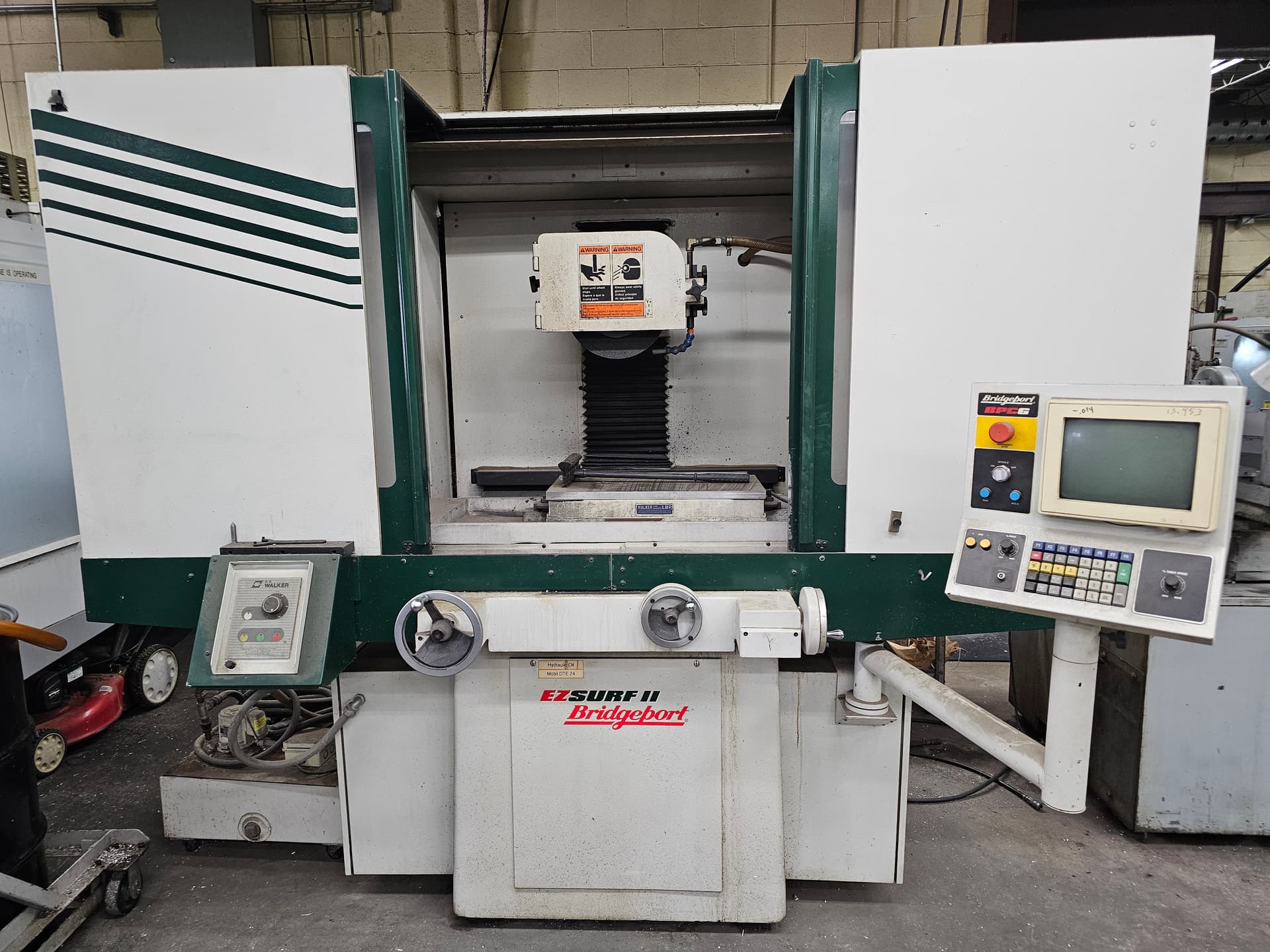
Reciprocating Surface Grinder
Horizontal spindle with a table moving back and forth under the wheel. Available in manual, hydraulic semi-automatic, and CNC. Tables 6×18 (toolroom) to 24×48+ (production).
Best for: Precision flatness/parallelism on smaller parts, tool & die work, sharpening, hardened steel finishing, prototype work.
Blanchard (Rotary) Grinder
Vertical spindle with a large rotating magnetic chuck. Wheel and chuck rotate opposite directions. Aggressive cuts of 0.010"+ per pass. Signature cross-hatched spiral finish.
Best for: High-volume face grinding, stock removal from castings/forgings, mold bases, fixture plates, die shoes — speed and flatness over finish.
Cylindrical Grinder (OD/ID)
Workpiece held between centers or in a chuck and rotated against the wheel. Universal models swivel for OD, ID, taper, and face grinding. Tolerances of 0.0001" or better.
Best for: Precision shafts, spindles, bearing journals, pins, punches, rolls — any round parts requiring tight OD/ID tolerances and fine finishes.
Centerless Grinder
Workpiece supported on a work rest blade between grinding wheel and smaller regulating wheel. Through-feed mode automatically processes parts. No centers, chucks, or fixtures required.
Best for: High-volume cylindrical parts: pins, dowels, rollers, shafts, tubes, needles, medical components. Thousands of parts per hour possible.
Key Specifications to Evaluate
Table / Chuck Size
Reciprocating: table size (e.g., 12×24) defines max workpiece. Blanchard: chuck diameter (20" handles ~18" diameter parts). Cylindrical: swing × between centers.
Grinding Wheel Size
Surface grinder wheels 7-14". Blanchard segmented wheels 14-36". Cylindrical wheels 14-24". Larger wheels = faster removal and longer life.
Spindle Power & Speed
2-3 HP toolroom; 5-15 HP production; 15-50 HP for Blanchard heavy stock removal. Variable speed adds flexibility for different wheels and materials.
Magnetic Chuck
Permanent (no power, fail-safe) vs electromagnetic (adjustable, demagnetize). Fine-pole for thin parts. Check holding power and surface condition on used machines.
Machine Geometry
Way flatness/straightness, spindle squareness to table, and overall rigidity define fundamental accuracy. Worn ways are expensive to recondition.
Top Grinding Machine Brands
Blanchard
Specialty: Rotary Surface
The original rotary surface grinder. Models 11, 18, 22, 36, 42, and 48 are virtually indestructible. Even 1960s-70s machines remain in active production. One of the safest used equipment investments you can make.
Brown & Sharpe
Specialty: Reciprocating
Iconic American brand known for precision reciprocating surface grinders. The Micromaster and earlier models set the standard for toolroom grinding accuracy. Production ceased, but parts and service remain available.
Chevalier
Specialty: Reciprocating
Taiwanese manufacturer with excellent price/performance balance. Widely used in North American shops with modern features (hydraulic drives, power down-feeds, CNC) at prices below comparable Japanese machines. FSG series most popular.
Okamoto
Specialty: Reciprocating
Japanese manufacturer of high-precision surface grinders. Tight tolerances, excellent build quality, and advanced features like automatic dressing and in-process gauging. ACC series is a popular production grinder.
Studer
Specialty: Cylindrical
Swiss-made cylindrical grinders representing the gold standard for OD/ID work. S33, S31, S41 are highly sought-after. Used Studers command premium prices but offer unmatched accuracy and longevity.
Okuma
Specialty: CNC Cylindrical
Japanese manufacturer with proprietary OSP control system. Known for thermal stability, precision, and long service life. Vertically integrated control/motor/structure provides optimized performance.
Kellenberger
Specialty: Universal Cylindrical
Swiss precision cylindrical grinder brand under United Grinding. Universal grinders extremely versatile — OD, ID, face, and taper grinding with exceptional accuracy. Well-maintained units retain value strongly.
Cincinnati (Fives)
Specialty: Centerless
Legendary American centerless grinder brand. Workhorses of high-volume production known for durability and consistent output. Now under Fives Group; used machines remain in strong demand.
Used Surface Grinder Pricing Guide
Prices reflect machines in good working condition, 5-20 years old, with standard equipment. Older machines in excellent condition may also fall within these ranges.
| Type | Size / Capacity | Price Range |
|---|---|---|
| Manual reciprocating | 6"×18" table | $3,000 – $8,000 |
| Hydraulic reciprocating | 8"×24" table | $8,000 – $20,000 |
| Hydraulic reciprocating | 12"×24" to 12"×36" | $15,000 – $35,000 |
| CNC reciprocating | Various | $25,000 – $75,000+ |
| Blanchard rotary | 20" chuck (Model 11) | $15,000 – $35,000 |
| Blanchard rotary | 36"-42" chuck (Model 22/36) | $35,000 – $80,000+ |
| Cylindrical OD grinder | Small (8" swing × 20") | $10,000 – $25,000 |
| Cylindrical OD/ID | Mid-size universal | $25,000 – $75,000 |
| CNC cylindrical | Studer / Okuma / Kellenberger | $50,000 – $150,000+ |
| Centerless grinder | Small to mid-size | $15,000 – $50,000 |
| Centerless grinder | Production size | $40,000 – $100,000+ |
Always Demand a Test Cut
A well-maintained surface grinder should produce flatness within 0.0002" across a 6" part and surface finishes of 16 Ra or better. If a seller won't let you grind a test piece — or won't provide one with matching results — consider that a red flag. Static inspection misses problems that only appear under load.
What to Inspect Before Buying a Used Grinder
Grinding machines are precision tools, and worn or damaged components directly affect part quality. A thorough inspection can prevent costly surprises.
Spindle Condition
Heart of any grinder. Listen for bearing noise at speed — should run quietly with no rumble or whine. Check runout in taper or on flange (under 0.0002" for precision). Spindle rebuilds run $5,000-$20,000.
Table & Way Condition
Inspect for scoring, excessive wear, galling. Run table through full travel feeling for roughness or tight spots. Check flatness with precision straight edge. Way reconditioning may require sending to a rebuilder.
Magnetic Chuck
Test with a workpiece — should hold firmly with no movement. Check surface for scoring/warping/corrosion. Worn chucks can be re-ground; weak magnets need replacement ($2,000-$10,000+). Test all settings on electromagnetic units.
Hydraulic System
Check for oil leaks, listen for pump noise, verify smooth table traverse. Table should reverse crisply without hesitation. Milky oil = water contamination; dark oil = overheating. Hydraulic rebuilds add $2,000-$8,000.
Grinding Accuracy Test
Best inspection: grind hardened steel and measure flatness, parallelism, surface finish. Well-maintained surface grinder should hit 0.0002" flatness across 6" with 16 Ra finish. Seller refusing test cuts = red flag.
Cylindrical-Specific
Verify center alignment between headstock/tailstock. Test workhead rotation smoothness. Verify tailstock quill clamping. Check wheelhead slide cross-feed. On CNC, run a test program and measure roundness, diameter, finish.
Centerless-Specific
Check regulating wheel drive consistency. Inspect work rest blade for wear (causes poor rounding). Test through-feed and in-feed modes. Verify truing/dressing systems. Run a batch and measure size consistency, roundness, finish.
Choosing the Right Grinder for Your Application
Before shopping, define your requirements clearly:
- Part geometry: Flat surfaces → reciprocating or Blanchard. Round parts → cylindrical or centerless.
- Volume: Low/prototype → manual or semi-automatic. Production → hydraulic automatic or CNC.
- Finish: Mirror finish → reciprocating with fine wheel. Functional flat → Blanchard.
- Part size: Determines table size, swing capacity, and between-centers distance.
- Tolerances: Tight tolerances (<0.0005") require precision machines from premium brands in good condition.
- Material: Hardened steel, carbide, and ceramics require specific wheel types and grinder capabilities.
Frequently Asked Questions
What is the difference between a surface grinder and a Blanchard grinder?
A reciprocating surface grinder uses a horizontal spindle and a table that moves back and forth under the wheel, producing very flat and precise finishes on smaller parts. A Blanchard grinder (rotary surface grinder) uses a vertical spindle and a large rotating magnetic chuck to grind the faces of parts quickly. Blanchard grinders are faster and better suited for heavy stock removal on larger, flatter parts, while reciprocating grinders deliver finer finishes and tighter tolerances.
How much does a used surface grinder cost?
Used surface grinder prices vary widely based on type and size. Small manual reciprocating grinders (6x18 table) start around $3,000-$8,000. Mid-size hydraulic grinders (8x24 to 12x24) run $8,000-$30,000. Large production grinders cost $25,000-$75,000+. Used Blanchard grinders range from $15,000 for a Blanchard 11 to $80,000+ for a Blanchard 22 or 36. Cylindrical grinders range from $10,000-$100,000+ depending on brand and capacity.
What should I look for when buying a used surface grinder?
The most important things to inspect are: spindle condition (listen for bearing noise, check runout), table and ways (check for wear and scoring), magnetic chuck condition and holding power, hydraulic system function (if equipped), accuracy (grind a test piece and measure flatness and parallelism), and overall machine geometry. Also verify that the machine has proper guarding and coolant containment.
Which surface grinder brands hold their value best?
Premium brands like Studer, Okuma, and Kellenberger hold value extremely well in cylindrical grinding. For reciprocating surface grinders, Brown & Sharpe, Chevalier, and Okamoto are strong. Blanchard rotary grinders retain excellent value due to their durability and demand — even 30-year-old Blanchard grinders command good prices because of their rugged construction.
Browse Used Grinding Equipment at Meadoworks
Meadoworks stocks used surface grinders, Blanchard grinders, cylindrical grinders, centerless grinders, and tool & cutter grinders from all major brands. Need help choosing the right grinder?