Twin Screw vs Single Screw Extruder: A Buyer's Guide
By Meadoworks | April 2026 | 12 min read
Key Takeaways
- Single-screw extruders are the workhorse for pipe, sheet, profile, film, and wire — where pellet feedstock is melted and shaped
- Twin-screw extruders dominate compounding, masterbatch, reactive extrusion, and devolatilization where mixing intensity matters
- Co-rotating intermeshing twins (Coperion ZSK, Berstorff ZE) are the global standard for compounding
- Counter-rotating twins (Battenfeld-Cincinnati, Krauss-Maffei) are the standard for PVC pipe and profile
- Used pricing: single-screws $5k–$200k+; twin-screws $25k–$1.5M+ depending on size and brand
The choice between a twin-screw and a single-screw extruder shapes everything that follows in a plastics processing line — capital cost, throughput, formulation flexibility, and the kinds of products you can make. This guide explains how each technology works, where each excels, what to expect from leading brands like Davis-Standard, Coperion, and Berstorff, and what to inspect on the used market.
Single-Screw, Co-Rotating, and Counter-Rotating
Three fundamental architectures cover virtually every commercial extruder on the market today. The right choice is dictated by what happens between feed throat and die — straight melt-and-shape, or true material engineering inside the barrel.
Single-Screw Extruder
One rotating screw conveys, melts, and pumps polymer through a die. Simple, robust, and the workhorse of straight extrusion when minimal mixing is required.
Best for: Pipe, sheet, profile, blown film, cast film, wire and cable insulation — anywhere homogeneous pellet feedstock is melted and shaped.
Co-Rotating Twin-Screw
Two intermeshing screws rotating in the same direction. Modular barrel and screw geometry provide intense, configurable mixing and devolatilization.
Best for: Compounding, masterbatch, reactive extrusion, devolatilization, fiber-reinforced compounds, biopolymers, recycling and PCR upgrading.
Counter-Rotating Twin-Screw
Two intermeshing screws rotating in opposite directions. Positive conveying with low shear — ideal for shear-sensitive polymers.
Best for: PVC pipe and profile extrusion, where temperature control and gentle conveying prevent thermal degradation of PVC formulations.
Head-to-Head Comparison
| Factor | Single-Screw | Twin-Screw |
|---|---|---|
| Primary Use | Straight extrusion of finished resin | Compounding, mixing, devolatilization |
| Mixing Quality | Light to moderate (with mixing sections) | Intense, distributive and dispersive |
| Capital Cost | Lower for given throughput | Higher (2-4x) for equivalent throughput |
| Modularity | Fixed barrel; screw must be pulled | Segmented barrel; rearrangeable elements |
| Devolatilization | Limited (single-vent at most) | Excellent (multiple vacuum vents) |
| Side-Feeding | Uncommon | Standard for fillers and reinforcements |
| Maintenance | Simple — one screw, fewer parts | More complex — gearbox, elements, bearings |
Other Factors to Weigh
Mixing Capability
Single-screw is light to moderate. Twin-screw is intense and configurable. Compounding fillers, fibers, or pigments effectively requires twin-screw geometry.
Throughput Range
Single-screw: 50–6,000 lb/hr depending on diameter. Twin-screw: 20–20,000+ lb/hr depending on screw size. Both scale predictably.
Modularity
Single-screws have fixed barrels — screw redesign requires removal. Twin-screws have segmented barrels and screw elements you can rearrange for new applications.
Wear & Maintenance
Single-screws are simpler — fewer wear surfaces and lower part costs. Twin-screws have more bearings, gearbox complexity, and screw-element costs but tolerate aggressive duty.
PVC: A Special Case
PVC is thermally sensitive and requires the gentle, positive conveying of a counter-rotating intermeshing twin-screw. Co-rotating twins generate too much shear for PVC, while single-screws lack the temperature control. If you're running PVC pipe or profile, look for Battenfeld-Cincinnati, Krauss-Maffei, Cincinnati-Milacron, or Davis-Standard counter-rotating twins.
Top Extruder Brands on the Used Market
Davis-Standard
Models: Single-screw: DSB, MAC, KOLD; twin-screw: D-TEX, Maillefer
American extrusion leader with deep depth in single-screw lines for pipe, sheet, blown film, and wire & cable. Widely supported by independent service organizations and abundant on the used market.
Coperion
Models: ZSK Mc, ZSK Mc18, STS, ZE-A
The reference brand for co-rotating twin-screw compounding. ZSK series dominates plastics compounding, masterbatch, and engineering compound production worldwide. Premium pricing reflects premium throughput and longevity.
Berstorff
Models: ZE, KE-W, KE-WT
Now part of KraussMaffei. Long history in twin-screw compounding and rubber extrusion. ZE series is a strong alternative to Coperion ZSK with similar capabilities at competitive used pricing.
Bühler
Models: BCG, MDDK, DNDC
Swiss-engineered twin-screws used heavily in food, masterbatch, and engineering compound applications. Known for build quality, energy efficiency, and Bühler's global service footprint.
Welex
Models: Single-screw sheet extruders, coextrusion lines
Specialist in sheet and coextrusion lines. Welex single-screws are commonly found on PP, HIPS, PET, and barrier sheet lines. Strong installed base in North American thermoforming sheet houses.
Battenfeld-Cincinnati
Models: ConEx, twinEX, solEX
Major builder of single and counter-rotating twin-screw lines for pipe and profile, especially PVC. ConEx and solEX single-screws are widely used; twinEX counter-rotating twins dominate North American PVC pipe production.
Used Extruder Pricing Summary
| Configuration | Used Price Range |
|---|---|
| Lab/pilot single-screw (1" – 1.5") | $5,000 – $25,000 |
| Small production single-screw (2" – 2.5") | $12,000 – $40,000 |
| Mid-production single-screw (3.5" – 4.5") | $30,000 – $90,000 |
| Large single-screw (6" – 8") | $80,000 – $200,000+ |
| Lab/pilot twin-screw (16-26mm) | $25,000 – $75,000 |
| Mid-production co-rotating twin (40-70mm) | $80,000 – $300,000 |
| Large co-rotating twin (90-180mm) | $250,000 – $1,500,000+ |
| Counter-rotating twin (PVC pipe/profile) | $50,000 – $250,000 |
What to Inspect on a Used Extruder
Screw & Barrel Wear
Pull the screw and measure flight diameter against barrel ID. Wear over 0.005" per side significantly reduces output. Replacement screws can run $15,000-$80,000; rebuilt barrels $20,000-$100,000+.
Gearbox Condition
Listen under load for whining, knocking, or oil temperature spikes. Twin-screw gearboxes are highly engineered and rebuilds can exceed $100,000. Pull the gearbox sample and verify clean oil.
Drive Motor & Controls
Verify motor amperage matches nameplate at rated screw speed. AC vector drives are preferred over older DC SCR drives. Check controller (Allen-Bradley, Siemens) for available spares and HMI condition.
Heater Bands & Cooling
Inspect each barrel zone heater band for hot spots or burn-through. Verify barrel cooling — water lines and blower fans on each zone. Failed cooling causes runaway temperatures and degraded polymer.
Screw Elements (Twin-Screw)
Modular twin-screw elements wear unevenly. Inspect kneading blocks, conveying elements, and turbine elements for chipping, plating loss, or dimensional change. Replacement elements often cost $1,000-$5,000 each.
Vacuum & Side-Feed Systems
If equipped, inspect vacuum pump condition, vent port screens for plugging, and side-feeder screws for wear. Vacuum systems are critical for devolatilization quality but commonly neglected.
Frequently Asked Questions
What is the difference between a twin-screw and single-screw extruder?
A single-screw extruder uses one rotating screw inside a barrel to convey, melt, and pump polymer through a die. It is the workhorse of straight extrusion — pipe, sheet, profile, and film — where the feedstock is already a homogeneous resin pellet. A twin-screw extruder has two intermeshing screws rotating in the same direction (co-rotating) or opposite directions (counter-rotating). The intermeshing geometry creates intense distributive and dispersive mixing, devolatilization, and reactive processing capability. Twin-screws dominate compounding, masterbatch, reactive extrusion, and devolatilization applications where mixing or chemistry must happen inside the extruder.
How much does a used twin-screw extruder cost?
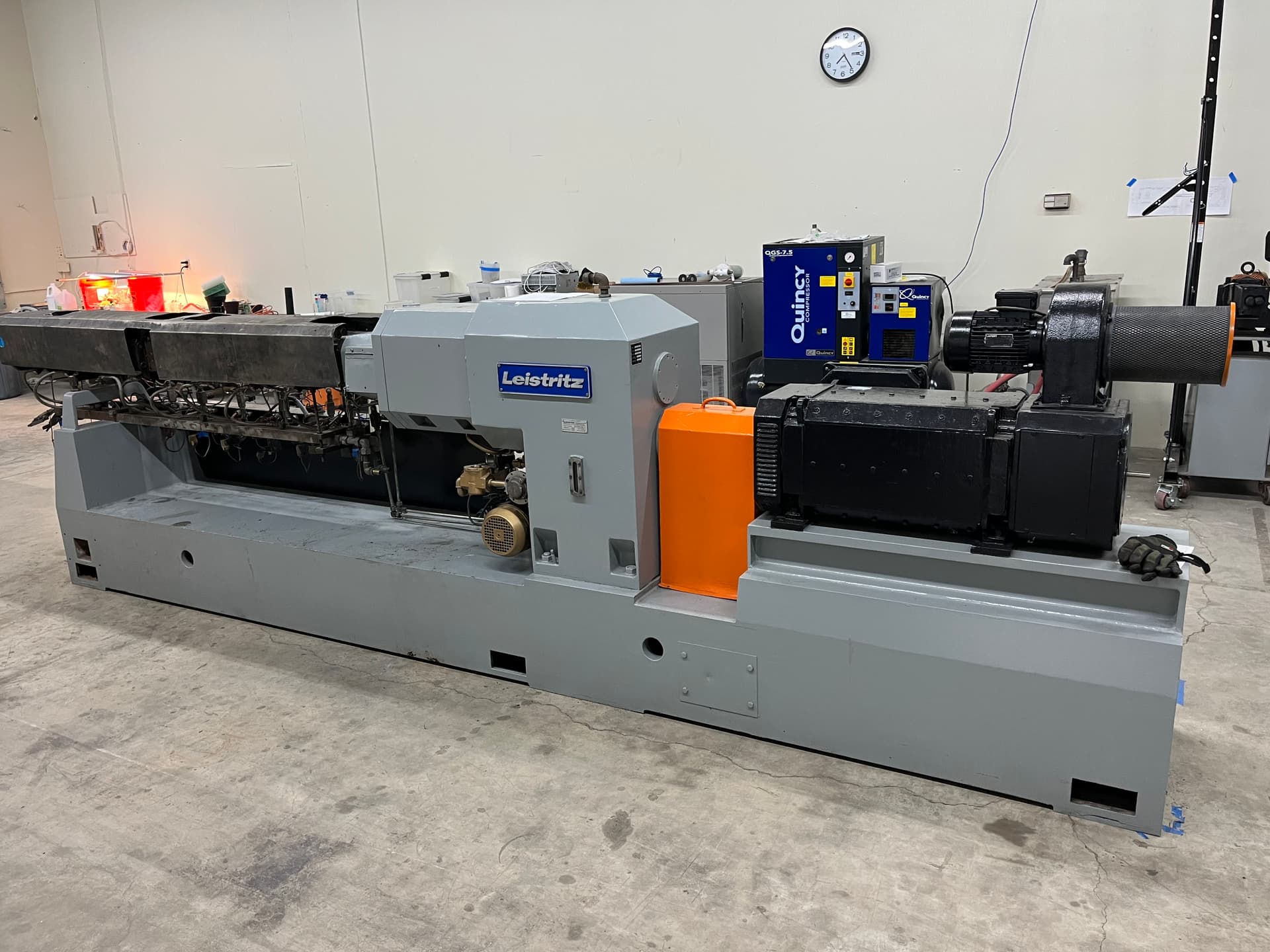
Used twin-screw extruder pricing varies dramatically by size and configuration. Small lab/pilot machines (16-26mm) range from $25,000 to $75,000. Mid-range production compounders (40-70mm) typically run $80,000 to $300,000. Large production lines (90-180mm) range from $250,000 to $1,500,000+. Co-rotating compounding lines from Coperion ZSK, Berstorff ZE, and Leistritz ZSE command the highest prices. Counter-rotating intermeshing twins for PVC pipe and profile typically run $50,000 to $250,000.
How much does a used single-screw extruder cost?
Used single-screw extruder prices range from $5,000 for small lab units to $200,000+ for large production extruders. A 2.5" general-purpose extruder (40-80 HP) typically sells for $15,000 to $40,000. A 4.5" extruder (150-250 HP) ranges from $40,000 to $90,000. A 6" or 8" production extruder runs $80,000 to $200,000+. Pricing depends heavily on screw and barrel wear, drive type (AC vs DC), and accessories like gravimetric feeders or downstream equipment.
Which is better for compounding: twin-screw or single-screw?
Twin-screw extruders are vastly superior for compounding. Co-rotating intermeshing twin-screws create the distributive and dispersive mixing required to incorporate fillers, fibers, color, and additives into a polymer matrix. Modular barrel sections allow precise placement of mixing elements, kneading blocks, vacuum venting for devolatilization, and side feeders for downstream addition of fillers. Single-screw extruders can be modified with mixing sections (Maddock, Saxton, pineapple) for light blending, but they cannot match the mixing intensity of a twin-screw for true compounding work.
What twin-screw configurations exist?
Twin-screws fall into four categories. Co-rotating intermeshing (most common for compounding — Coperion ZSK, Berstorff ZE, Leistritz ZSE) provides high shear, excellent mixing, and self-wiping screws. Counter-rotating intermeshing (Cincinnati, Krauss-Maffei, Davis-Standard) is the standard for PVC pipe and profile because of its positive conveying. Counter-rotating non-intermeshing (Welding Engineers) is used for devolatilization. Co-rotating non-intermeshing is rare today. Configuration is selected based on the application — compounding, PVC processing, devolatilization, or reactive extrusion.
Need help choosing the right extruder?
Meadoworks stocks single-screw and twin-screw extruders from every major builder. Our team can help you scope the right machine size, screw geometry, and downstream equipment for your application.
Browse extrusion equipment or contact a specialist. Call 800-323-0307.