Used Vertical Plastic Injection Molding Machines for Sale
All used injection molding machines (63) →
See all 63 Injection Molding Machines →
5 results

Item #5856
2005 Cincinnati Milacron Magna V30-S
USA

Item #5651
Multiplas - VC-SD-35T
USA

Item #3872
Cincinnati Milacron - HC 70
USA

Item #4737
Autojectors - HS-35-S
USA

Item #3873
Autojectors - HCR-90
USA
Vertical Injection Molding Machines by the numbers
From our own catalog: machines listed now and machines we have sold. Updated every few minutes.
Our track record
324 machines sold · 19 makes · model years 1980–2023 · 7 sold at our own auctions
By clamp force
| Clamp force | In stock now | Sold by Meadoworks |
|---|---|---|
| Under 100 tons | 5 | 203 |
| 100–299 tons | 0 | 101 |
| 300–499 tons | 0 | 19 |
By brand
| Brand | In stock now | Sold by Meadoworks | Model years |
|---|---|---|---|
| Autojectors | 2 | 90 | 1983–2001 |
| Milacron | 2 | 26 | 1993–2007 |
| Multiplas | 1 | 6 | 1992–1997 |
| Newbury | 0 | 70 | 1980–2000 |
| Engel | 0 | 53 | 1992–2012 |
| Nissei | 0 | 31 | 1989–2020 |
| Arburg | 0 | 12 | 1989–2022 |
| Battenfeld | 0 | 6 | 1994–2010 |
| Van Dorn | 0 | 6 | 2001–2003 |
| Demag | 0 | 4 | 1999–2000 |
Spec ranges across our machines
| Spec | Range | Machines |
|---|---|---|
| Clamp force | 10–400 tons | 328 |
| Shot size | 0.4–63.6 oz | 297 |
| Screw diameter | 16–80 mm | 67 |
| Tie-bar spacing (first figure) | 5–48 in | 72 |
| Platen size (first figure) | 6–59.1 in | 217 |
Controls we see most: PLC (31), Relay (25), CC100 (16), Matrix (15), Solid (14), CAMAC (12)
Looking for Something Specific?
Most of our inventory sells before we can list it online. If you need a specific brand, model, or specification, tell us what you need—we have access to unlisted equipment and machines coming in from plant closures.
Browse Used Vertical Injection Molding Machines by Brand
Browse Used Vertical Injection Molding Machines by Country
Looking to Sell Your Vertical Injection Molding Machines?
Meadoworks is an active cash buyer of used industrial equipment. Get a free valuation from our AMEA-certified appraisers.
About Used Vertical Injection Molding Machines
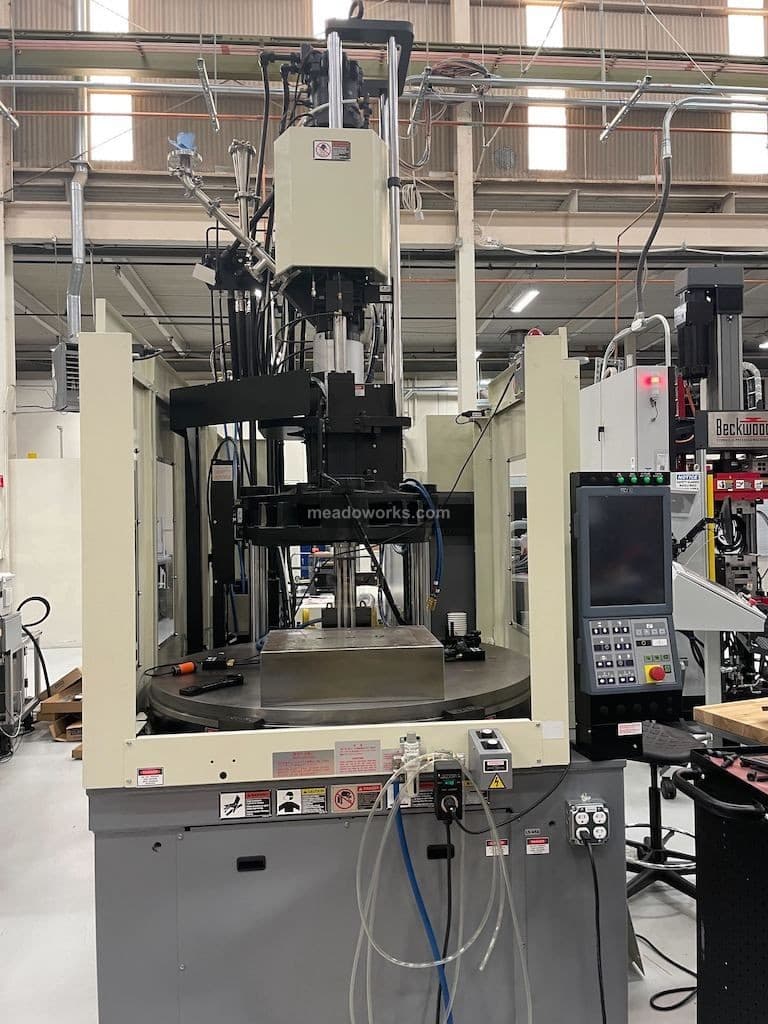
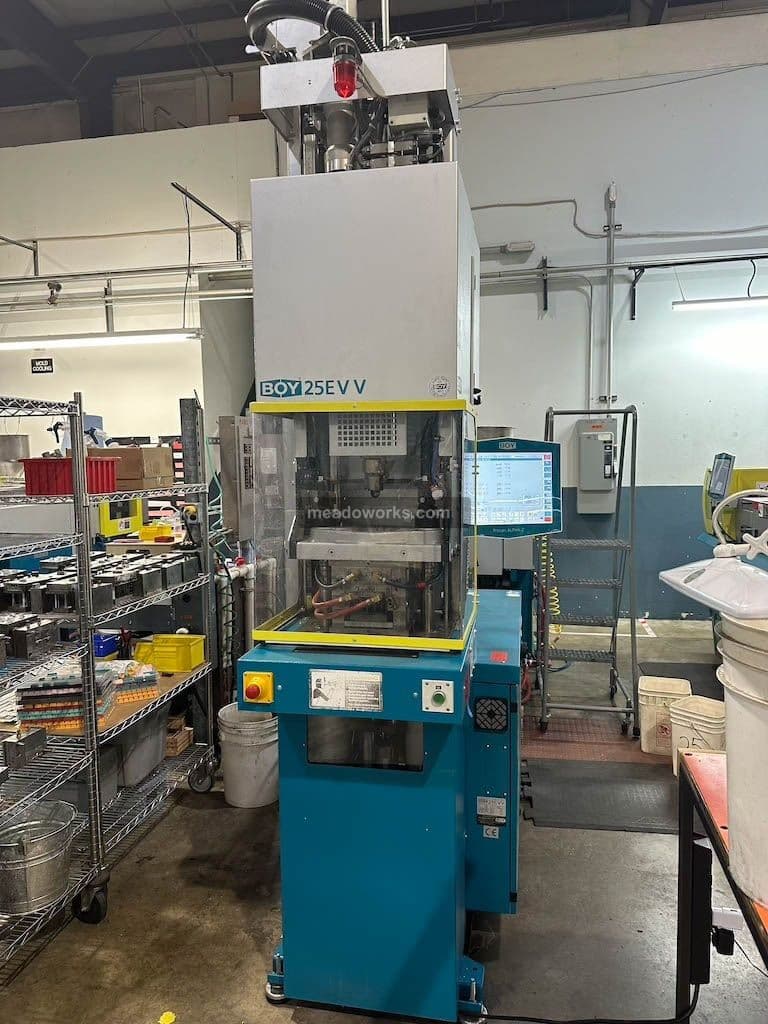
Vertical plastic injection molding machines (also known as vertical injection moulding machines) feature a vertical clamping unit with the injection unit positioned above or beside the mold. This configuration is ideal for insert molding, over-molding, and multi-material applications where components are loaded into the lower mold half. Vertical injection molding machines use gravity to hold inserts in place, making them the preferred choice for embedding metal components, connectors, and other materials into plastic parts.
Vertical injection machines are available in shuttle table, rotary table, and single-station configurations. Shuttle table machines allow an operator to load inserts on one mold half while the other is cycling, maximizing productivity. Rotary table vertical molding machines offer even higher throughput with multiple stations. Single-station vertical plastic molding machines are compact and cost-effective for lower-volume production.
Meadoworks has sold more than 300 used vertical injection molding machines, from 10-ton insert presses up to 400 tons. Autojectors, Newbury, Engel and Nissei are the makes we have sold most, followed by Milacron and Arburg. Whether you need a small vertical plastic moulding machine for connector insert molding or a large vertical injection machine for automotive over-molding, contact our team at 800-323-0307.
How to Choose a Used Vertical Injection Molding Machine
Insert molding is the reason
The clamp stands upright, so gravity holds an insert in the lower half while the mold closes. That is the job: overmold a pin, a blade, a connector, or a second material. A horizontal press can do inserts with a robot. A vertical press does them with a person or a shuttle, and the footprint is smaller.
Shuttle and rotary tables let you load one station while another is molding. A single station is simpler and slower. Pick the table from how many inserts a person can place in the cycle, not from clamp tons.
Clamp and shot still rule
Vertical machines are often smaller in tons than the horizontal presses in the same shop. The shot still has to fill the part. The lower platen has to accept the mold, and the daylight has to clear the insert and the operator's hands or the shuttle.
Tie the choice to the insert. A tall insert needs more daylight. A multi-cavity insert tool needs a rotary or a shuttle if you want the operator out of the clamp during the shot.
Vertical Injection Molding Machine Specs to Compare
| Spec | Typical range | Why it matters |
|---|---|---|
| Clamp (tons) | Often about 15–300 tons | Insert tools are usually smaller. The tons still have to hold the projected area. |
| Shot size (oz) | Has to fill the overmold, not the insert. A large screw on a tiny shot will degrade the resin. | |
| Table style | Shuttle and rotary let you load off-cycle. A single station waits on the operator. | |
| Daylight (in) | Has to clear the insert, the mold, and the hands or the fixture that loads it. |
Clamp (tons)
Typical range: Often about 15–300 tons
Insert tools are usually smaller. The tons still have to hold the projected area.
Shot size (oz)
Has to fill the overmold, not the insert. A large screw on a tiny shot will degrade the resin.
Table style
Shuttle and rotary let you load off-cycle. A single station waits on the operator.
Daylight (in)
Has to clear the insert, the mold, and the hands or the fixture that loads it.
What to Inspect on a Used Vertical Injection Molding Machine
Stroke the table
A shuttle or rotary that indexes late will close on a fixture. Cycle it empty and watch the stop.
Check the lower platen
Insert tools bolt to the bottom. Worn locating rings and pulled threads are the fit problem.
Run mold protect
An insert that sits proud should stop the clamp. If protect is dead, the tool is at risk.
Look at the injection unit
Vertical injection units leak at the nozzle and the carriage. A nozzle that drools will string on the insert.
Related Equipment
- Water Temperature Controllers
Hold the mold at a setpoint
- Servo Robots
Take the part out and place it
- Used Multi-Shot & 2-Shot Injection Molding Machines
Over-molding in one cycle on a horizontal press
More Injection Molding Machines types
Types of Injection Molding
Common Applications
Frequently Asked Questions
What is a vertical injection molding machine used for?
Vertical injection molding machines (also called vertical injection moulding machines) are primarily used for insert molding — embedding metal pins, connectors, bearings, or other components into plastic parts. The vertical configuration uses gravity to hold inserts in place in the lower mold half while the upper clamp closes from above. They're also used for over-molding, multi-material molding, and applications requiring bottom-side access to the mold.
How much does a used vertical injection molding machine cost?
Used vertical plastic injection molding machine prices range from $10,000-$40,000 for small single-station machines (10-50 tons) to $50,000-$200,000+ for larger shuttle or rotary table machines (100-500 tons). Pricing depends on brand, tonnage, table configuration, and condition. Contact Meadoworks at 800-323-0307 for current pricing on specific machines.
What is the difference between vertical and horizontal injection molding machines?
The primary difference is the orientation of the clamp. Horizontal machines open/close along a horizontal axis and are the standard for most molding applications. Vertical machines open/close vertically and excel at insert molding because gravity holds components in the lower mold half. Vertical machines typically have a smaller footprint but may require more vertical clearance.
What is insert molding and why use a vertical press?
Insert molding places a metal pin, nut, terminal or cable into the mold and molds plastic around it. A vertical clamp lets gravity hold the insert in the lower mold half, and a shuttle or rotary table lets the operator load the next set while the machine cycles — which is why most insert molding is done on vertical presses.
Shuttle table or rotary table vertical press — which do I need?
A shuttle table carries two lower mold halves side to side; it suits one operator loading inserts by hand. A rotary table indexes two to four stations and suits higher volume or a robot loading inserts. Rotary tables cost more used and need more floor height; shuttle tables are the most common machines we sell.
Which brands make vertical injection molding machines?
Meadoworks has sold more than 300 used vertical presses. Autojectors, Newbury, Engel and Nissei are the makes we have sold most, followed by Cincinnati Milacron, Arburg and Multiplas. Arburg and Engel also build vertical clamps with horizontal injection units for over-molding.
Related Resources
Recently Sold Vertical Injection Molding Machines
View all sold injection molding machines →

Need Help Finding the Right Equipment?
Contact our team with your specifications and we'll help you find the right machine.
