Used Plastic Pelletizers & Pelletizing Lines for Sale
1 result

Looking for Something Specific?
Most of our inventory sells before we can list it online. If you need a specific brand, model, or specification, tell us what you need—we have access to unlisted equipment and machines coming in from plant closures.
Browse Used Plastic Pelletizers by Country
Looking to Sell Your Plastic Pelletizers & Pelletizing Lines?
Meadoworks is an active cash buyer of used industrial equipment. Get a free valuation from our AMEA-certified appraisers.
What Is a Plastic Pelletizer?
Meadoworks regularly handles used plastic pelletizers and complete pelletizing lines — strand pelletizers, underwater pelletizers, water-ring pelletizers, and air-cooled die-face cutters — for compounding, masterbatch production, post-industrial recycling, and post-consumer reclaim. Whether you need a standalone strand pelletizer for a small compounding line or a complete underwater pelletizing line for high-throughput resin production, our team can help you source the right used plastic pelletizing equipment.
A plastic pelletizer is the downstream cutting system at the end of a plastics compounding or recycling extrusion line. Its job is to convert the molten polymer leaving the extruder die into uniform, free-flowing pellets that can be packaged and shipped, or fed back into a downstream molding or extrusion process. The pellet shape, size, and consistency directly affect how the resin handles in conveying systems, drying, and dosing — so pelletizer choice has a meaningful impact on resin quality.
Plastic pelletizers fall into four broad categories. Strand pelletizers extrude polymer strands through a die, cool them in a water bath, dry them on a blower or air knife, and chop them with a rotary cutter into cylindrical pellets — the simplest and most common approach for compounders up to about 5,000 lb/hr. Underwater pelletizers cut the polymer directly at the die face under water, producing nearly spherical pellets — ideal for high throughputs, sticky resins, low-viscosity polymers, and post-consumer recycling. Water-ring pelletizers cut at the die face with a rotating water ring — common for polyolefins and PVC. Air-cooled die-face cutters are used for low-temperature applications and certain hot-melts.
When buyers search for “plastic pelletizer,” “pelletizing line,” or “plastic pelletizing extrusion,” they usually evaluate throughput (lb/hr), polymer type, pellet shape, system footprint, and brand. Gala (now part of Maag), Coperion, Davis-Standard, BKG (Nordson), Reduction Engineering, and Beringer are leading brands. Meadoworks regularly handles used pelletizers and complete pelletizing lines from compounders consolidating equipment or upgrading capacity.
Types of Plastic Pelletizers
Strand Pelletizer
Polymer strands cool in a water bath, dry on a blower, then feed into a rotary cutter. Simple, reliable, and the dominant choice for compounding lines up to 5,000 lb/hr.
Underwater Pelletizer (UWP)
Polymer cut at the die face under water, then conveyed and dried in a centrifugal dryer. Produces near-spherical pellets — ideal for high throughput, sticky/soft resins, and recycling.
Water-Ring Pelletizer (WRP)
Cutter rotates against the die face with a water-ring spray cooling pellets immediately. Common for polyolefins, PVC compounds, and small-batch production.
Air-Cooled Die-Face Cutter
Cuts pellets at the die face with air cooling instead of water — used for hot-melts, hygroscopic resins, and applications where water exposure is undesirable.
Recycling Pelletizing Lines
Complete lines combining single or twin screw extruder, melt filter, vacuum venting, and underwater pelletizer for post-industrial / post-consumer reclaim.
Compounding Pelletizing Lines
Twin screw compounder + side feeders + vacuum venting + die + pelletizer + pellet classifier for masterbatch, engineering plastics, and specialty compounds.
Related Equipment Categories
Used Twin Screw Extruders
Compounding extruders that feed pelletizing lines.
Used Pipe Extrusion Lines
PVC, PE, and PP pipe extrusion lines.
All Extrusion Machinery
Browse the full Meadoworks extrusion equipment catalog.
Used Plastic Shredders
Pre-processing for compounding feedstock prep.
Used Plastic Granulators
Beside-the-press and central granulators.
Top Pelletizer & Pelletizing Line Brands
Coperion
Coperion ZSK twin-screws paired with Coperion Pelletizing Technology (formerly Werner & Pfleiderer) make complete compounding-pelletizing lines.
Davis-Standard
Strand pelletizers and complete pelletizing lines for compounders, masterbatch producers, and recyclers worldwide.
Leistritz
ZSE compounding extruders feeding strand or underwater pelletizers — popular for color, additive, and engineering compounding.
Berstorff
(KraussMaffei) ZE twin-screws paired with strand and underwater pelletizing systems for compounding and PVC.
Battenfeld-Cincinnati
Twin-screw extruders paired with various pelletizing systems for PVC compounding and recycling lines.
Gala Industries (Maag)
Underwater pelletizing systems — the global benchmark for spherical-pellet production at all throughputs.
Frequently Asked Questions
What is a plastic pelletizer used for?
A plastic pelletizer converts molten polymer leaving an extruder die into uniform, free-flowing pellets ready for packaging or downstream use. Pelletizers are the standard finishing step for compounding, masterbatch, post-industrial recycling, and post-consumer reclaim. Pellet shape and quality directly affect how the resin handles in conveying, drying, and dosing systems.
What is the difference between strand and underwater pelletizers?
Strand pelletizers extrude polymer through a die into water-cooled strands, dry the strands, and cut them with a rotary cutter into cylindrical pellets — simple, reliable, and dominant for compounding up to 5,000 lb/hr. Underwater pelletizers cut at the die face directly under water, producing near-spherical pellets — ideal for high throughputs, sticky/soft polymers, and recycling applications where strand stability is difficult.
How much does a used plastic pelletizer cost?
Used plastic pelletizer prices range from $15,000-$50,000 for small strand units, $30,000-$120,000 for mid-range strand pelletizers, and $80,000-$250,000 for large strand systems. Underwater pelletizers (UWP) range from $60,000-$500,000+ depending on throughput. Complete recycling pelletizing lines (extruder + melt filter + UWP + dryer + classifier) range from $200,000 to $1,500,000+.
Which pelletizer brands does Meadoworks carry?
We regularly handle used pelletizers from Gala (now Maag), Coperion, Davis-Standard, BKG (Nordson), Berstorff (KraussMaffei), Leistritz, Reduction Engineering, Beringer, and other manufacturers. Many systems come from compounders consolidating equipment or upgrading lines. Call 800-323-0307 for current availability.
What pelletizer do I need for plastic recycling?
Most modern plastics recyclers prefer underwater pelletizers (UWP) for post-consumer and post-industrial reclaim because they handle inconsistent melt, contaminated material, and tacky/soft polymers better than strand pelletizers. A complete recycling line typically includes a single or twin screw extruder, a continuous melt filter, vacuum venting (for moisture and volatiles), the UWP, a centrifugal dryer, and a pellet classifier.
Can a pelletizer handle multiple polymer types?
Most pelletizers can run multiple polymer types with appropriate die changes and process parameter adjustments. Underwater pelletizers tolerate the widest range. Strand pelletizers may struggle with very low-viscosity or sticky polymers. For frequent product changes, look for systems with quick-change die plates and clean-in-place water systems.
Do you ship pelletizing lines internationally?
Yes. Meadoworks ships used pelletizers and complete pelletizing lines worldwide, including to Mexico, Turkey, Pakistan, the Middle East, and across Europe and South America. We coordinate rigging, multi-container ocean freight, and customs documentation for entire lines.
Buying Guides & Resources
Plastic Pelletizing Guide
Strand vs. underwater vs. water-ring pelletizers — how to choose.
Read GuideUsed Plastics Equipment Guide
Buying used plastics processing equipment, from extruders to pelletizers.
Read GuideHow Industrial Auctions Work
Buying compounding equipment at industrial auctions and plant closing sales.
Read GuideRecently Sold Plastic Pelletizers
View all sold extrusion machines →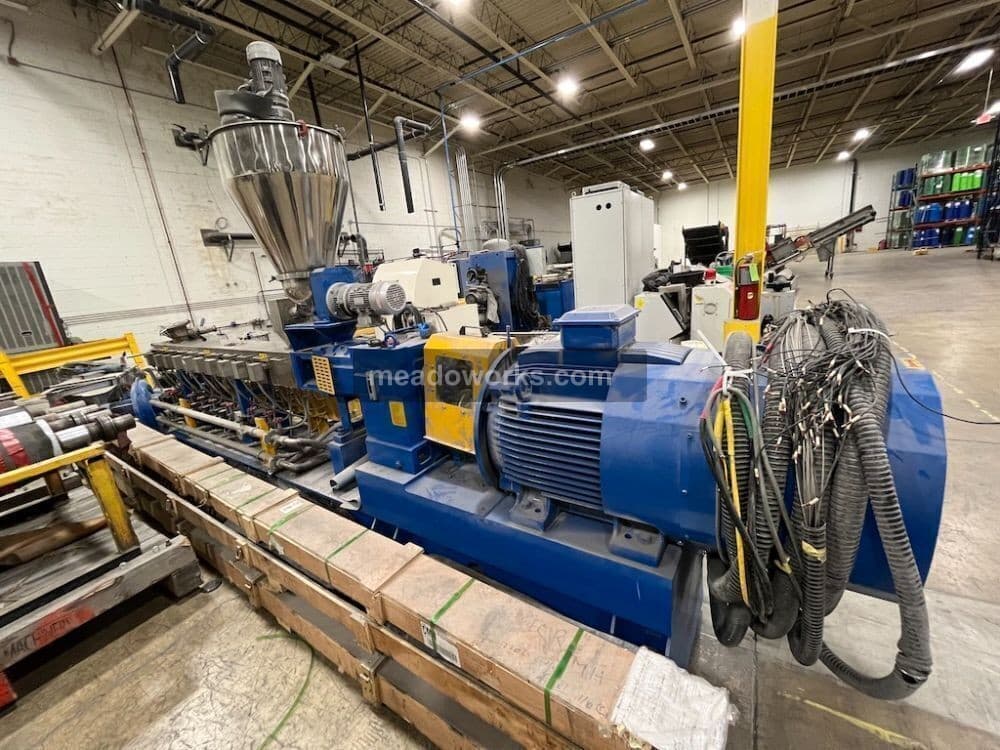


Key Takeaways
- 4 main pelletizer types: strand, underwater (UWP), water-ring (WRP), and air-cooled die-face
- Strand pelletizers are simplest and most common — ideal for compounding lines up to 5,000+ lb/hr
- Underwater pelletizers dominate high-throughput production and tacky / soft polymer applications
- Top brands: Gala (now Maag), Coperion, Davis-Standard, BKG (Nordson), Reduction Engineering
- Used pelletizer pricing ranges from $20K (small strand) to $500K+ (production underwater systems)
What to Look For When Buying a Used Plastic Pelletizer
Confirm complete system inventory
A complete pelletizing line includes the die, melt pump (if used), pelletizer, water management system, dryer, and pellet classifier. A bare pelletizer requires significant additional investment to put into production. Get a written list of every component included.
Inspect cutting tools and bedplate
Pelletizer knives and bed knives wear quickly, especially on filled or abrasive compounds. For strand pelletizers, check rotor balance and knife alignment. For underwater pelletizers, check die plate, cutter blades, and water box for erosion and pitting.
Check water management and dryer condition
Water filtration, temperature control, and dryer efficiency directly affect pellet quality. Worn centrifugal dryers can leave pellets too wet, causing downstream problems. Inspect dryer screens, blowers, and water filtration system condition.
Verify electrical and control systems
Modern pelletizers have integrated PLC controls coordinating the extruder, die, pelletizer, and dryer. Older systems may need control upgrades. Ask about HMI software, recipe storage, and remote diagnostics.
Confirm pellet shape and size capability
Underwater pelletizers produce near-spherical pellets; strand pelletizers produce cylindrical pellets. Pellet size is set by die hole diameter and cutter speed/throughput ratio. Verify the pelletizer can produce your target pellet geometry.
Ask about product changeover history
Pelletizers running multi-product compounding require frequent cleaning. Ask about typical changeover times and whether the system has clean-in-place capability or requires manual disassembly.
Used Plastic Pelletizer Pricing Guide
Used plastic pelletizer prices depend on system type, throughput rating, brand, age, and whether downstream equipment (water management, dryer, classifier) is included.
| Configuration | Typical Used Price | Notes |
|---|---|---|
| Small strand pelletizer (200-500 lb/hr) | $15,000 - $50,000 | Lab and small compounding lines |
| Mid strand pelletizer (500-2,000 lb/hr) | $30,000 - $120,000 | Production compounding, masterbatch |
| Large strand pelletizer (2,000-5,000+ lb/hr) | $80,000 - $250,000 | Production compounding lines |
| Small underwater pelletizer (UWP) | $60,000 - $180,000 | Lab/pilot scale, recycling pilot lines |
| Production underwater pelletizer | $150,000 - $500,000+ | Resin production, high-output recycling |
| Water-ring / die-face cutter | $25,000 - $150,000 | Polyolefin, PVC, hot-melt applications |
| Complete recycling pelletizing line | $200,000 - $1,500,000+ | Extruder + melt filter + UWP + dryer + classifier |
Premium brand premiums (Gala/Maag, Coperion, Davis-Standard, BKG) typically run 20-40% above generic equivalents. Complete lines with full water management and pellet handling are priced significantly above standalone components. Call 800-323-0307 for current pricing.
Need a complete pelletizing line?
Tell us your polymer type, throughput target, pellet shape preference, and budget. Our team has 50+ years of experience matching compounders and recyclers to the right used pelletizer — including unlisted equipment from facility closures.
