Used Deburring & Finishing Machines for Sale
1 result
Looking for Something Specific?
Most of our inventory sells before we can list it online. If you need a specific brand, model, or specification, tell us what you need—we have access to unlisted equipment and machines coming in from plant closures.
Looking to Sell?
Meadoworks is an active cash buyer of used industrial equipment. Get a free valuation from our AMEA-certified appraisers.
About Used Deburring & Finishing Machines
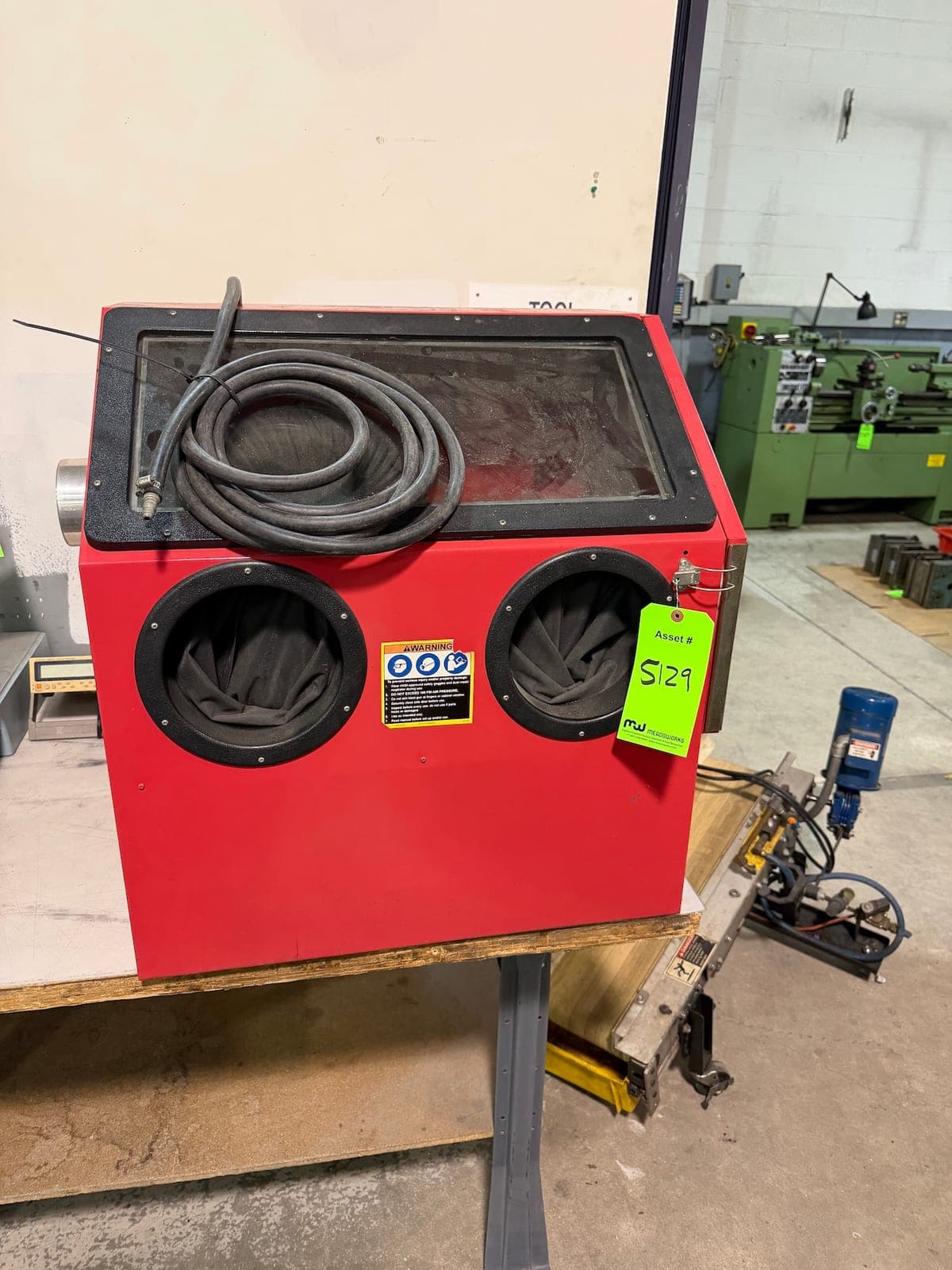
A deburring machine breaks an edge, knocks a burr off a cut part, or gives a surface a texture. The machines in this group are often the same cabinets as a blast cabinet: a box, gloves, a gun and media. A belt sander, a vibratory tumbler and a blast cabinet are three different ways to get there, and a photo will tell you which one you are looking at. A belt takes a flat edge. A tumbler rolls a batch of small parts in media. A blast cabinet throws bead or grit at one part you hold. Do not describe all three as the same process.
The result you need is the spec. A measured edge break on a laser-cut plate wants a belt or a brush machine with a conveyor. A tumbled radius on a small machined part wants media, time and a tub that fits the batch. A blasted texture, or a clean-up of scale, wants a cabinet, a gun and dry air. Media is the tooling. Glass bead, aluminum oxide and a ceramic chip do not leave the same surface, and they do not belong in each other's machines.
Dust and fluid are part of running them. A belt or a blast cabinet without a collector puts the grit in the room. A tumbler needs a way to separate media from parts. Gloves, the window and the gun hose are what fail on a cabinet. A belt tracking off the pulley is what fails on a sander. Vibratory liners wear through. Run a part you know. An edge that is still sharp did not get finished.
A used deburring machine should be named for the motion in the photo before you talk about grit. Confirm belt width or tub volume or cabinet size, and whether the collector or the fluid system is included. The two cabinets that appear in this offering and in blast work are the same iron. If the job is a glove box and a gun, you are buying a blast cabinet. If the job is a belt under a burr, you are not.
How to Choose Used Deburring & Finishing Machines
Belt, Bowl, or a Cabinet
A wide-belt machine is for flat blanks and a consistent edge break. A vibratory bowl or tub is for a batch of small parts that can tumble. A blast cabinet is for a part you hold, including passages and faces a belt never sees.
The listings on this group are blast cabinets today. That does not make blast the answer to a sheet edge. Name the part first. Then open the cabinet chip only if the part belongs in a cabinet.
What the Current Listings Actually Are
Read a cabinet as a cabinet: media, gloves, a gun, a window, and a dust collector. Do not read it as a stand-in for a belt line that is not in the list. No belt or vibratory brand is claimed here, because those machines are not the current stock.
If your edge is a laser burr on a panel, keep looking for a belt process. If your edge is a fitting or a casting you can hold, the cabinet chip is the next group. The family exists so those are not the same sentence.
Deburring & Finishing Machines Specs to Compare
| Spec | Why it matters |
|---|---|
| Process | The part picks the process. A cabinet will not do a belt's job. |
| What is noted now | The family currently holds cabinets. Belt and bowl are the other choices, not the current rows. |
| Part size | Size and shape decide which of the three processes can even touch the edge. |
| Edge result | Those finishes are not interchangeable. Know which one the print allows. |
| Media | Each process consumes a different media. Do not shop one with the other's consumable. |
| Housekeeping | A blaster without extraction, or a bowl without its fluid, is half a machine. |
Process
The part picks the process. A cabinet will not do a belt's job.
What is noted now
The family currently holds cabinets. Belt and bowl are the other choices, not the current rows.
Part size
Size and shape decide which of the three processes can even touch the edge.
Edge result
Those finishes are not interchangeable. Know which one the print allows.
Media
Each process consumes a different media. Do not shop one with the other's consumable.
Housekeeping
A blaster without extraction, or a bowl without its fluid, is half a machine.
What to Inspect on Used Deburring & Finishing Machines
Name the edge before the machine
Sheet face, small-part batch, or a part you can hold. The process follows that, not the photo.
Treat current rows as cabinets
If the listing is a blast box, inspect it as a blast box. It is not a wide-belt machine in disguise.
Do not invent a belt brand
Belt and vibratory are real processes. They are not a name we are assigning to a cabinet.
Match the finish the print allows
A texture from blast is not a controlled edge radius from a belt. Know which you can ship.
Check the part fits the process
A panel will not tumble. A pocket of fittings will not lie flat on a belt. A huge casting may not fit a benchtop cabinet.
Open the cabinet chip for gun detail
Gloves, media, and the collector are inspected there. This group will not repeat that list.
Say if you needed a belt
Ask for that process rather than forcing a cabinet to stand in. The wrong edge is still the wrong edge.
Related Equipment
- Blast Cabinets
The machines this group currently lists
Common Applications
Frequently Asked Questions
Why does this deburring machine group show blast cabinets?
Because that is what the family holds right now. Blast cabinets are a real deburring process, a gun and media in a closed box, and they are the rows you can open. Wide-belt machines and vibratory bowls are the other two choices, and they are explained here so you do not treat a cabinet as a stand-in for them. If your part is a flat blank, keep looking for a belt. If you can hold the part, the cabinet chip is the listing.
How do belt, vibratory, and blast differ as a deburring machine?
A belt or drum works a flat face and an edge, one blank at a time, and it can hold a more even break. A vibratory bowl or tub tumbles a batch of small parts in media until the burrs round. Blast hits what the gun can see, including pockets, and it leaves a texture. None of the three replaces the others. No belt or bowl brand is being claimed on this group, because those machines are not the current listings.
When is a blast cabinet the right deburring machine?
When you can hold the part, or fixture it, and you need to clean a surface, a passage, or a light burr the belt cannot reach. It is the wrong machine for a stack of sheet that wants a consistent edge down a long side. The cabinet chip is where gloves, media, the gun, and the dust collector get inspected. If the decision is already blast, leave for that chip and do not keep comparing it with a bowl.
When would a wide-belt deburring machine be the better process?
When the part is flat, the burr is on the edge or the face, and you want the same break on every blank. Laser scale and a punched burr on sheet are the usual reasons. A cabinet will texture that panel and will not give you the belt's even edge. A bowl will not accept the panel at all. This group does not pretend a belt is in the current rows. If that is the process, ask for it rather than forcing the cabinet to stand in.
What does a vibratory deburring machine do that a cabinet does not?
It finishes a batch. Small parts go in with media, and the motion rounds edges without someone holding each one. A cabinet is one part, one gun, one pair of hands. The media is different, ceramic or plastic in the bowl rather than a blast grit. Cycle time is the batch, not the trigger. Again, that machine is a choice on this group, not a brand we are attaching to the cabinets that are compared. Use it when the parts are small and numerous. Use blast when they are not.
How should I describe the edge before I pick a deburring machine?
Say what made it, laser, punch, saw, or a machine tool, and whether the part is a sheet, a handful of fittings, or one casting. Say whether you need a measured break, a tumbled radius, or a clean texture. Those three sentences pick the process. Brand comes after, and on this group the brand conversation for belt and bowl should wait until those machines are actually here. For a cabinet, move to the blast group with the part in mind. The edge is the specification.
