Used Hydraulic Presses for Sale
3 results
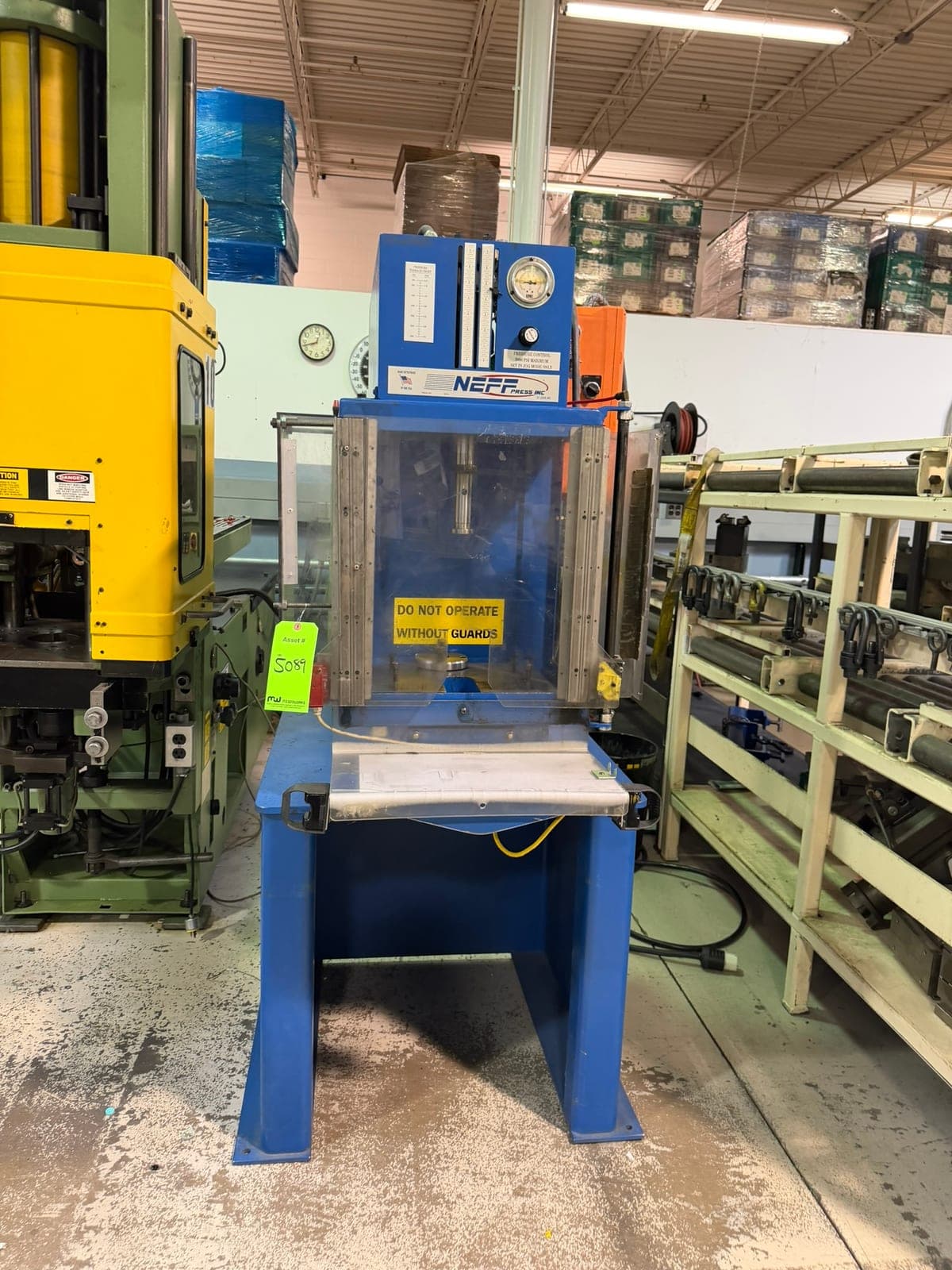
Lot 41
Neff 4.7 Ton Hydraulic Press
Naperville, IL
Live auction · Tue, Oct 27, 10:00 AM CT

Lawton 206-Ton 4-Post Up-Acting Hydraulic Press
USA
 Video
VideoMinster SE2-400-84-48 - Hevi-Stamper
USA
Looking for Something Specific?
Most of our inventory sells before we can list it online. If you need a specific brand, model, or specification, tell us what you need—we have access to unlisted equipment and machines coming in from plant closures.
Looking to Sell?
Meadoworks is an active cash buyer of used industrial equipment. Get a free valuation from our AMEA-certified appraisers.
About Used Hydraulic Presses
Oil pressure on a piston is what builds the force, and a relief valve is what limits it. A crank press stores energy in a flywheel and reaches its rating only near the bottom of the stroke. A hydraulic press can deliver that rating at any height in the travel, then hold while the tool stays closed. The same knob turns the force down for a lighter die instead of running every job at the nameplate. Drawing, straightening, press fits, and compression work sit well on that behavior. A high hit rate does not. Nothing in this drive keeps up with the fastest mechanical blanking press, and a short pierce still belongs on a stamper.
Frame style is the next decision, and it is a short one. An open throat gives reach from three sides and lets long stock pass behind the ram, at the cost of spring when the load sits off center. Steel slabs on both sides of the slide keep a long die closer to parallel. Columns around a broad platen spread the load and leave every side open, which is the usual 4-post hydraulic press layout for a large fixture or a mold. A ram that rises leaves the part in a nest and closes from below. Tonnage does not turn one of those into another. Once the tool's frame is known, compare only machines built that way.
Daylight is the open distance from the bolster to the ram at the top. Shut height is the clearance over the bed with the ram fully down. Stroke has to cover loading, the work, and stripping. Extra travel is easier to add here than on a crank, and 12, 18, or 24 inches is a common set of stroke lengths. Bed area does not follow the tons. Full force on an industrial machine usually arrives somewhere between 1,000 and 3,000 psi, so the gauge and the relief setting are part of the fit. Depth is the weak spot. A limit switch often will not repeat much closer than about 0.020 inch, which is why kiss blocks still live in tooling that must stop in one place. Horsepower follows how long, how far, and how fast the ram is working, not the nameplate tons alone.
A used hydraulic press is judged with the power unit running. Milky oil, a reservoir that runs hot, a ram that drifts off a setpoint, and a hose wet at the fitting are ordinary hydraulic repairs. Packing, a solenoid coil, and a valve are normal service. A scored ram or a cracked weld is not. Both palm buttons should be required to start a stroke, and a button that has been tied down is a reason to walk away. Meadoworks takes these frames from plant closures and consignment floors. Look at the cylinder, the bed, and the guards before you commit, and book the crane with the rest of a heavy shipment rather than the morning the truck arrives.
How to Choose a Used Hydraulic Press
How to Size a Hydraulic Press
Match the force to the process, then leave room so the relief valve is not sitting on its stop every cycle. You can turn that force down for a lighter tool, which is hard to do on a crank stuck at one rating. The formulas for blanking and drawing still apply, and the dies usually interchange. What you gain is force anywhere in the travel and a pause under load. What you give up is speed. A short pierce that lives on strokes per minute still belongs on a mechanical stamper. Horsepower should be read against how long the ram is actually working, not against the tons painted on the side.
Daylight, Shut Height, and the Bed
Stack the die, the part, the clamps, and any knockout. That stack has to fit the open gap and still reach the closed position. Stroke has to include loading and stripping, not only the thickness of the material. A generous bed does not add force. It only tells you whether the tool bolts down. If the load is off center or the die is long, a closed frame will hold alignment better than an open throat. If operators must pass long stock through the back all day, the open throat is the point. Some molding and assembly tools want the platen to rise, and a downward slide will not substitute for that motion.
Hydraulic Press Specs to Compare
| Spec | Typical range | Why it matters |
|---|---|---|
| Tonnage at rated pressure | Force follows oil pressure and piston area. The nameplate number is the ceiling, and the relief valve sets less. | |
| System pressure at full tonnage | 1,000 to 3,000 psi | Industrial machines usually develop full force in that band. Read the gauge against the job, not only the tons. |
| Stroke | 12, 18, or 24 in. are common | Travel has to cover loading, the work, and stripping. Extra stroke is easier to buy here than on a crank. |
| Daylight and shut height | The tool has to fit the open gap and still reach the closed position with the bolster in place. | |
| Bed or platen size | A large bed does not add tonnage. It only tells you whether the die and the clamps bolt down. | |
| Dwell and reversal | Drawing and assembly often need a pause at pressure, or a reverse at a set depth, not only a trip to the bottom. |
Tonnage at rated pressure
Force follows oil pressure and piston area. The nameplate number is the ceiling, and the relief valve sets less.
System pressure at full tonnage
Typical range: 1,000 to 3,000 psi
Industrial machines usually develop full force in that band. Read the gauge against the job, not only the tons.
Stroke
Typical range: 12, 18, or 24 in. are common
Travel has to cover loading, the work, and stripping. Extra stroke is easier to buy here than on a crank.
Daylight and shut height
The tool has to fit the open gap and still reach the closed position with the bolster in place.
Bed or platen size
A large bed does not add tonnage. It only tells you whether the die and the clamps bolt down.
Dwell and reversal
Drawing and assembly often need a pause at pressure, or a reverse at a set depth, not only a trip to the bottom.
What to Inspect on a Used Hydraulic Press
Name the frame before the tons
Confirm open throat, straight sides, columns, or a rising platen. The tons do not convert one into another.
Look for cracks and old weld repairs
Check the throat, the window corners, and around tie rods or columns. Paint over a crack is still a crack.
Cycle the ram with no tool
The ram should travel smoothly, hold a pressure setpoint, and return without a shudder or a slow drift.
Inspect oil, hoses, and the pump
Milky oil, a howling pump, or a hose wet at the fitting is a repair before the ram can be trusted.
Check ram and platen faces
Scoring, a dish in the bolster, or a ram that is not square to the bed prints into the part.
Test the safety circuit
Two-hand buttons, the light curtain, and the emergency stop should interrupt a stroke, not only be present.
Match the stack height
Bring the die height, the part, and the clamps. Open daylight is not the closed height with your tool installed.
Meadoworks Track Record
14
Sold through Meadoworks
3
Listed now
Makes we have handled most
Common models
Neff Press DF25-5HS-U, Lawton 300 Ton Upacting, Neff Press DF25-10HS-U
Related Equipment
- Straight Side
Guided slide and a stiffer frame under load
- C-Frame / Gap
Open throat and access from three sides
- Up-Acting
Ram pushes upward for molding and assembly
Hydraulic Presses Brands We've Sold
Common Applications
Frequently Asked Questions
What does full tonnage through the stroke mean on a hydraulic press?
The pump and the relief valve set the force, so rated tonnage is available at any point in the travel, not only near the bottom the way a crank does. That is why drawing, straightening, and a press fit sit well on this drive. A dwell timer can also pause under load. A high hit rate is a different machine. If the die wants dozens of strokes a minute, look at stamping equipment instead of asking an oil cylinder to imitate a flywheel. The formulas for the force itself are the same ones a crank shop already uses.
How is a 4-post frame different from an open gap?
Four columns guide a broad platen and leave access on every side, which suits a large fixture, a mold, or a sheet that has to enter from more than the front. An open gap is a C-shaped frame with a throat, better when the operator needs three-side reach or long stock behind the ram. Column spacing and platen thickness matter more than the word post. Under load, a column frame tends to deflect straight up and down, while an open throat can spring. Pick the one the tool was built around.
How do I compare daylight and shut height on a hydraulic press?
Daylight is the open distance from the bolster to the ram at the top of the stroke. Shut height is how close the ram and the bed can come, usually with the bolster considered. Stroke is the travel between those positions. Stack the die, the part, the clamps, and any knockout, then see whether that stack fits while the ram is open and still reaches the working position. Enough tons with the wrong stack will not make the part. Ask for those three numbers before you compare brands.
What should I inspect on the oil system of a hydraulic press?
Look at the oil before you look at the paint. Milky oil means water. Dark, burnt oil and a hot, noisy pump mean the fluid and the pump have been working past their condition. Wet fittings, cracked hoses, and a ram seal that weeps under pressure are the usual leaks. Cycle the ram and see whether it holds a setpoint or drifts. A machine that will not hold pressure will not hold a dimension either. The reservoir, the filters, and a heat exchanger, if one is fitted, belong in that same look.
When is a hydraulic press a better fit than a stamping press?
Choose the oil drive when the job is a squeeze, a draw at a controlled speed, a straighten, or an assembly that must dwell. Choose a stamping press when the job is a die at production speed. The frames can look alike in a catalog because both are presses, and the motion does not. A blanking tonnage chart will mislead you here. Hits per minute favor the flywheel. Force you can set, and time under that force, favor the cylinder. Impact coining can still prefer the mechanical blow.
Which frame should I compare once I know the tool?
Match the frame the tool was built for, then ignore the others. An open throat is for three-side reach and long stock through the back. Straight sides and gibs are for a die that must stay parallel, including an off-center load. A rising platen is for a nest or a mold loaded on the bed. A four-column layout is for a broad fixture with access from more than one side. Tonnage is the force only after that geometry fits. Voltage and a working two-hand circuit come after the geometry too.
