Used 3D Printers & Additive Manufacturing Machines for Sale
2 results

Looking for Something Specific?
Most of our inventory sells before we can list it online. If you need a specific brand, model, or specification, tell us what you need—we have access to unlisted equipment and machines coming in from plant closures.
Looking to Sell?
Meadoworks is an active cash buyer of used industrial equipment. Get a free valuation from our AMEA-certified appraisers.
About Used 3D Printers & Additive Manufacturing Machines
A 3D printer builds a shape from a digital file, one layer at a time, instead of filling a steel mold or cutting a block. Filament machines, the process shops call FDM, melt a polymer thread and trace it through a heated nozzle onto a build plate. Binder jet is a different additive manufacturing path. A recoater lays powder, a print head jets binder where that layer's cross-section belongs, and the part is later unpacked from the loose powder. ExOne describes the unbound powder as the support, so many geometries do not need the props a filament job uses. Metal or sand parts from that process still need a cure and, for metal, a sinter or infiltration the filament machine never does.
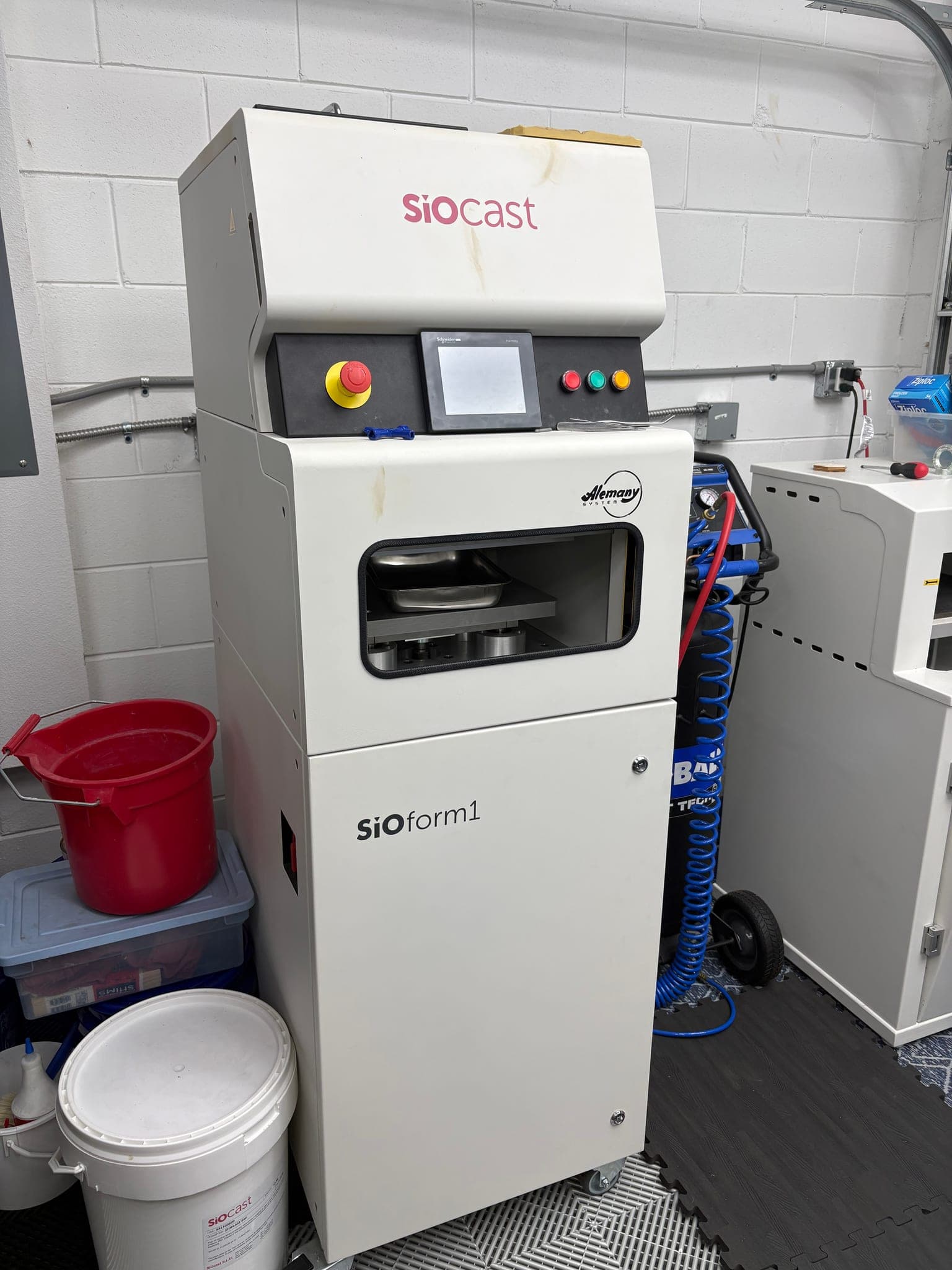
Silicone-mold casting systems are often offered next to printers. A Siocast-style machine injects thermoplastic into a soft tool. It does not pull a spool, and it is sized by the tool, not by a filament diameter or a powder layer. Treat those rows as casters. A file alone does not make the three processes interchangeable. Filament suits a polymer prototype, a jig or a short run. Binder jet is the path when the part has to come from a powder bed. A mold and a press are the path when you need a production resin in real quantity.
In a plant the machine is a lab or toolroom tool, not a stand-in for the molding press. Use it when the shape will change, when you need a handful of pieces, or when a fit check is the goal. It does not dry resin, heat a mold or cut steel. For a filament job the envelope has to clear the part plus supports, and layer height is a time and surface trade. Production FDM layer settings commonly run from about 0.005 in to 0.020 in. A large production system such as a Stratasys F900 builds in a box about 36 by 24 by 36 in, with extrusion temperatures from about 320 °C on ABS grades to about 415 °C on PPSF, and an oven that follows the resin. A small open frame is enough for many simple prototype grades. Warping polymers want the chamber.
A used 3D printer should make a test part, not just power on and home the axes. Look at the nozzle or the jet for a clog or dried binder. Ask what ran last: a filament grade, a powder or a casting compound. A caster will not respond to a spool.
Meadoworks handles these machines from labs, toolrooms and auctions. The head or the jet can be inspected before a common-carrier pallet leaves, and the frame is rarely a crane project. Material cooked in a nozzle, or powder left unmanaged in a job box, matters more than the year on the cabinet.
How to Choose Used 3D Printers & Additive Manufacturing Machines
How to Choose a 3D Printer Process
Filament, the FDM path, is for a polymer prototype, a jig or a short run in a thermoplastic. Binder jet is the path when the part is built in a powder bed and bound, including sand or metal powder that is finished after it leaves the machine. A silicone-mold caster that is offered beside these machines is neither. It injects into a soft tool and is sized by that tool, not by a spool.
Pick the process from the material the part has to be. A file alone does not make the processes interchangeable. If the row does not name a spool or a powder, read the description before you call it a printer. Siocast-style equipment is the caster case.
How to Size a 3D Printer Build
For a filament machine, the envelope has to clear the part plus supports, and the nozzle and bed have to reach the temperatures the polymer wants. Layer height is a finish and time tradeoff. Production FDM notes commonly list slices from about 0.005 in to 0.020 in. A fine layer takes longer and shows less stair-step. A large production box is on the order of 36 by 24 by 36 in, which is more than most lab jigs need.
For binder jet, size the job box and the powder the head was set up to bind. A caster is sized by the silicone tool, not by a spool. Do not buy envelope you will never use, and do not buy a process that cannot make the material.
3D Printers & Additive Manufacturing Machines Specs to Compare
| Spec | Typical range | Why it matters |
|---|---|---|
| Process | The process decides the material. A filament head, a powder bed and a silicone mold are different machines. | |
| Build envelope | Up to 36 x 24 x 36 in | The part, including supports on a filament job, has to fit the box. A file that does not fit will not shrink. |
| Material form | A spool feeds filament. Powder feeds binder jet. A caster uses a silicone tool and is not a spool machine. | |
| Layer or resolution | 0.005 to 0.020 in | Layer height trades time for surface on FDM. It does not change which process can make the material. |
| Nozzle or jet | 320 to 415 °C | Production FDM grades extrude in that band. A clogged nozzle and a dried binder jet fail in different ways. |
| Enclosure | 85 to 225 °C oven | Warping polymers want a heated chamber. A small open frame is enough for many simple prototype grades. |
Process
The process decides the material. A filament head, a powder bed and a silicone mold are different machines.
Build envelope
Typical range: Up to 36 x 24 x 36 in
The part, including supports on a filament job, has to fit the box. A file that does not fit will not shrink.
Material form
A spool feeds filament. Powder feeds binder jet. A caster uses a silicone tool and is not a spool machine.
Layer or resolution
Typical range: 0.005 to 0.020 in
Layer height trades time for surface on FDM. It does not change which process can make the material.
Nozzle or jet
Typical range: 320 to 415 °C
Production FDM grades extrude in that band. A clogged nozzle and a dried binder jet fail in different ways.
Enclosure
Typical range: 85 to 225 °C oven
Warping polymers want a heated chamber. A small open frame is enough for many simple prototype grades.
What to Inspect on Used 3D Printers & Additive Manufacturing Machines
Name the process
Confirm filament, binder jet or a silicone-mold caster. The caster is not a spool printer, whatever the title implies.
Print or cast a coupon
Power-on is not a test. A small part shows whether the head, the jet or the caster actually makes geometry.
Measure the envelope
The build box has to clear your part. A stated size the mechanics cannot reach is not a size.
Inspect the head
A clogged nozzle or a dried jet is the usual wear item. Look before you assume a new tip is included.
Check heat and motion
The bed or chamber should reach temperature, and the axes should home without losing steps.
Ask what material ran
Filament grade, powder or a casting compound changes the cleanup and whether your material will run.
Confirm file and power
You need a way to get a file in, and the supply has to match the lab circuit you will plug into.
Related Equipment
- Plastic 3D Printers
Filament machines and build envelopes
- Additional Equipment
The rest of the catch-all families
- Machining Centers
Cut a metal part a printer will not
Common Applications
Frequently Asked Questions
What is the difference between FDM and a binder-jet 3D printer?
An FDM machine melts a polymer filament and traces the part. A binder-jet 3D printer lays binder onto a powder bed, and the part is unpacked and often sintered after printing. Both are additive manufacturing. They do not share material or a head. Filament suits polymer prototypes, jigs and short runs. Binder jet is the path when the conversation is powder, including metal or sand. A silicone-mold caster offered in the same lots is a third thing. It injects into a soft tool and is not either printer.
How do I choose a 3D printer process for a short-run part?
Choose filament when the prototype can be a thermoplastic and you want a spool, a nozzle and a build plate. Choose binder jet when the part has to come from a powder bed. Choose a mold and a press when you already know you need production resin in production quantity. A printer is a poor substitute for that last case. Also read the row. If the machine injects into a silicone mold, it is a caster, not a filament printer you can feed with a spool.
What should I inspect on a used 3D printer?
Make a test part. Homing the axes only proves the motion pack. Look at the nozzle or the jet for clogs and dried material, and confirm the bed or chamber reaches temperature. Measure the real envelope against your part. Ask what ran last: a filament grade, a powder or a casting compound. A caster will not respond to a spool. Power and a way to load a file still have to match the lab. A machine that only lights up has not shown you a part.
Are silicone-mold casters a 3D printer?
No. A silicone-mold caster injects into a soft tool. It does not trace filament and it does not jet binder onto a powder bed. Siocast-style machines are that caster: pellets go in, a vulcanized silicone tool sets the shape, and the cycle is sized by the tool. Treat them as casters. If you need a spool machine, read past any caster until you see a nozzle and a build plate. If you need metal powder, look for binder jet rather than a filament head.
What does additive manufacturing mean next to a 3D printer?
Additive manufacturing is the name for building a part by adding material, which is what a 3D printer does, whether the material is a filament bead or a bound powder. It is not a separate machine on the floor. Use the phrase when you are talking about the process, and use the printer type when you are buying. Filament and binder jet are both inside it. A silicone-mold caster is not, even when it is offered in the same lot of modeling equipment.
When should a 3D printer stay off the production press?
When you need hundreds or thousands of the same part in a production resin, with the strength and the surface a mold gives you. A printer earns its place on fit checks, jigs and shapes that will change next month. It does not dry resin, heat a mold or cut steel. Keep it in the lab and keep the press in the cell. If the part must be metal from powder, read binder jet before you shop a filament head that cannot make that material.
