Used Electric Forklifts for Sale
1 result
Looking for Something Specific?
Most of our inventory sells before we can list it online. If you need a specific brand, model, or specification, tell us what you need—we have access to unlisted equipment and machines coming in from plant closures.
Looking to Sell?
Meadoworks is an active cash buyer of used industrial equipment. Get a free valuation from our AMEA-certified appraisers.
About Used Electric Forklifts
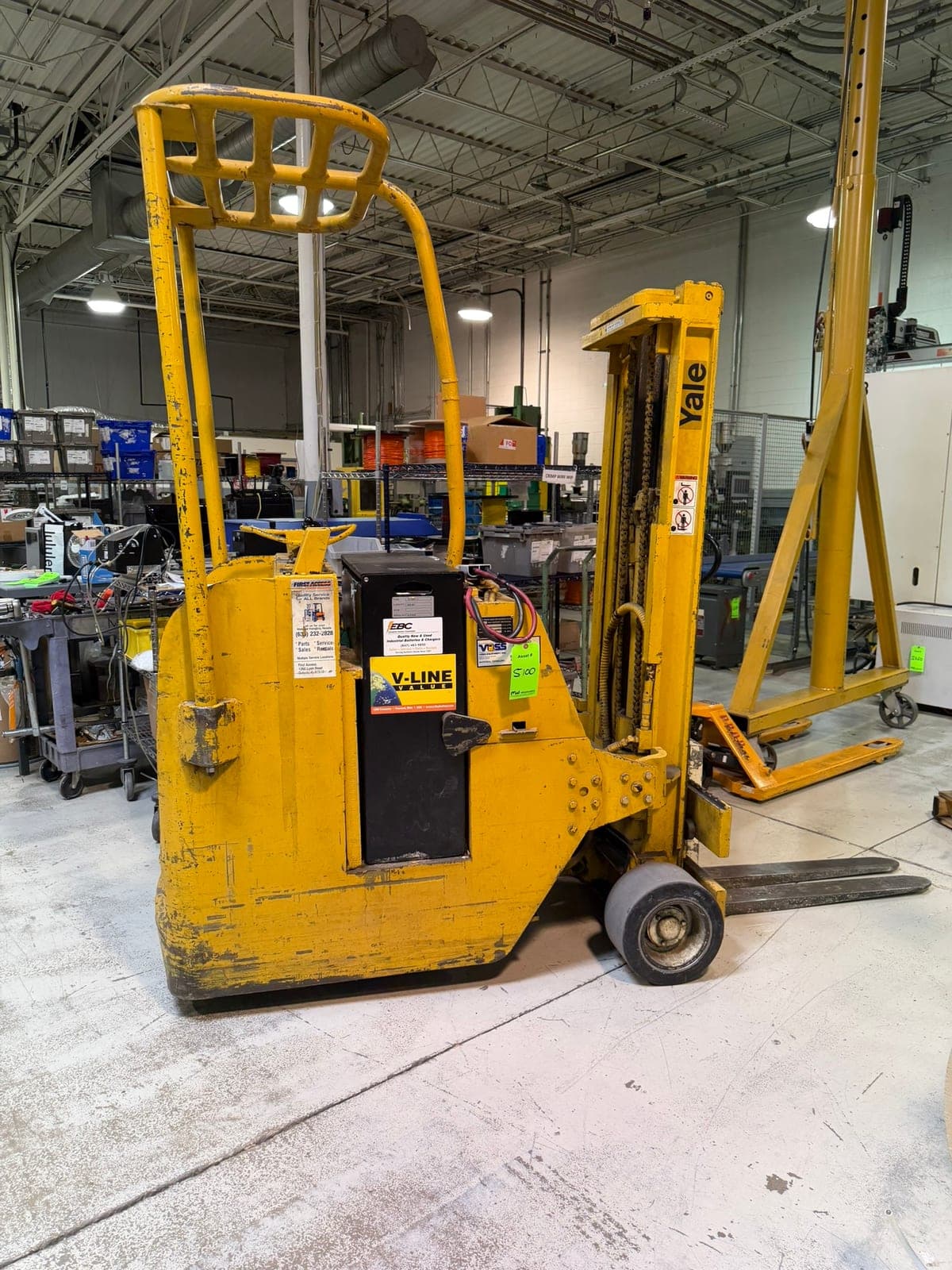
An electric forklift lifts and moves pallets on battery power, with no engine exhaust in the aisle. Sit-down trucks are the general warehouse machine. Stand-up reach trucks work narrower aisles and put the operator on a platform. Capacity is pounds at a stated load center, often 24 inches, not a number you can ignore because the pallet looks light. A 3,000-pound truck with the load stuck out past the load center is overloaded. Lift height has to clear the rack beam you actually use. Collapsed mast height has to clear the door or the trailer you drive into.
Battery and charger are half the purchase. A tired battery will lift in the morning and die on the second shift. The connector, the voltage, 24, 36 or 48 volts on many trucks, and whether the charger is included decide if the truck runs next week. Cushion tires belong on smooth indoor floors. Pneumatic tires belong outdoors or on broken pavement. A cushion truck on a yard will tear the tires and the steer axle. Fork length has to match the pallet, and the forks themselves are wear items that get bent and ground thin.
Brakes, the steer axle, hoses and the mast rollers are what fail. A mast that chatters on the way down needs rollers or chains. A truck that pulls to one side needs the steer axle, not a new coat of paint. Cycle the lift to full height with a load if you can, and listen. Read the hour meter. Electric hours are real work, and a low meter on a rusty truck is a story.
A used electric forklift should be driven, not just lifted empty. Confirm capacity at the load center, collapsed height, fork length and battery voltage. Ask whether the charger and a water kit for a flooded battery come with it. A reach truck and a sit-down counterbalance are different machines even when both are electric. Match the aisle you have before you match the color of the paint. Side-shift and a fork-positioner are options worth finding on the carriage, because a truck that cannot place the pallet costs more labor than the option did.
How to Choose a Used Electric Forklift
How to Size an Electric Forklift
Start with the aisle and the rack, not with a fuel comparison. A reach truck fits a narrow aisle and stands the operator up. A sit-down electric needs a wider aisle and lifts like a counterbalance. Capacity is the load at a stated load center, and it can fall as the mast goes higher. Lift height has to reach your beam. Lowered mast height has to clear the door. Battery voltage, often 36 or 48 volts, has to match the charger you have or the charger in the listing. Fork length has to match the pallet. Cushion tires are the usual plant floor. Write voltage, both mast heights and capacity before you compare two trucks.
Reach Trucks and Sit-Down Electrics
A stand-up reach truck reaches into the rack and is the narrow-aisle electric forklift. A sit-down electric is the four-wheel truck that carries the load ahead of the mast. They are both on this group because both are battery trucks. They are not interchangeable in the same aisle. The battery and the charger are half the purchase. A truck with a tired battery will not finish a shift even if the mast is straight. Hour meters count drive time and do not prove the battery. Confirm the charger voltage matches the battery. This group stays with electric trucks. Combustion fuels are not the decision being made here. Measure the aisle before you choose.
Electric Forklift Specs to Compare
| Spec | Typical range | Why it matters |
|---|---|---|
| Truck type | The aisle you have picks the truck. A reach truck and a sit-down electric do not share a path. | |
| Capacity | A higher lift or a longer load center can reduce what the data plate allows. | |
| Lift height | The mast has to reach the beam you use, not a height from a different building. | |
| Lowered mast height | The truck has to enter the door. A tall collapsed mast will not. | |
| Battery voltage | Often 36 or 48 volts | The battery and the charger are a matched pair. A mismatch will not charge. |
| Forks and tires | Forks have to fit the pallet. Cushion tires are the usual smooth-floor plant truck. |
Truck type
The aisle you have picks the truck. A reach truck and a sit-down electric do not share a path.
Capacity
A higher lift or a longer load center can reduce what the data plate allows.
Lift height
The mast has to reach the beam you use, not a height from a different building.
Lowered mast height
The truck has to enter the door. A tall collapsed mast will not.
Battery voltage
Typical range: Often 36 or 48 volts
The battery and the charger are a matched pair. A mismatch will not charge.
Forks and tires
Forks have to fit the pallet. Cushion tires are the usual smooth-floor plant truck.
What to Inspect on a Used Electric Forklift
Read the data plate
Write capacity, load center, voltage and both mast heights. Do not trust the title alone.
Identify reach or sit-down
A stand-up reach truck and a sit-down counterbalance need different aisles.
Inspect the battery
Look for a battery in the compartment and ask about the charger voltage. A missing charger is a gap.
Check mast and chains
The mast should be straight. Chains, rollers and hoses should not be dry, cracked or loose.
Measure forks and sideshift
Fork length has to match the pallet. Note whether a sideshift is actually on the carriage.
Look at tires and brakes
Cushion tires should be even. Brakes and steering should work before you plan a shift.
Note the hour meter
Hours are drive time. They do not replace a look at the battery and the mast.
Related Equipment
- Plant & Material Handling
The rest of the plant-floor equipment family
- Lifts & Work Platforms
Maintenance platforms and tables, not the truck
- Cranes & Hoists
Overhead lifts when a mast is the wrong tool
More in Plant & Material Handling
Common Applications
Frequently Asked Questions
What kinds of electric forklift are on this group?
Stand-up reach trucks and sit-down electrics. A reach truck puts the operator standing and extends the forks into a narrow aisle. A sit-down electric is a counterbalance that carries the load ahead of the mast. Both are battery trucks. the nameplate should say which one it is, because the aisle decides. Capacity, mast height and battery voltage still have to match after you know the type. This group does not walk through propane or diesel choices.
Why do voltage and the charger matter so much?
The battery is a large part of what you are buying, and the charger has to match its voltage, often 36 or 48 volts. A 36 volt truck will not use a 48 volt charger. A truck without a charger is not ready to run unless you already own the mate. Hour meters do not tell you the battery still holds a charge. Look in the compartment and ask whether the charger is in the listing or was a wall-mounted unit in the same sale.
How do I read lift height against lowered mast height?
Lift height is how high the forks go. Lowered mast height is how tall the truck is with the mast down, which is what has to clear the door. A triple mast is the usual way to get rack height without a mast that will not enter the building. Write both numbers. A truck that reaches the beam and will not come through the door is the wrong truck. Capacity at that lift height can be lower than the headline number.
Reach truck or sit-down electric for my aisle?
Use a reach truck when the aisle is narrow and the rack is the job. Use a sit-down electric when you want a counterbalance on a wider path, moving pallets across a plant floor. They are both electric forklifts and they are not substitutes. Measure the aisle and the rack before you pick. Fork length, cushion tires and whether you need a sideshift come after the type. The battery voltage still has to match a charger you can plug in.
What should I inspect on a battery truck?
The data plate, the mast, the chains, the forks, the tires, the brakes and the battery. A straight mast and even cushion tires are the visible condition. A tired battery will make a good truck look weak, so do not stop at the paint. Confirm the charger. Hours are context, not a substitute for that look. Photos should show the mast fully enough to judge it and the battery compartment open enough to see that a battery is there.
What does capacity at a load center mean?
The data plate rates the truck at a load center, a distance out on the forks, not at an unlimited pallet. A longer load or a higher lift can reduce the weight you may carry. Read the plate rather than the title. Fork length still has to match the pallet you move. A sideshift, if fitted, does not change that rating by itself. Match the plate to the heaviest pallet you will lift, at the height you will lift it.
