Used Industrial Ovens for Sale
See all 1 Industrial Ovens & Heat Treating →
Nothing is listed right now — these are machines we've recently sold. or tell us what you need.
Recently sold
 SOLD
SOLDCM Furnaces 1000K 1200°C Furnace
USA
 SOLD
SOLDDavron Technologies DTI-914
USA
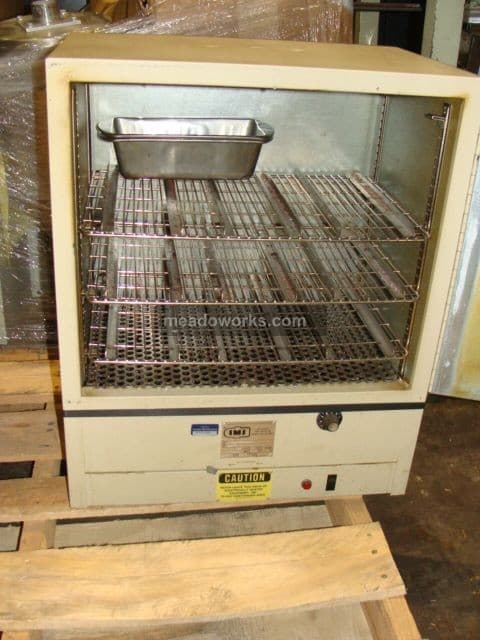 SOLD
SOLDIMS DOT1-DG0209-120
USA
Looking for Something Specific?
Most of our inventory sells before we can list it online. If you need a specific brand, model, or specification, tell us what you need—we have access to unlisted equipment and machines coming in from plant closures.
Looking to Sell?
Meadoworks is an active cash buyer of used industrial equipment. Get a free valuation from our AMEA-certified appraisers.
About Used Industrial Ovens
An industrial oven holds a load at a temperature long enough to dry, cure or bake it. Powder coating, paint, adhesive and composite tools are the usual work. It is not a furnace for hardening steel, and it is not an induction coil that heats one joint. The difference is the temperature, the atmosphere and what the part is supposed to become. A cure oven lives in a few hundred degrees in air. A heat-treat furnace lives hotter, often in a gas that is not air.
Batch or continuous is the layout. A batch cabinet loads through a door, soaks, and unloads. A conveyor oven moves parts through zones, which suits a line that cannot stop. Airflow is what makes the setpoint mean something. A recirculating fan pushes air through the load. Without it, the thermocouple near the element is hot and the middle of a rack is not. Uniformity of 10 or 15 degrees is a normal claim. A survey with parts in the rack is the proof.
Inside dimensions have to fit the rack, the fixtures and the door swing, not only the part print. Floor rating has to carry that rack. Electric elements are simple and common. Gas burners put more heat into a large box and need a flue and combustion air that the room can support. Exhaust matters when the load gives off solvent or powder volatiles. A sealed box with no exhaust is a bad cure and a worse room.
Doors, gaskets, fan belts and elements are what age. A gasket that does not seal wastes heat and pulls cold air across the load. An element string that is open drops a zone. Controls that store a ramp and a soak are worth more than a single knob if you run more than one coating. A chart or a data log is what you show later when someone asks whether the cure happened.
A used industrial oven should be heated before you trust it. Bring it to the setpoint you actually run and walk the shell for hot spots. Listen to the fan. Read the nameplate for kilowatts or burner input, voltage and inside size. Ask what was cured in it. A cabinet that lived on powder will have different contamination than one that lived on solvent paint. Match the exhaust and the floor loading to your rack before you match the paint on the door.
How to Choose a Used Industrial Oven
Batch vs a Continuous Industrial Oven
This chip is batch work. You load a chamber, run a cycle and unload. A continuous oven, a belt that never stops, is a different layout and a different floor plan. If your parts arrive in racks or carts, batch is the match. If you need a never-ending belt, do not force that job into a box with a door.
Inside batch, the split is temperature and atmosphere. A curing or preheat cycle and a true furnace cycle do not share a chamber just because both have doors. Count the cart, not an imaginary belt.
How to Size an Industrial Oven
Size the chamber to the load plus the fixture, with the door closed and airflow still able to move. Then match the temperature class to the cycle. A preheat oven that cannot reach the spec is not close enough.
If the cycle needs a controlled atmosphere, the shell and the seals have to be built for it. Power, and gas when there is gas, have to be available at the bay. Uniformity across the rack matters more than a peak reading taken in an empty corner. Measure the rack, not the doorway alone.
Industrial Oven Specs to Compare
| Spec | Why it matters |
|---|---|
| Temperature class | The cycle sets the class. A moderate oven will not become a high-temperature furnace by a setpoint change. |
| Chamber size | The work has to fit and still leave a path for air. A propped door is not a larger chamber. |
| Atmosphere | Air is enough for many cures. A spec that needs gas requires seals and a supply, not just a hotter dial. |
| Airflow | A dead fan or a blocked duct makes a hot zone and a cold zone inside one setpoint. |
| Heat source | The bay has to supply whichever the chamber uses. Elements and burners fail in different ways. |
| Door and hearth | The load has to enter, and the floor has to carry it. A pretty chamber with a weak hearth still fails. |
Temperature class
The cycle sets the class. A moderate oven will not become a high-temperature furnace by a setpoint change.
Chamber size
The work has to fit and still leave a path for air. A propped door is not a larger chamber.
Atmosphere
Air is enough for many cures. A spec that needs gas requires seals and a supply, not just a hotter dial.
Airflow
A dead fan or a blocked duct makes a hot zone and a cold zone inside one setpoint.
Heat source
The bay has to supply whichever the chamber uses. Elements and burners fail in different ways.
Door and hearth
The load has to enter, and the floor has to carry it. A pretty chamber with a weak hearth still fails.
What to Inspect on a Used Industrial Oven
Heat the chamber
Watch the controller climb. A number that never leaves room temperature is elements, a burner or a control, not a calibration.
Inspect elements or burners
Broken elements and fouled burners explain a zone that lags. Look before you trust an empty-chamber story.
Check the door seal
A crushed gasket or a warped door leaks heat and ruins an atmosphere cycle. Close the door and look at the fit.
Run the recirculating fan
The fan should move air. A dead fan is how one shelf overcooks and the shelf below never arrives.
Read the temperature class
Match the plate to the cycle. A preheat class will not run a furnace spec because you asked it to.
Measure with the fixture
The load and the rack have to fit with the door closed. A tight fit that blocks air is not a fit.
Confirm power or gas
Electric chambers need the voltage and the amps. Gas chambers need the fuel and a vent the building can take.
Related Equipment
- Industrial Ovens & Heat Treating
Ovens, furnaces and induction in one map
- Induction Heating
Selective heat with a coil, not a chamber
- Additional Equipment
Other equipment around the production floor
Common Applications
Frequently Asked Questions
How do I size an industrial oven chamber?
Fit the load and the fixture with the door closed, and leave a path for air so the back of the rack sees the same cycle as the front. Then match the temperature class to the process sheet. A preheat or cure oven and a furnace are not the same class, even when both are batch boxes. If you need a controlled atmosphere, the seals have to hold it. Power or gas has to be at the bay.
What should I inspect on a used industrial oven?
Heat it. The controller should climb, the fan should move air, and the door should seal when it is closed. Look at elements or burners for breaks and fouling. Read the temperature class against your cycle so you do not buy a preheat box for a furnace spec. Measure the chamber with the rack you will actually use. A crushed gasket is a cheap part and a failed atmosphere. Voltage or gas supply has to match the plate. A cold display is not a demonstration.
How is an industrial oven different from induction heating?
An industrial oven soaks whatever is in the chamber. Induction heats a metal zone through a coil and leaves the surroundings cooler. Brazing one fitting is an induction job. Curing a rack of coated parts is an oven job. Buying a chamber to do a selective braze wastes energy and heats parts you did not mean to heat. Buying a coil to soak a cart of parts will not work. Keep this group for batch air heat and furnaces. Keep the induction group for the coil.
What temperature class should an industrial oven have?
The class the cycle names, not the highest sticker in the auction. Curing and preheat live in a moderate band. Hardening, some ceramics and similar cycles need a furnace-class chamber. A controller that can display a high number does not mean the elements, the insulation and the shell were built for it. Read the plate. If your spec sits above that plate, you are on the wrong machine even if the chamber looks large. Atmosphere, when you need it, is a separate question from the peak temperature.
Does an industrial oven need a controlled atmosphere?
Only when the process says so. Many cures and preheats run in air, and a recirculating fan is the important part. A cycle that calls for a specific gas needs a chamber built to hold that gas, with seals that are still seals. A standard air oven will not become that furnace because you pipe a cylinder to a vent hole. If the sheet says air, do not pay for a complicated atmosphere system you will never close. If the sheet names a gas, do not buy a leaking door.
Is a furnace the same kind of industrial oven?
On this group, yes in the sense that both are chambers you load and unload, and no in the sense of temperature and atmosphere. A heat treat furnace is the industrial oven you need when the cycle is hotter or the atmosphere is controlled. A batch curing box is the industrial oven you need when the load must sit in hot air at a moderate setpoint. Induction is the one that does not belong in either description. Shop the class.
