Used Plastic 3D Printers for Sale
See all 2 3D Printers & Additive →
2 results

Looking for Something Specific?
Most of our inventory sells before we can list it online. If you need a specific brand, model, or specification, tell us what you need—we have access to unlisted equipment and machines coming in from plant closures.
Looking to Sell?
Meadoworks is an active cash buyer of used industrial equipment. Get a free valuation from our AMEA-certified appraisers.
About Used Plastic 3D Printers
A plastic 3D printer, in the filament sense, melts a polymer spool and traces a part through a heated nozzle. That is FDM. The spool, the nozzle and the build plate are the working parts. Software slices the file into layers, the head deposits one layer, the plate drops by the layer height, and the cycle repeats. A second nozzle, when the machine has one, carries support material for overhangs that would otherwise fall. Stratasys Direct's production notes list slice heights from about 0.005 in to 0.020 in. Finer layers take longer and show less stair-step. They do not turn the machine into a molding press.
The envelope has to clear the part plus those supports. A brochure number the gantry no longer reaches is not your box. A large production FDM system builds about 36 in wide, 24 in deep and 36 in high. Nozzle temperature has to cover the polymer. On that class of machine, ABS grades extrude near 320 °C and high-heat grades such as PPSF near 415 °C, while the oven runs from about 85 °C on some ABS styles to about 225 °C on the hottest resins. PLA is the forgiving prototype grade and often runs on an open frame. ABS wants a hotter nozzle and a controlled bed. Nylon and filled grades usually want a chamber, because they warp off a cool plate. Match the spool you will actually run.
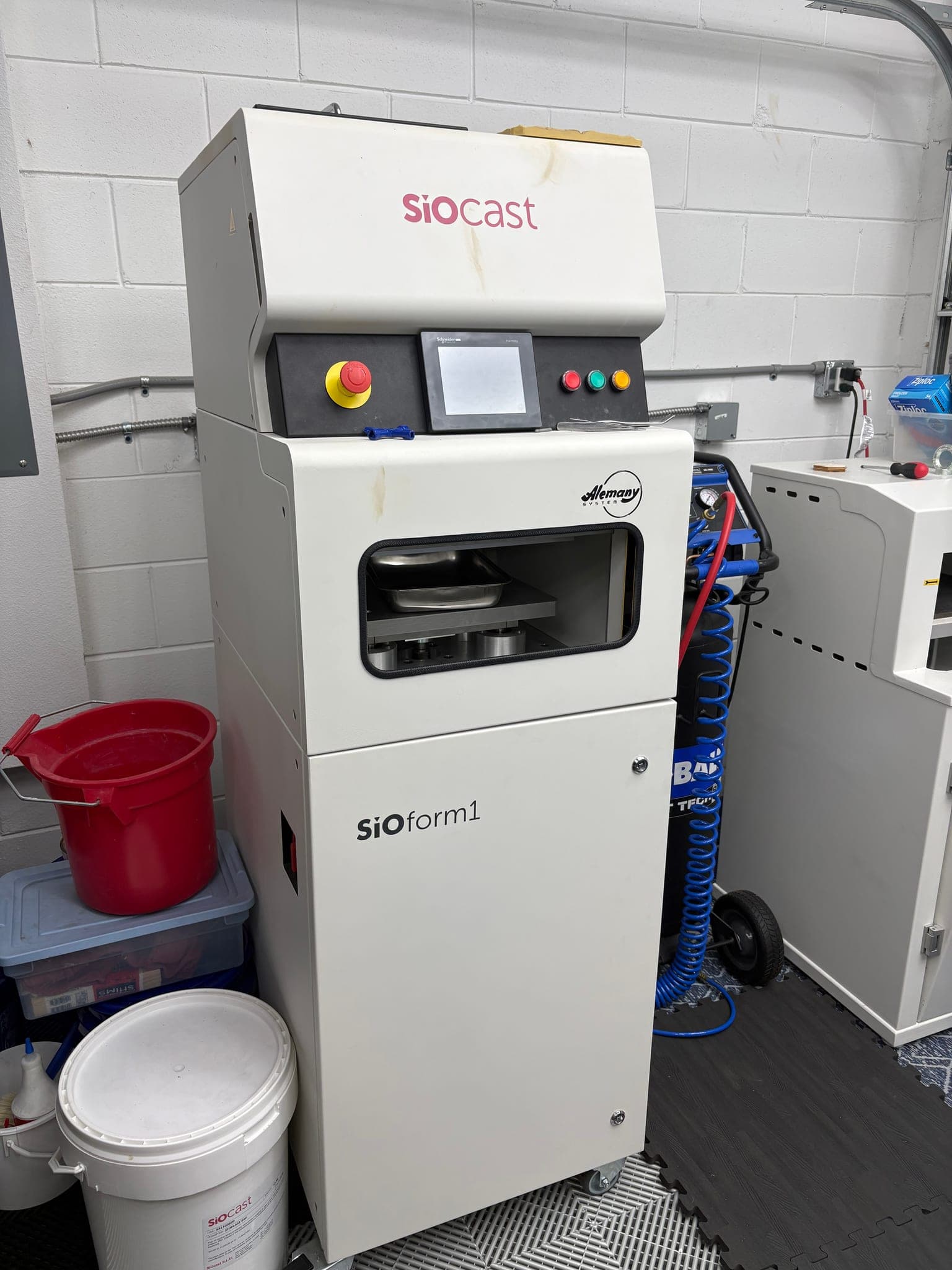
Silicone-mold casters sit in the same plastic-modeling lots, and they are not filament machines. A Siocast-style unit melts pellets and injects them into a vulcanized silicone tool. There is no spool path and no build plate tracing a bead. Metal binder jet is a third process, a powder bed and a binder head, and it is not sized by nozzle temperature. If a row has no spool, do not force it into a filament comparison.
The machine lives in a lab, a toolroom or a design office, next to the people who change the file. It does not stand in for the molding press, and it does not need a dryer or a thermolator. Use it for fit checks, jigs and shapes that will change. Use a mold when the quantity and the resin are already decided.
Power up a used plastic 3D printer and watch a small coupon, especially the first layers. The nozzle should reach temperature and lay a continuous bead, and the bed should hold the part. A clog or a worn tip leaves gaps. Ask which filament was run last so you know what is cooked inside.
Meadoworks places these machines from labs and auctions, with a look at the head before the crate is closed. A unit of this size usually ships as a pallet, not as a crane move. A tired bed heater appears as warp on the first layer, which is the moment to find it.
How to Choose a Used Plastic 3D Printer
Filament vs a Silicone-Mold Caster
A filament machine pulls a spool, melts it and traces layers. A silicone-mold caster offered in the same lots injects into a soft tool and never sees a spool. If the description does not mention a nozzle and a build plate, do not treat it as the printer you came for. Siocast-style machines are casters.
Metal powder and binder jet are a different process too. A powder bed and a binder head are not sized by nozzle temperature or a filament diameter. This comparison is the polymer, spool-fed path. Read past any caster before you compare envelopes. Compare build boxes only after that split is clear.
How to Size a Plastic 3D Printer Envelope
The build box has to clear the part plus supports. A number on a brochure that the gantry cannot reach is not your envelope. Nozzle temperature and bed temperature have to cover the polymer, and a warping grade wants a chamber rather than an open frame. On a large production FDM system the box is about 36 by 24 by 36 in, with extrusion from about 320 °C to about 415 °C depending on the resin.
Layer height is time versus surface. Finer layers, commonly 0.005 in to 0.020 in, take longer. They do not make a filament machine into a production press. Match the spool you will actually run, then match power to the lab circuit.
Plastic 3D Printer Specs to Compare
| Spec | Typical range | Why it matters |
|---|---|---|
| Build envelope | Up to 36 x 24 x 36 in | The part has to fit the motion, not just a brochure number. Supports add size on overhangs. |
| Nozzle temperature | 320 to 415 °C | ABS and high-heat grades do not share a setpoint. A nozzle that cannot reach the grade will not extrude it. |
| Bed or chamber | 85 to 225 °C oven | Warping grades want enclosed heat. A simple prototype grade often runs on an open bed. |
| Layer height | 0.005 to 0.020 in | Layer height sets surface and time on FDM. It does not change strength the way the resin choice does. |
| Material form | A spool is the feed on a true filament machine. A row with no spool path is likely a caster. | |
| Extruder count | 1 or 2 heads | A second head carries support material for overhangs. A single head is enough for simple shapes. |
Build envelope
Typical range: Up to 36 x 24 x 36 in
The part has to fit the motion, not just a brochure number. Supports add size on overhangs.
Nozzle temperature
Typical range: 320 to 415 °C
ABS and high-heat grades do not share a setpoint. A nozzle that cannot reach the grade will not extrude it.
Bed or chamber
Typical range: 85 to 225 °C oven
Warping grades want enclosed heat. A simple prototype grade often runs on an open bed.
Layer height
Typical range: 0.005 to 0.020 in
Layer height sets surface and time on FDM. It does not change strength the way the resin choice does.
Material form
A spool is the feed on a true filament machine. A row with no spool path is likely a caster.
Extruder count
Typical range: 1 or 2 heads
A second head carries support material for overhangs. A single head is enough for simple shapes.
What to Inspect on a Used Plastic 3D Printer
Confirm it is filament
Look for a spool, a nozzle and a build plate. A silicone-mold caster in the same lots is a different machine.
Print a small coupon
Watch a real extrusion. A homing cycle does not prove the nozzle melts and the axes hold position.
Measure the envelope
Jog the axes and compare travel with your part, including supports. A sticker size can overstate the box.
Heat the nozzle and bed
Both should reach the setpoint for your polymer. A tired bed heater appears as warp on the first layer.
Inspect the nozzle
A clog or a worn tip leaves gaps. Ask what filament ran last so you know what is cooked inside.
Check the enclosure
If you need nylon or a filled grade, confirm there is a chamber. An open frame will not hold that heat.
Load a file and power
You need a way to get a file in, and the supply has to match the circuit at the bench.
Related Equipment
- 3D Printers & Additive
Filament, binder jet and casters together
- Additional Equipment
Other families around the production floor
- Machining Centers
Machine a metal part the spool cannot
Common Applications
Frequently Asked Questions
How do I size a plastic 3D printer build envelope?
The box has to clear the part plus any supports the overhangs need. Jog the machine if you can, because a brochure number sometimes describes a travel the mechanics no longer reach. A large production FDM system builds about 36 in wide by 24 in deep by 36 in high, which is more box than a small jig needs. Then match nozzle and bed temperature to the polymer. PLA is forgiving. ABS and nylon want more heat, and nylon often wants a chamber so the part does not warp off the bed.
What should I check on a used plastic 3D printer?
Print a coupon and watch the first layers. The nozzle should reach temperature and lay down a continuous bead, and the bed should hold the part. Look for a clog or a worn tip, and ask which filament was run last. Measure real travel against your part. Confirm whether you are looking at a filament machine or a silicone-mold caster. Power and a way to load a file still have to match the bench. A machine that only boots has not shown you a part.
Is a silicone-mold caster a plastic 3D printer?
No. A caster injects into a silicone tool. It does not pull a filament spool and it does not trace layers with a nozzle. Siocast-style machines melt pellets and shoot them into a vulcanized mold. Read the description. If there is no spool and no build plate, you are not looking at the filament machine this comparison is about. Metal binder jet is a third case, a powder bed and a binder head, and it is not sized by nozzle temperature.
Which filament grades need a heated chamber?
PLA is the easy prototype grade and runs on many open-frame machines. ABS wants a hotter nozzle and a controlled bed. Nylon and filled grades usually want a chamber because they warp. On production FDM equipment, extrusion runs from about 320 °C on ABS grades to about 415 °C on PPSF, and the oven follows the resin up to about 225 °C. A machine that topped out on PLA will disappoint on nylon even if the envelope is large enough. Match the spool you will buy every month.
How is a plastic 3D printer different from a production mold?
A filament machine makes a handful of polymer parts directly from a file, with layer lines and the strength of the printed bead. A mold in a press makes the same geometry in a production resin, over and over, once the tool exists. Use the printer when the shape is still moving or you need a jig. Use the mold when the quantity and the resin are already decided. The printer does not need a dryer or a thermolator. It also will not replace them on the press.
Where does binder jet belong if the part is not filament?
Binder jet belongs with powder-bed machines, not with a spool and a nozzle. A recoater lays powder, a head jets binder, and the part is unpacked and often sintered. That process is not sized by filament diameter or by the 0.005 to 0.020 in layer steps used on FDM. If a row has no spool, do not force it into a filament comparison. Shop the powder, the job box and the binder head on their own terms.
