Used Hydraulic Press Brakes for Sale
2 results
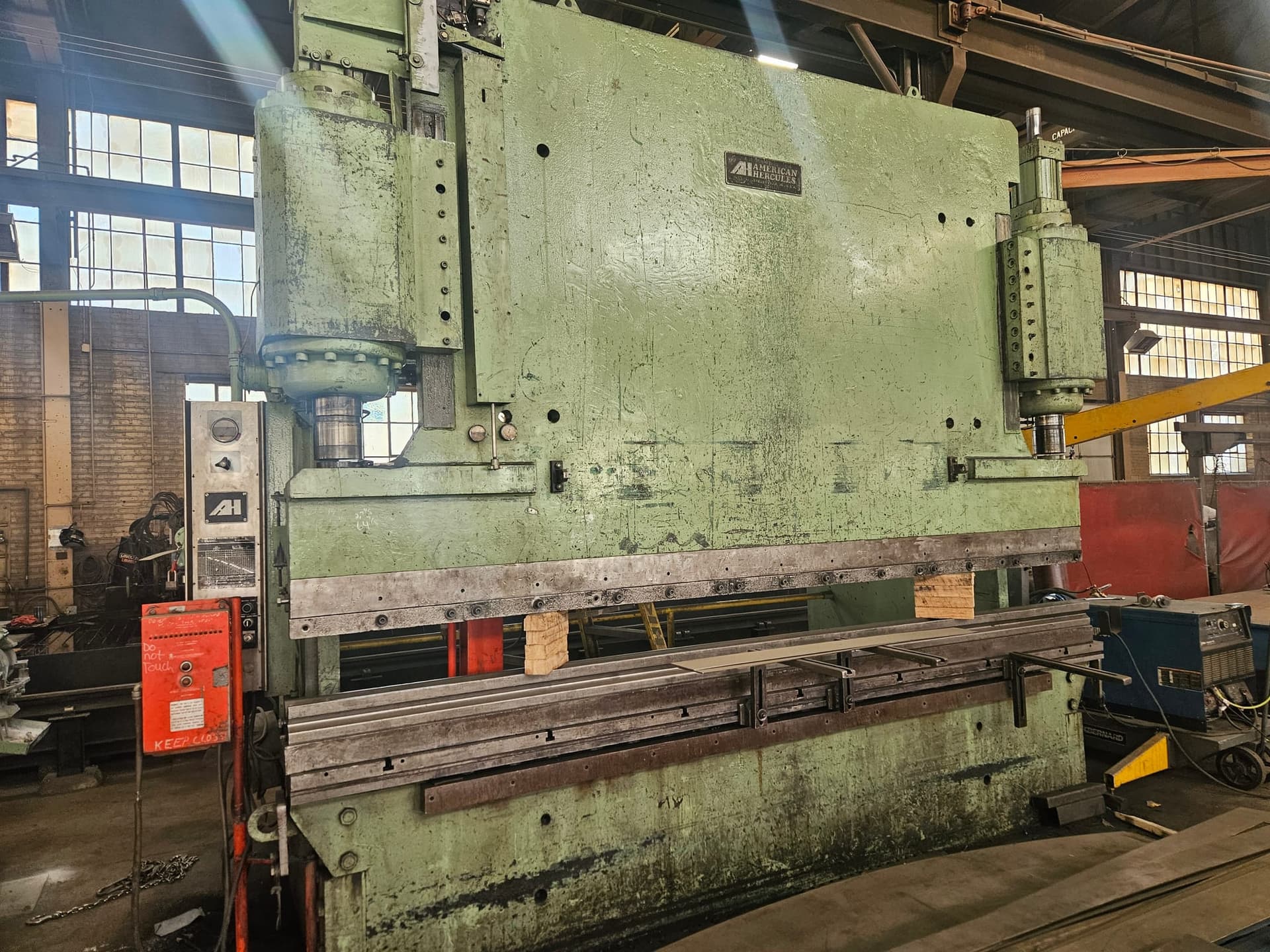
American Hercules Manufacturing Co. 700-Ton Hydraulic Press Brake
USA

Pacific Hydraulic Press Brake
USA
Looking for Something Specific?
Most of our inventory sells before we can list it online. If you need a specific brand, model, or specification, tell us what you need—we have access to unlisted equipment and machines coming in from plant closures.
Looking to Sell?
Meadoworks is an active cash buyer of used industrial equipment. Get a free valuation from our AMEA-certified appraisers.
About Used Hydraulic Press Brakes
Cylinders, not a crank, set the force and can hold it while the punch is in the die. That is what a hydraulic press brake is. Tonnage follows the material, the thickness, the length of the bend, and the V opening. A wider V needs less force and uses more flange. Air bending is lighter than bottoming the same part. Leave a margin so the machine is not stalled on every piece, and do not buy a much larger frame only because the number feels safe. A longer bend in the same thickness wants more of that force. The control, if there is one, does not create tons the pistons do not have.
Bed length has to clear the longest part with room at the ends. Working on the last inch of the ram is hard on the angle and on the ways. Stroke, open height, and throat are three different numbers. Stroke and open height decide whether a tall flange or a deep box can form and come back out. Throat depth decides how far a bend can sit from the edge of a wide sheet before the side housing is in the way. The distance between those housings limits a return flange that must pass through the machine. Two cylinders have to arrive together. A ram that twists makes an angle that changes along the part. Scales, valves, and guides are the usual causes.
A manual stop or a simple NC gauge is the right machine when the shop bends the same few flanges all week. It is a poor fit when every job is a different stepped part that needs stored finger positions. Many beds are machined with a crown so the ram sits nearer to parallel around half to two-thirds of capacity under an even load. That crown is in the iron. A crown a control moves, and fingers that travel on their own, are a gauge question. Cincinnati is the builder that turns up most often. A brake can carry both cylinders and a programmable gauge. Read the force and the bed here.
A used hydraulic press brake should form a full-length piece in your thickness, with the angle read at the ends and the middle. Hold a pressure below the nameplate and watch for drift. Milky oil, a howling pump, and a wet gland are repairs before the angle can be trusted. Confirm voltage and that the foot pedal and the emergency stop actually interrupt motion. Meadoworks takes these brakes from fab floors and from closures. Bring the material and the die you intend to run. The wrong bed or the wrong tons will not be saved by a fresher nameplate, and a long bed needs a planned lift.
How to Choose a Used Hydraulic Press Brake
How to Size a Hydraulic Press Brake
Size the tons from the material, the thickness, the bend length, and the V you will actually use. Air bending needs less force than bottoming and uses more flange. Leave a margin, and do not buy a much larger brake only because the number feels comfortable. Bed length has to fit the longest bend with room at the ends.
Cylinders and an older NC or manual stop are this decision. X, R, and fingers that move on their own are a gauge decision. A brake can be hydraulic and still carry a programmable stop. Split those questions on purpose. The pistons do not gain axes because the frame is oil-driven, and a stored program does not add tons.
Ram Parallelism and the Oil
Two cylinders have to arrive together. A ram that twists leaves an angle that changes along the part. Scales, valves, and guides are the usual causes, and fresh paint will not hide a full-length bend.
Then look at the oil. Leaks at the glands, a noisy pump, and a ram that will not hold pressure are the repair. A manual or NC stop is not a defect on a machine whose work does not need a program. It is a mismatch only when the parts have outgrown a single stop. Confirm the pedal and the emergency stop in the same visit as the voltage.
Hydraulic Press Brake Specs to Compare
| Spec | Why it matters |
|---|---|
| Tonnage | Cylinders set the force. A longer or thicker bend, or a tighter V, needs more of it. |
| Bed length | Working at the extreme end of the ram is hard on the angle and hard on the machine. |
| Stroke and open height | A deep box or a tall tool fails here even when the tons on the side of the frame are fine. |
| Throat depth | A bend away from the edge of a wide blank needs throat, not only bed length. |
| Distance between frames | A return flange that must pass through the side housings is limited by that opening. |
| Stop type | A manual or NC stop fits repeated flanges. Stored multi-axis fingers are a different decision. |
Tonnage
Cylinders set the force. A longer or thicker bend, or a tighter V, needs more of it.
Bed length
Working at the extreme end of the ram is hard on the angle and hard on the machine.
Stroke and open height
A deep box or a tall tool fails here even when the tons on the side of the frame are fine.
Throat depth
A bend away from the edge of a wide blank needs throat, not only bed length.
Distance between frames
A return flange that must pass through the side housings is limited by that opening.
Stop type
A manual or NC stop fits repeated flanges. Stored multi-axis fingers are a different decision.
What to Inspect on a Used Hydraulic Press Brake
Bend your thickness full length
Measure the angle at both ends and the center. A short sample hides ram twist and bed deflection.
Watch the ram ends
They should meet the bend together. A lag points at a valve, a scale, or a guide.
Hold pressure
Set a force below the nameplate. Drift means seals or valves, not a calibration trivia item.
Inspect oil and glands
Milky oil, a howling pump, or a wet ram seal is work before the brake can be trusted.
Read bed, throat, and stroke
Compare them with the longest part and the tallest flange, not with a wish for more tons.
Note manual or NC stops honestly
A simple gauge is correct for repeated flanges. It is the wrong machine only if you needed stored axes.
Cycle the pedal and the stop
The foot pedal and the emergency stop should interrupt motion. Confirm voltage at the same time.
Related Equipment
- Press Brakes
Every brake, before you narrow to cylinder drive
- CNC Press Brakes
Control, backgauge axes, and programs
- Hydraulic Shears
Squaring blanks that often go to the brake next
Hydraulic Press Brakes Brands We've Sold
Common Applications
Frequently Asked Questions
How do the cylinders set force on a hydraulic press brake?
Oil pressure on the pistons is the tonnage, and it can be held through the bend instead of peaking only at one point in a mechanical stroke. You still size that force from material, thickness, length, and the die opening. A wider V needs less tonnage and uses more flange. Air bending is lighter than bottoming the same part. A programmable stop does not create tons the pistons do not have. Read the nameplate, then compare it with the bend you actually run, including a margin so the machine is not stalled on every piece.
What bed length do I need on a hydraulic press brake?
Longer than the bend, with room so you are not forming on the last inch of the ram. Also check the distance between the side housings and the throat if a wide blank or a return flange has to pass. Stroke and open height have to clear the tooling and the box you are making. A bed that matches the part and a tonnage that does not, or the reverse, is still a miss. Measure the longest part rather than guessing length from a photo of the housings.
Do older NC and manual machines count as a hydraulic press brake?
Yes. A manual stop or an NC gauge is a fit when the shop bends the same flanges and does not need stored multi-axis positions. It is a poor fit when every job is a different stepped part that needs fingers in several places. Do not treat a simple oil-driven brake as incomplete. Treat the stop as the wrong level only when the work has outgrown it. The cylinders, the bed, and the throat are still the sizing questions on that simpler machine. A programmable gauge can be added later on some frames, and it does not change the tons.
What should I check for ram tilt on a hydraulic press brake?
Form a full-length piece and measure the angle at both ends and the middle. A twist means the cylinders, the scales, or the guides are not sharing the load. Also set a pressure and see whether the ram holds or drifts, which is seals and valves rather than geometry. Oil condition and wet glands belong in the same look. A short coupon at one end will not reveal tilt. If the two ends of the ram do not meet the bend together, find out whether a valve, a scale, or a guide is lagging.
When does a simple stop beat a multi-axis gauge on a hydraulic press brake?
When the shop bends the same flanges and a single stop can find them. Stored programs, independent fingers, and a crown the control drives matter when the part changes all day. Cylinders, tonnage, bed, and throat still have to be right either way. A brake can carry both oil cylinders and a programmable gauge. Read the force and the bed for the drive, and read the axes only when the part needs them. A manual stop is not a broken gauge. It is the correct gauge until the work outgrows it.
What do throat and stroke limit on a hydraulic press brake?
Throat depth limits how far a bend can sit from the edge of a wide sheet before the side housing is in the way. Stroke and open height limit the flange and the tooling stack, including a deep box that has to form and come back out. Distance between the housings is the third limit for a return flange that passes through the machine. Tons do not fix any of those. Compare them with the part before you compare two similar photos of the ram.
