Used Hydraulic Shears for Sale
2 results
Looking for Something Specific?
Most of our inventory sells before we can list it online. If you need a specific brand, model, or specification, tell us what you need—we have access to unlisted equipment and machines coming in from plant closures.
Looking to Sell?
Meadoworks is an active cash buyer of used industrial equipment. Get a free valuation from our AMEA-certified appraisers.
About Used Hydraulic Shears
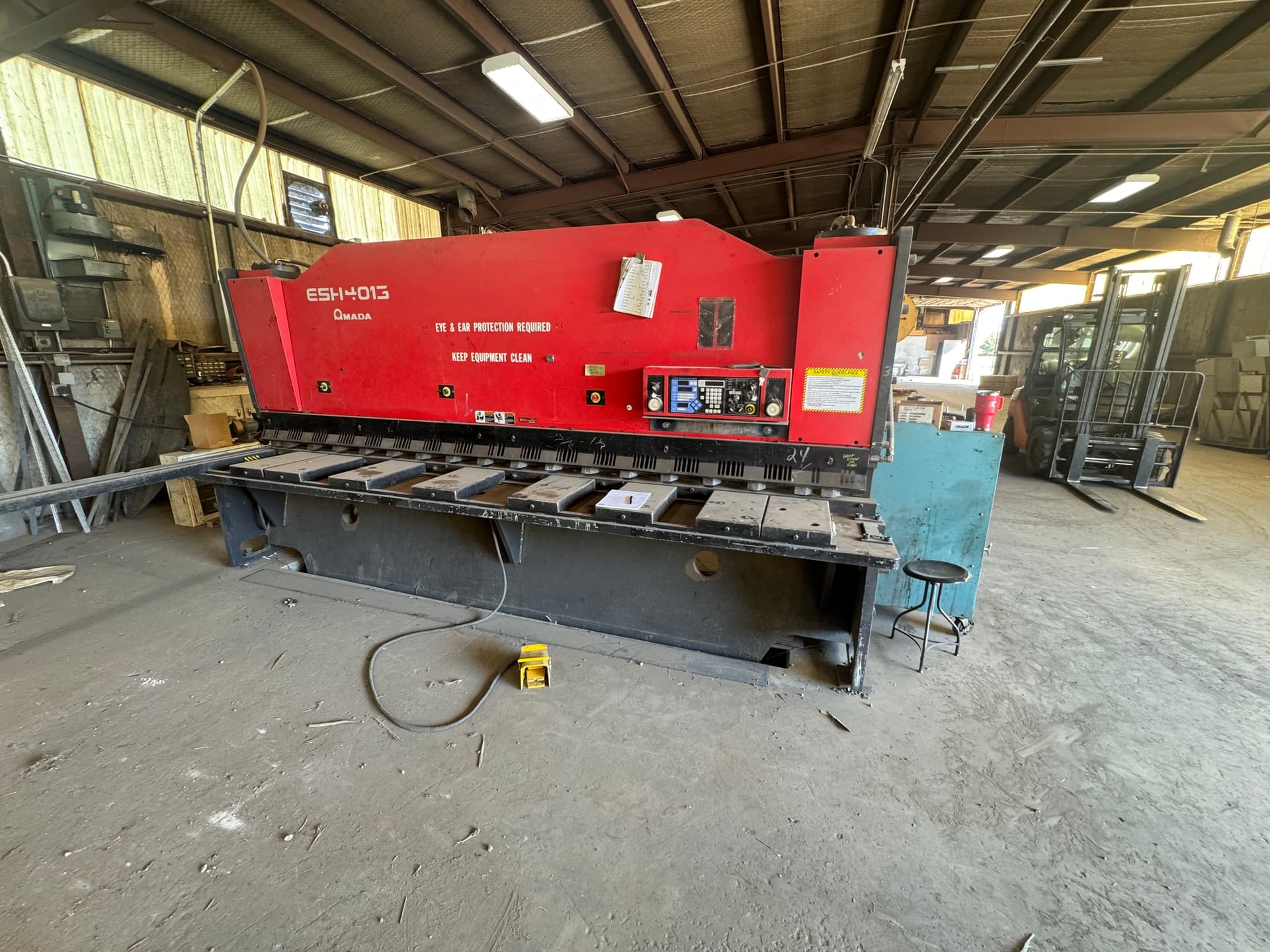
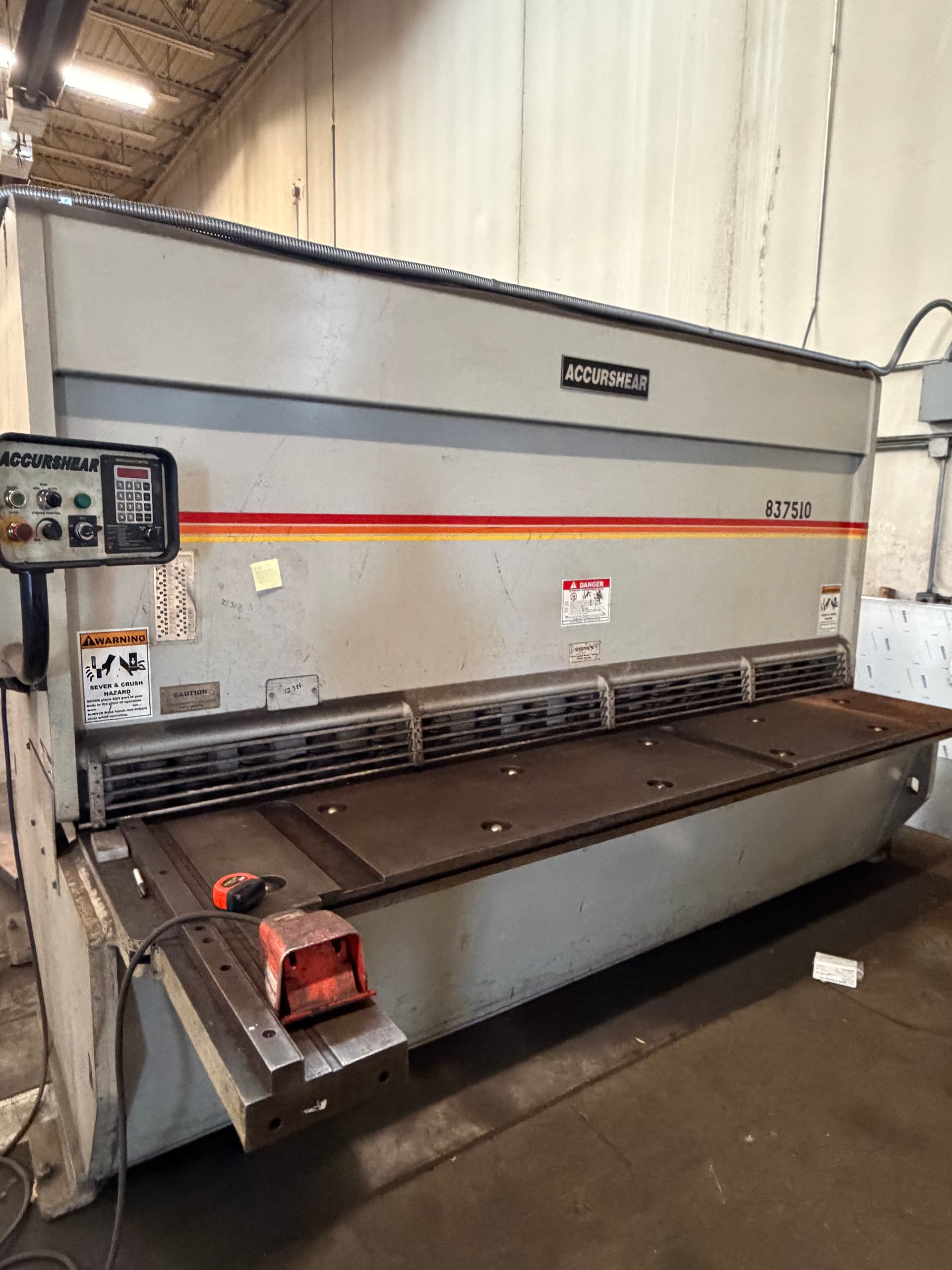
A hydraulic shear cuts a straight line through sheet or plate with a blade, while a hold-down keeps the blank from lifting. It is not a saw, and it is not a laser. The cut is one stroke. Blade length and rated thickness are the pair on the nameplate. A 10-foot shear rated for 1/4-inch mild steel will not cut that thickness in a harder alloy, and it will not cut a blank longer than the blade without a reposition you usually do not want.
Rake angle is the slope of the blade. More rake lowers the tonnage and twists a thin strip. Less rake leaves a flatter drop and needs more force. Blade gap has to match thickness. A gap set for plate will tear thin sheet, and a gap set for sheet will stall or chip the blade in plate. The hold-down has to clamp before the blade arrives. A hold-down that is weak lets the blank kick, and the edge shows it. Back gauge, manual or powered, is how you repeat a width. A powered gauge that has lost its counts is a tape measure.
Blades are consumable and often dull in the middle, where every cut lived. A nick throws a burr for the rest of the edge. The ways or the pivots that guide the ram should not knock. Hydraulic leaks at the cylinders are the usual age. Cycle the shear empty and listen, then look at the last edge it cut if a drop is still there.
A used hydraulic shear should be measured at the blade and the gap, not admired for the throat. Confirm length, rated thickness and the rake. Run the hold-down and the gauge. Ask when the blades were turned or replaced. Four edges are the usual life of a blade set, and a shear on its last edge is a blade purchase. Match the thickness you cut every week, including the alloy, before you match the paint. Square the back gauge against the blade with a tape before you trust a width. A gauge that reads and a gauge that is square are different facts.
How to Choose a Used Hydraulic Shear
Length and Thickness, Then Rake
The sheet has to be shorter than the blade, and thinner than the shear's rating at that length. Rake helps thick plate and can curl a thin strip, so the rating and the rake belong in the same decision.
This is a squaring machine. A brake bends the blank after the edge exists. A laser or a turret makes a profile. If you only need a straight drop, wait. If you need a shape, you already left.
Gap, Hold-Downs, and the Gauge
Blade gap is a setup, not a permanent personality, and it has to be able to change for the thicknesses you run. Hold-downs that clamp late or unevenly are why blanks move. The backgauge only helps if it repeats.
Cut both ends of a full-length piece and measure. Bow and a heavy burr are blade, gap, or rake, and they will not be argued away. Oil leaks are the other half of a hydraulic machine and they are ordinary to find and necessary to notice.
Hydraulic Shear Specs to Compare
| Spec | Why it matters |
|---|---|
| Length and thickness | Both numbers have to cover the sheet. Length without thickness, or the reverse, is a miss. |
| Rake | Rake reduces force and can twist a narrow blank. Know which compromise you are buying. |
| Blade gap | Wrong gap tears sheet or stalls in plate. The adjustment has to move. |
| Hold-downs | A blank that kicks will not be square, no matter how sharp the blade is. |
| Backgauge | The gauge sets blank depth. It only helps if it repeats and locks. |
| Blade condition | Burr height is mostly the blade and the gap, not the paint on the ram. |
Length and thickness
Both numbers have to cover the sheet. Length without thickness, or the reverse, is a miss.
Rake
Rake reduces force and can twist a narrow blank. Know which compromise you are buying.
Blade gap
Wrong gap tears sheet or stalls in plate. The adjustment has to move.
Hold-downs
A blank that kicks will not be square, no matter how sharp the blade is.
Backgauge
The gauge sets blank depth. It only helps if it repeats and locks.
Blade condition
Burr height is mostly the blade and the gap, not the paint on the ram.
What to Inspect on a Used Hydraulic Shear
Cut full length in your thickness
Measure squareness and burr at both ends. A short snip hides bow and a ram that is out of plane.
Change the blade gap
It should move and lock. A frozen gap means one thickness forever, if that thickness still cuts.
Watch the hold-downs
They should clamp before the blade and release after. A late clamp lets the sheet kick.
Read the rake against your thinnest strip
A rake that is happy in plate can twist a narrow blank. Know which you cut more often.
Inspect the blade edges
A four-edge blade may have a sharp side left. A blade with nothing left is a grind or a replacement.
Check oil and drift
Leaks at the cylinders and a ram that will not hold are the hydraulic repair, separate from the knives.
Repeat the backgauge
Set a depth, cut, and set it again. A gauge that will not return will not give you a blank size.
Related Equipment
- Shears
Parent group for hydraulic and mechanical squaring shears
- Press Brakes
Bends the blank after the edge is squared
- Laser Cutters
Profile cutting when a straight drop is not enough
Common Applications
Frequently Asked Questions
What thickness and length can a hydraulic shear cut?
The rating is thickness by blade length, and both have to cover the sheet in your hand. A longer cut in the same thickness needs the longer machine, not a slower stroke on a short blade. Rake changes how that thickness feels, because more rake lowers the force and can twist a strip. Read the plate on the shear and compare it with your thickest full-length sheet. A capacity that works on a coupon and fails on a full sheet is the usual disappointment.
How do rake and blade gap affect a hydraulic shear?
Rake is the blade angle. More rake cuts heavier plate with less tonnage and is rougher on a thin, narrow piece. Blade gap is the clearance between the knives, and it has to grow with thickness. A plate gap tears sheet. A sheet gap stalls or chips in plate. The gap adjustment has to move, or you own one thickness. Ask to see it changed, then cut both ends of your range. Burr and bow are the report card.
What does the backgauge do on a hydraulic shear?
It sets how deep the blank is, the dimension from the blade to the stop. A manual gauge is a stop you lock. A powered gauge is a position you can repeat without a tape on every sheet. Either is fine when it actually returns to the same place. Cut, reset, and cut again. A gauge that drifts gives you a pile of almost-squares. The gauge does not square the cut by itself. Blade, gap, and hold-downs do that.
Why are hold-downs part of a hydraulic shear cut?
They clamp the sheet before the blade arrives so the blank cannot kick or walk. A hold-down that is late, weak, or missing on one end is why a cut bows or the sheet jumps. Watch a stroke and see the order: clamp, then cut, then release. Hydraulic leaks at those cylinders matter as much as leaks at the main ram. A sharp blade cannot compensate for a blank that moved. Include the hold-downs in the inspection instead of treating them as trim.
What should I look at on the blades of a hydraulic shear?
Whether a sharp edge remains, and whether the blade can be turned to the next edge or has to be ground. Nicks print into every cut. Gap and rake still have to be right, or a new edge burrs anyway. Cut your thickness full length and look at both ends. Also look at the ram that carries the upper blade, because a ram that is not even appears as a burr that changes along the sheet. Oil condition is the other half of that ram.
How is a hydraulic shear different from a press brake?
A hydraulic shear makes a straight cut. A press brake makes a bend. They often sit in the same cell, and they are not substitutes. Squaring a blank and then forming a flange is two machines. Buying a shear to bend, or a brake to square production drops, wastes the tool. Mechanical shears are a different drive again, a clutch and a flywheel rather than cylinders. Stay on this group when the cut is hydraulic and the result has to be a straight edge.
