Used MIG & TIG Welders for Sale
See all 3 Welders & Welding Equipment →
1 result
Looking for Something Specific?
Most of our inventory sells before we can list it online. If you need a specific brand, model, or specification, tell us what you need—we have access to unlisted equipment and machines coming in from plant closures.
Looking to Sell?
Meadoworks is an active cash buyer of used industrial equipment. Get a free valuation from our AMEA-certified appraisers.
About Used MIG & TIG Welders
A MIG welder feeds a wire and shields the puddle with gas, or with flux in the wire. It is the production source for steel, stainless and aluminum when the joint is a fillet or a groove a person or a robot can reach. A TIG source, in the same offering, uses a tungsten electrode and a filler you add by hand. It is slower and it is the choice for a thin wall, a sanitary joint or a weld you will look at. They are not the same power source with a different gun. A MIG gun, a drive roll and a liner will not make a TIG weld.
Duty cycle is how long the source welds before it must rest, at a given amperage. A 60 percent duty cycle at 300 amps is not 300 amps all day. Voltage has to match the bay. A machine built for 230 volts will not shrug onto 460 without a transformer the nameplate allows. The feeder, the liner and the contact tip have to match the wire diameter. The wrong drive roll flattens aluminum and slips on steel. Gas, when the process is not flux-core, has to be the mix the procedure calls for. A regulator that leaks is a weld that pores.
Cables, the ground clamp and the gun liner are the wear you can see. A cracked gun neck and a liner full of shaved wire explain a weld that hunts. On a TIG machine, the torch, the foot pedal and the gas lens are the same story. Cycle the feeder with the wire you run. Strike an arc if the gas and the power are there.
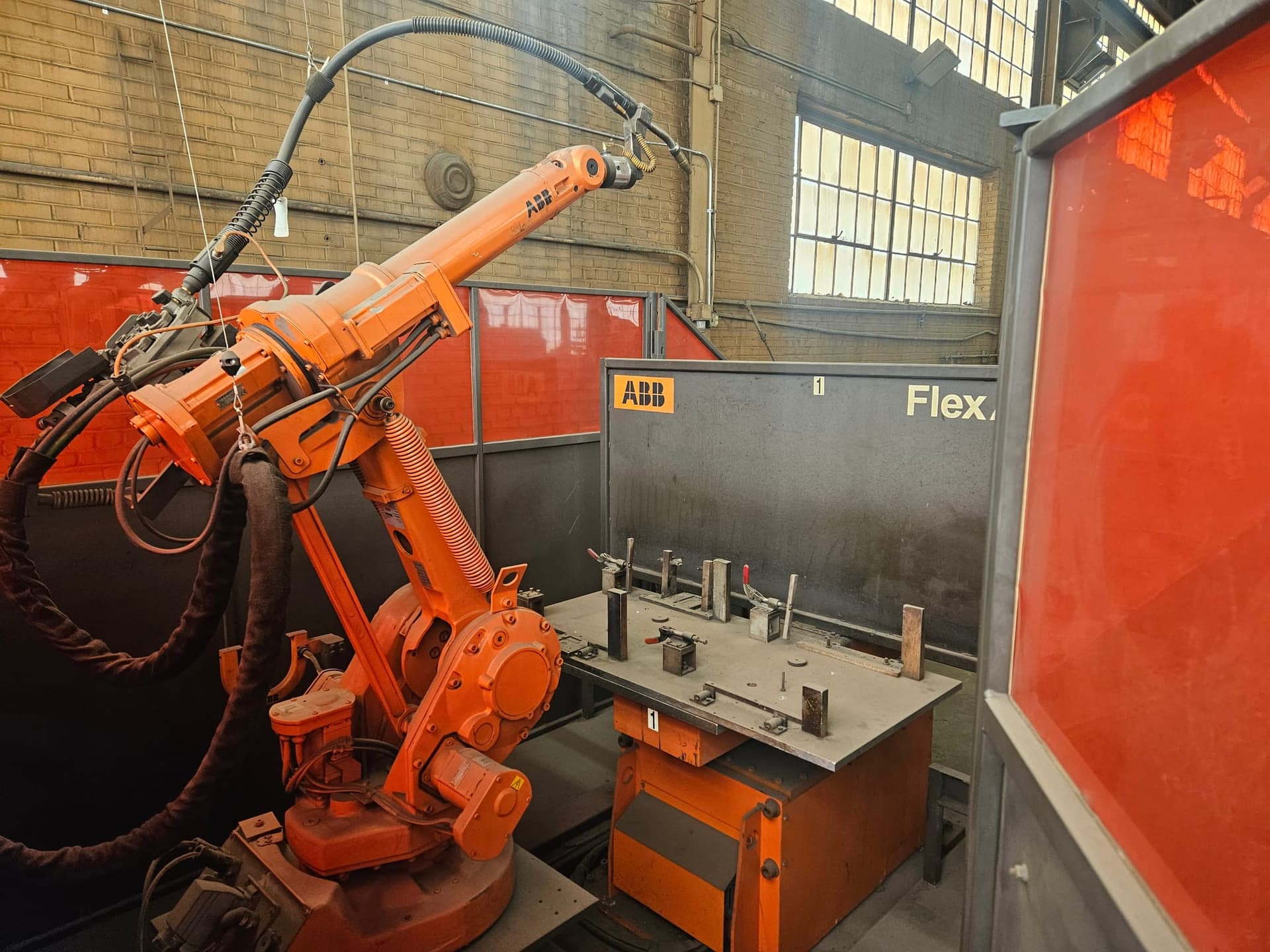
A used MIG welder should be matched to the metal and the thickness, then checked for duty cycle and voltage. Confirm the gun, the feeder and a set of rolls for your wire are included. If the photo is a TIG torch, read it as TIG and do not price it as a wire feeder. A robotic cell is a different purchase, with a positioner and a fence. This source is the power supply and the gun.
How to Choose Used MIG & TIG Welders
Wire and Gas, or a TIG Torch
Pick MIG when the joint is a fillet or a seam you want to finish at production speed and the bead can look like a wire weld. Pick TIG when the metal is thin, the bead has to be small, or the alloy is unhappy with a wire spray. The power sources in this range cover both, and they are not one machine with two labels.
Gas and wire have to match on the MIG side. A TIG bottle and a TIG torch will not turn a wire feeder into a TIG weld. Read which process the listing actually is.
A Bench Source or the Cell
One listing in this group is a robotic wire cell. That is a robot, a torch, a table, and safety, and it is written up on the robotic group. A manual power source is what you buy for a bench or a booth.
Duty cycle still matters on the manual machine. A welder that rests more than it welds will not keep a production gun busy. Strike an arc in your thickness before you compare nameplates. The feeder and the ground are part of that test.
MIG & TIG Welders Specs to Compare
| Spec | Why it matters |
|---|---|
| Process | The joint picks the process. A wire feeder does not become TIG. |
| Duty cycle | A short duty cycle will not carry a production gun through a shift. |
| Wire and gas | The wrong gas or the wrong wire is spatter, poor fusion, or no arc. |
| Feeder and gun | Most 'bad settings' are a liner or a roll, not the power supply. |
| Cell versus bench | The cell includes a robot and safety. Do not price it as a suitcase welder. |
| Input power | A mismatch needs a different supply, not a longer ground cable. |
Process
The joint picks the process. A wire feeder does not become TIG.
Duty cycle
A short duty cycle will not carry a production gun through a shift.
Wire and gas
The wrong gas or the wrong wire is spatter, poor fusion, or no arc.
Feeder and gun
Most 'bad settings' are a liner or a roll, not the power supply.
Cell versus bench
The cell includes a robot and safety. Do not price it as a suitcase welder.
Input power
A mismatch needs a different supply, not a longer ground cable.
What to Inspect on Used MIG & TIG Welders
Strike an arc in your thickness
Watch the puddle. A lamp on the panel is not a weld test.
Feed wire the length of the gun
It should push without slipping or bird-nesting. Rolls and the liner are the usual cause.
Confirm gas flow
At the nozzle, not only at the bottle. No gas, no shield, no weld you can ship.
Read duty cycle against the job
A source that must rest every few minutes will not run a production gun.
Separate TIG from wire
If the listing is a TIG source, do not expect a feeder. If it is MIG, do not expect a TIG puddle.
Notice if it is the cell
A robot, a table, and a fence are a different purchase. Open the robotic group for that machine.
Check the ground path
A poor clamp makes a good source look weak. Include it in the arc test.
Related Equipment
- Welders & Welding Equipment
Parent group for cells, wire, TIG, and spot
- Robotic Welding Cells
Robot, torch, positioner, and safety around a wire process
- Deburring & Finishing
Edges and scale that appear before or after a weld
Common Applications
Frequently Asked Questions
When should I choose a mig welder instead of TIG?
When the joint can take a wire bead and you care about speed. Fillets and ordinary steel seams are the MIG habit. Choose the TIG source in this same range when the metal is thin, the bead has to stay small, or you are on a material that wants a rod and a pedal. They are different torches and different skills. A wire feeder will not pretend to be TIG, and a TIG power source will not feed wire. Start with the joint, then open the listing that matches it.
What shielding gas and wire does a mig welder need?
A pair that matches the metal and the thickness. A mix and a straight carbon-dioxide setup do not behave the same, and the wire diameter has to fit the drive rolls and the tip. Gas that never reaches the nozzle is the same as no gas. Set voltage and wire speed for the thickness rather than for a memory of another job. If the arc spatters or will not wet, check the gas and the liner before you condemn the power source. Those consumables are the process.
Why is a robotic cell listed with a mig welder?
Because the cell welds with wire, so it shares this process group, and it is still a cell. The robot, the torch path, the positioner, and the fence are written up on the robotic welding group so this one does not pretend a power source is a booth. If you needed a bench gun, skip the cell. If you needed unattended or repeat path welds, skip the suitcase and read that group. Duty cycle and gas still apply inside the cell. The safety circuit does not.
What duty cycle should I read on a mig welder?
How long it can weld in a ten-minute window before it must cool, at a stated output. A short duty cycle is fine for repair and tacking. It is a poor fit for a gun that stays lit. Compare the number with the joints you actually run, not with the maximum on the brochure. Heat in the source during a real weld is the confirmation. A welder that trips while your part is unfinished is the wrong size, even if it struck a beautiful inch-long bead.
What should I test on a mig welder before I buy it?
An arc on your thickness, wire that feeds without a bird nest, and gas at the nozzle. Include the ground clamp. Liners, tips, and rolls are cheap and they cause most of the drama, so look at them while the arc is running. If the listing is the robotic cell, a bench test is the wrong test and you should be jogging a path. If the listing is the TIG source, stop looking for a feeder. The weld, or the honest absence of one, is the specification.
Can a mig welder group also include a TIG power source?
This one does, on purpose, because both machines are in the same catalog group and buyers mix them up. The group says which process is which. TIG is the torch and the rod. MIG is the wire and the gas. You do not get both out of one unlabeled power source. Read the listing title and then the process notes here. A cell that runs wire stays a MIG conversation plus a robot. A TIG box stays a TIG conversation. The shared group is only the index.
