Used Robotic Welding Cells for Sale
See all 3 Welders & Welding Equipment →
1 result
Looking for Something Specific?
Most of our inventory sells before we can list it online. If you need a specific brand, model, or specification, tell us what you need—we have access to unlisted equipment and machines coming in from plant closures.
Looking to Sell?
Meadoworks is an active cash buyer of used industrial equipment. Get a free valuation from our AMEA-certified appraisers.
About Used Robotic Welding Cells
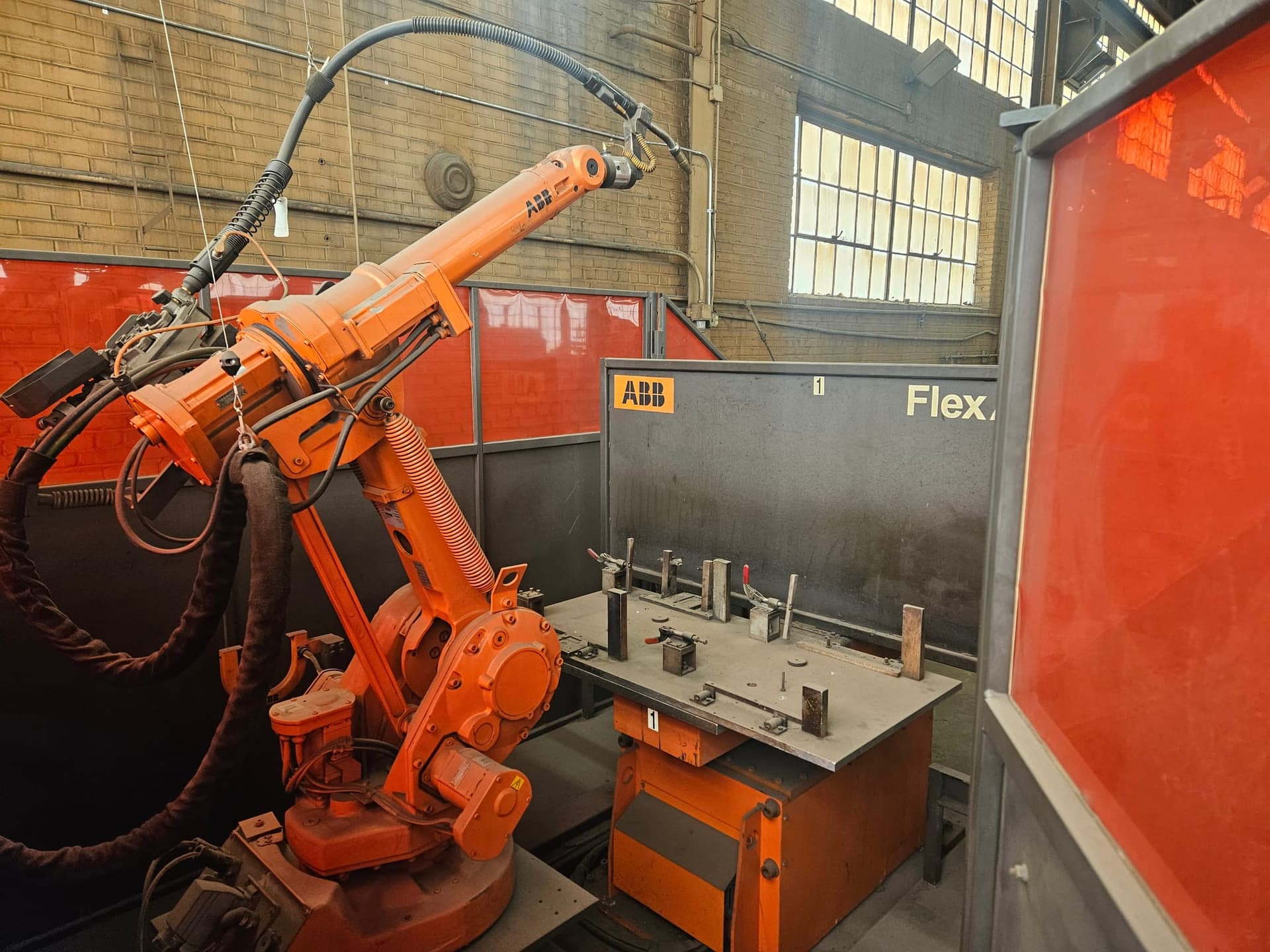
Robotic welding is a robot, a torch, a positioner or a table, and a fence. The robot does not know the joint. A fixture puts the part in the same place, and the program follows a path someone taught. Reach has to cover the joint in that nest, with the torch at an angle the puddle will accept. A part that needs a flip needs a positioner, a rotary or a second table. Without that motion, the robot welds only what it can see.
The dress package, the liner and the wire feeder have to repeat. A liner that shaves wire will make the robot hunt the same way a hand gun hunts, and it will do it on every part. Touch sensing or a seam tracker, when the cell has it, finds a joint that moved. Many cells do not have it, and then the fixture is the accuracy. Guarding and interlocks have to drop the arc when a gate opens. A cell with the fence missing is not a cell you can run.
The robot itself is hours, backlash and a controller that still boots. Mastering that was lost in a crash is a long day. The welding source, often a MIG package, has the same duty cycle and the same consumables as a manual source, plus a mount. Programs live in the controller and in a backup you hope exists. A pendant that will not jog is a robot you cannot reteach.
Used robotic welding equipment should be jogged through the path, with the fixture in place if it is still there. Confirm reach against your part, the positioner, and whether the programs and a backup are included. Look at the liner and the torch neck. A pretty arm with no fixture welds the air. Match the joint and the nest before you match the color of the robot. Torch angle and stick-out belong in the program, and a neck that was crashed will not hold either one. Look at the seam the cell last ran if a coupon is still in the fixture.
How to Choose a Used Robotic Welding Cell
A Cell, Not a Power Source
Buy the cell when the joint repeats and a person should not be holding the torch. You are buying the robot, the path, the fixture, and the fence together. A manual MIG or TIG source is the other group.
If you do not have a fixture, you do not have a process yet. The arm will not invent a nest. Confirm the reach against your part before you fall in love with the controller brand.
Path, Positioner, and the Gate
A positioner exists so the weld stays in position. A fixed table is enough only when every joint is already presented that way. Jog the path with the arc off and watch for a torch that clips the fixture.
Then open the gate. The interlock should kill the arc and the motion you expect it to kill. A cell with a bypassed door is not a small paperwork item. Programming access, a live pendant and a backup, is the other half of whether the job comes back on Monday.
Robotic Welding Cell Specs to Compare
| Spec | Why it matters |
|---|---|
| What is included | An arm without the table and the safety is not the cell that ran the part. |
| Reach and fixture | Reach without a repeatable fixture will not hold a bead on the joint. |
| Positioner | Gravity and access decide whether a fixed table is enough. |
| Torch and wire | A crashed torch or a bad liner moves the weld even when the robot is accurate. |
| Safety circuit | A fence that does not interrupt is scenery. |
| Program access | A cell you cannot edit or restore is a statue. |
What is included
An arm without the table and the safety is not the cell that ran the part.
Reach and fixture
Reach without a repeatable fixture will not hold a bead on the joint.
Positioner
Gravity and access decide whether a fixed table is enough.
Torch and wire
A crashed torch or a bad liner moves the weld even when the robot is accurate.
Safety circuit
A fence that does not interrupt is scenery.
Program access
A cell you cannot edit or restore is a statue.
What to Inspect on a Used Robotic Welding Cell
Jog a path with the arc off
Watch the torch clear the fixture. A collision in the air is cheaper than a collision in the part.
Confirm the cell is complete
Robot, torch, positioner or table, and fence. An arm on a skid is not the listing you think it is.
Open the gate
The interlock should do what it claims. A jumper in the safety circuit is a reason to stop.
Check the dress package
Rubbed cables, a bent torch, and a liner full of debris are the crash history.
Load a backup or the pendant
You need a way to see and save the job. A dead teach pendant ends the purchase.
Fit your part in a fixture
Reach is not enough. The joint has to sit in the same place every cycle.
Weld a sample only after the jog
Utilities and gas have to be real. A cold demo that never arcs does not prove the power source.
Related Equipment
- Welders & Welding Equipment
Parent group for manual sources and cells
- MIG / TIG
Hand-held wire and TIG power sources, not the cell
- Deburring & Finishing
Scale and edges cleaned before a repeat weld
Common Applications
Frequently Asked Questions
What has to be in a robotic welding cell besides the robot?
A torch on a dress package, a table or a positioner, a fixture for the part, and a fence with interlocks. The power source and the wire feed are in there too, and they are components. An arm by itself will not present a joint or keep a person out of the arc. Ask what actually ships. A cell that ran in a plant often depends on a nest that is easy to leave behind. If the fixture is absent, budget one before you call the robot ready.
How is robotic welding different from a manual power source?
A person holds the manual torch and chooses the path each time. Robotic welding stores the path and repeats it, which only works when the part is fixtured. The manual group is where MIG and TIG power sources are compared for a bench. This group will not re-teach duty cycle and rod versus wire. If you needed a gun at a booth, you are in the wrong listing. If you needed the same seam all day without a hand on the torch, stay and inspect the cell.
What does the positioner do in robotic welding?
It moves the part so the seam sits where the torch can weld it, often flat, instead of making the robot reach around gravity. A fixed table is enough only when every joint is already presented. Jog the positioner with the robot and see whether they are coordinated or two separate machines that happen to stand nearby. A positioner that does not index, or a robot that cannot see that index, will not run the job you remember from the video. Confirm the pairing.
Which safety devices should I confirm on robotic welding?
The fence, the gate, and the interlock that drops motion and arc when the gate opens. Light curtains or floor scanners, if they were part of the cell, have to be present and not jumped. A bypassed door switch is not a detail for later. Test it. Also look at how a person is supposed to load the part, because a brilliant path with no safe load position is not a cell you can run. Safety is part of the machine, the same as the torch.
What fixture questions come with robotic welding?
Whether a nest exists for your part, whether the clamps clear the torch, and whether the joint lands in the same place every time. Reach charts do not answer that. A cell from another product will not magically clamp yours. If you must build the fixture, say so in the budget and the schedule. Bring the part to the inspection and see if the existing nest even accepts it. Programming a path onto a moving target is how robotic cells disappoint.
What should I see move during a robotic welding dry run?
The arm through the path, the positioner if there is one, and the torch staying clear of the fixture, with the arc off. Then the gate should interrupt that motion. A pendant that cannot jog is a stopped purchase. After the dry run, a sample weld proves the power source, the gas, and the wire. Skip straight to a spark and you will miss a crash. The order is path, safety, then arc. Anything else is a demonstration, not an inspection.
