Used Hydraulic Gap Presses for Sale
1 result
Looking for Something Specific?
Most of our inventory sells before we can list it online. If you need a specific brand, model, or specification, tell us what you need—we have access to unlisted equipment and machines coming in from plant closures.
Looking to Sell?
Meadoworks is an active cash buyer of used industrial equipment. Get a free valuation from our AMEA-certified appraisers.
About Used Hydraulic Gap Presses
Throat clearance is the number that decides whether a gap frame press can even see the work. Measure it from the centerline of the ram back to the upright behind the bed. A part that has to sit farther out will not become a fit because the cylinder is larger. The C shape is what opens the front and both sides, and it is also what lets the upper and lower arms spread once the force is on. Shops call that spring yawning. Work that cannot tolerate a little opening belongs on side plates or on columns, where the load path is closed.
Long stock is the everyday reason to live with that spring. A bar or a bracket can project through the back without being threaded through a window. Fixtures that change several times a shift are the other reason: the operator can see the tool and reach the clamps. Keep the force near the frame when the part cares about squareness. A load parked out by the throat, close to the rating, is how the inside corner cracks and how the ram starts to cock. A centered press fit in a small nest often never notices the flex.
Daylight, shut height, and stroke still decide whether the fixture closes, and they are separate from the throat. A cylinder can hold force along the travel, and a timer can pause there when the panel actually has one. Neither feature erases the spring. Holding force on an offset tool still cocks the ram, so do not buy a gap frame press expecting the parallelism of gibbed uprights. Rapid approach and a slower pressing speed are often separate settings, which matters on a fit more than on an empty trip downward. Read the supply voltage in the same visit as the throat tape.
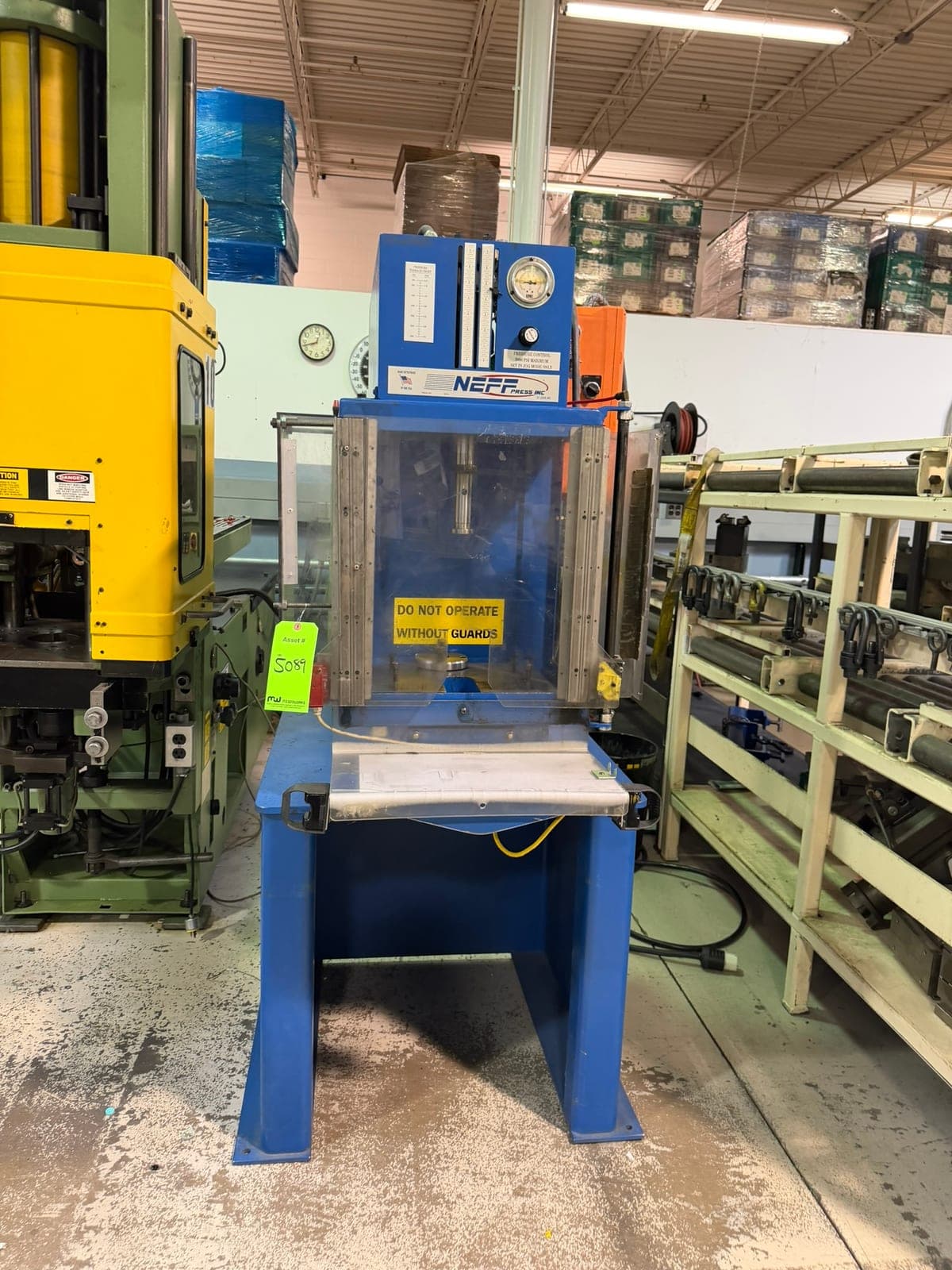
A used gap frame press is judged at the inside corner, at the ram gland, and on a dry cycle. Paint can hide a grind-and-weld repair. A weep at the seal, and oil that has turned milky, are the ordinary jobs. Neff built many of these open frames for assembly benches and short-run forming. Meadoworks brings them off fab floors and out of closed plants. Put your part in the throat before you schedule a truck, and confirm the voltage while you are standing there, because a compact frame is still the wrong machine on the wrong power.
How to Choose a Used Hydraulic Gap Press
Throat Access Versus a Closed Frame
Buy the open throat when people have to reach the tool, pass a long piece out the back, or change a small fixture several times a shift. That opening is the whole point. Buy uprights when the die is long, the load sits off center, or a little spring in the arms will spoil the part.
Do not split the difference in your head. An open frame will not become rigid because the tons are modest, and side plates will not grow a throat because you wish the stock were shorter. Measure whatever has to pass behind the ram, then decide. Tonnage is the second conversation.
Tonnage, Throat Depth, and Deflection
Force is still set by the cylinder and the relief valve, and it is available along the travel. Throat depth is how far from the frame face the ram center sits, and it caps the work you can support. A deep throat on a light weldment moves more under load than a shallow throat on a heavier one.
Keep heavy or offset tools closer to the frame when the process allows. A centered press fit in a small nest is the usual fit. A wide die that must stay parallel wants side plates instead. After the geometry fits, look for oil leaks and a cracked radius at the inside corner. Those are condition, not a reason to ignore the throat tape.
Hydraulic Gap Press Specs to Compare
| Spec | Why it matters |
|---|---|
| Tonnage | The cylinder and the relief valve set the force. Match the process and leave room above the peak load. |
| Throat depth | Work that sits farther back than the ram centerline does not fit, no matter what the tonnage plate says. |
| Daylight and shut height | The fixture has to load while the ram is open and still reach the working position when it closes. |
| Stroke | Assembly and forming need travel for loading and for the press itself, not only a tonnage number. |
| Bed and ram size | Reach from three sides does not help if the tool and the clamps cannot be bolted down. |
| Approach and press speeds | A controlled pressing speed matters on fits. Rapid travel only saves time on the way to the work. |
Tonnage
The cylinder and the relief valve set the force. Match the process and leave room above the peak load.
Throat depth
Work that sits farther back than the ram centerline does not fit, no matter what the tonnage plate says.
Daylight and shut height
The fixture has to load while the ram is open and still reach the working position when it closes.
Stroke
Assembly and forming need travel for loading and for the press itself, not only a tonnage number.
Bed and ram size
Reach from three sides does not help if the tool and the clamps cannot be bolted down.
Approach and press speeds
A controlled pressing speed matters on fits. Rapid travel only saves time on the way to the work.
What to Inspect on a Used Hydraulic Gap Press
Confirm the open throat
You should see a C-shaped frame, not uprights on both sides of the slide. Closed sides are a different machine.
Measure throat depth against the part
The stock or the fixture has to pass. A tonnage match with a shallow throat is still a miss.
Inspect the throat radius for cracks
The inside corner of the gap is where these frames complain. Paint can hide a repair.
Watch the ram for tip
Cycle under a light centered load and look for a ram that cocks. Offset wear appears here first.
Check seals, hoses, and oil
A weep at the gland or a soft hose is the usual repair. Milky oil means the reservoir took on water.
Test pressure hold
Set a force below the nameplate and see if the ram stays. Drift is a valve or a seal, not a cosmetic issue.
Match voltage and the two-hand control
Confirm the supply and that the palm buttons or the light curtain actually stop a stroke.
Related Equipment
- Hydraulic Presses
Family overview before you commit to an open throat
- Straight Side
Closed frame when the ram has to stay square
- Up-Acting
Upward ram for molding and assembly fixtures
Hydraulic Gap Presses Brands We've Sold
Common Applications
Frequently Asked Questions
Why does a gap frame press open on three sides?
The C-shaped frame leaves the front and both sides clear, and the throat lets stock or a fixture extend out the back. That access is why assemblers and fab shops accept the spring. You can see the tool, change it quickly, and feed a long piece without a window in the way. Under load the arms can spread and the ram can tip. If the part cannot tolerate that movement, uprights are the other choice, and they will not give you this reach. Sketch the part in the opening before you fall for a larger cylinder.
How deep a throat does a gap frame press need?
Deep enough that the working center of the part sits under the ram while the rest of the stock stays inside the opening you measured. Throat depth runs from the frame face to the ram center, and it does not grow when the cylinder does. A heavier ram does not move backward. Sketch the part in that opening before you compare nameplates. If the part is wide and must stay parallel, stop hunting a deeper gap and look at uprights instead. The throat tape is the fit. The tons are the force after that.
When does deflection become a problem on a gap frame press?
When the load sits away from the frame, or near the rating, and the part cares about squareness. The open throat is a spring. A centered press fit in a small nest often never notices. A wide form, a long die, or years of offset work leave a ram that is no longer square and a throat that has been welded. Look at the inside corner and cycle the ram under a light load. A repaired radius under fresh paint is still a repaired radius. Modest tons do not make a light weldment rigid.
What should I look at on a Neff gap frame press?
Neff built a lot of open-throat shop frames, and the checks are the same as on any C-shaped hydraulic machine. Read tonnage, throat, stroke, and daylight. Cycle the ram, hold a pressure, and look for a weep at the seals. Inspect the throat radius for cracks or a grind-and-paint repair. Confirm the voltage and that both palm buttons are required. A clean nameplate does not replace those steps. The frame still has to match the part, and a Neff casting does not add throat the drawing does not have.
How is a gap frame press different from a straight-side machine?
This frame is open. A straight-side machine closes the load path with uprights and guides the slide on gibs. You buy the opening for reach and for long stock through the back. You buy the uprights when tilt and spring will scrap the part. Both can use a cylinder, so both can hold force through the travel. The oil does not make them the same structure. If you are unsure, measure whether anything has to pass behind the ram. If it does, the throat is the feature you came for.
Can a gap frame press dwell under pressure?
Often yes, if the control includes a timer and a pressure setpoint. The cylinder can hold force away from the bottom of the travel, which helps press fits and some forming. Confirm that function on the panel rather than assuming every open frame has it. A pause does not cancel throat spring. Holding force on an offset tool still tips the ram. Use the timer for a centered assembly. Use uprights when the die has to stay parallel for the whole hold. Rapid approach is a separate setting from that pressing speed.
