Used Incline Conveyors for Sale
1 result
Looking for Something Specific?
Most of our inventory sells before we can list it online. If you need a specific brand, model, or specification, tell us what you need—we have access to unlisted equipment and machines coming in from plant closures.
Looking to Sell?
Meadoworks is an active cash buyer of used industrial equipment. Get a free valuation from our AMEA-certified appraisers.
About Used Incline Conveyors
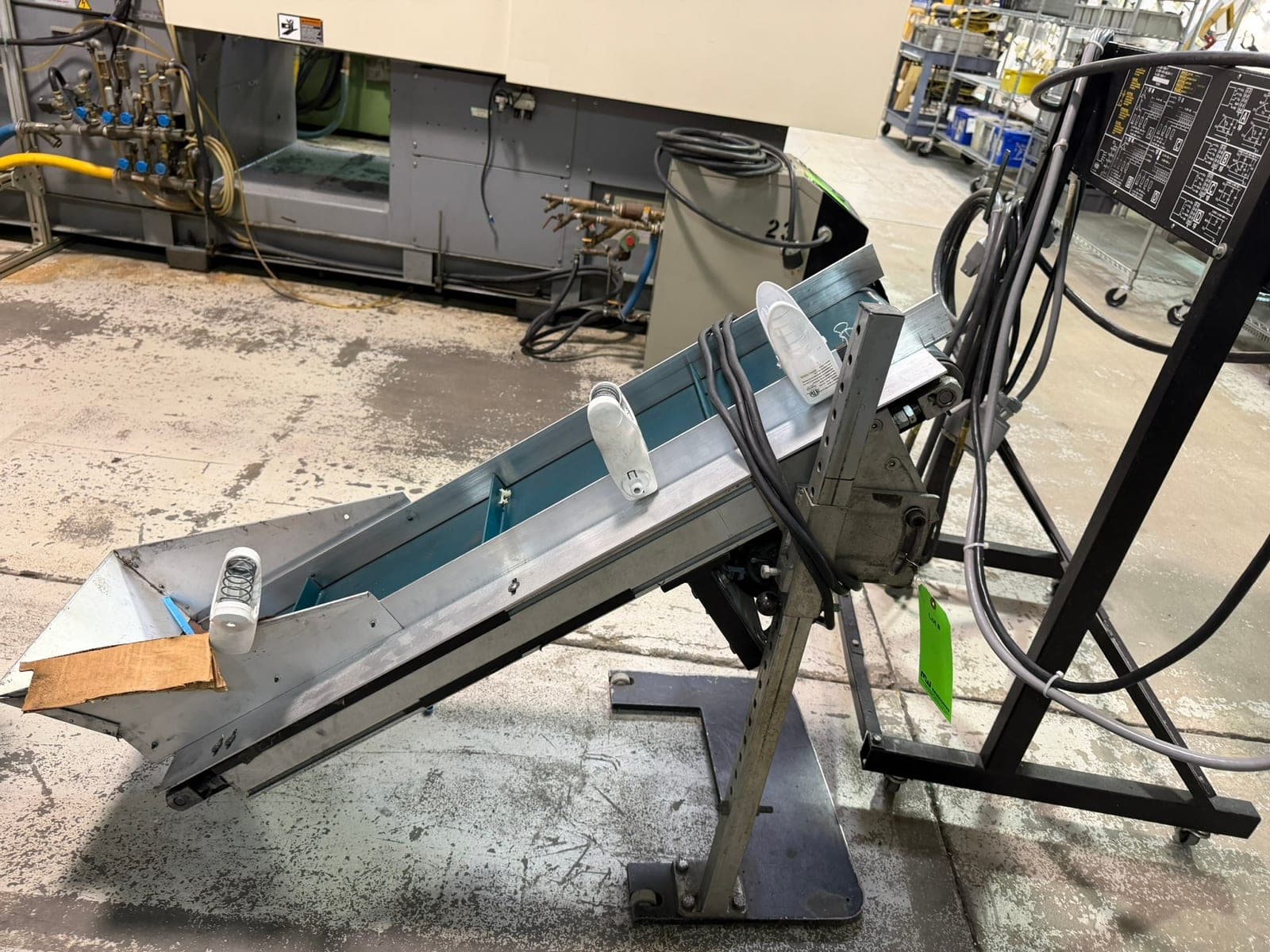
Parts and cartons that have to change height need a frame that climbs. A smooth belt holds a gentle slope and then lets the load slide back. An incline conveyor with cleats is the usual answer once the angle is steep. Hytrol and Dyna-Con are the names that repeat. EMI's adjustable-angle parts frames, set from about 20 to 45 degrees, are the same idea beside a press: a cleated belt, side rails, and a discharge height you specify. Level press-side frames stay with the flat belts. Cartons and molded parts both ride a climb when the cleat is tall enough to catch them and spaced so a carton does not tip.
Discharge height and the floor length you can give the frame set the angle. A steeper angle needs a taller cleat and more torque. Hytrol's Model C uses a slider bed and hardwood cleats about 1 inch high, spaced on about 60 inch centers, and the angle adjusts from horizontal to 45 degrees. Belt widths on that model run about 14 to 30 inches. EMI's Trim Line adjustable-angle frames use about 1.5 inch cleats on 18 inch centers, with belt widths from 6 to 24 inches, a variable speed around 4 to 60 feet per minute, and a load around 50 pounds. Round parts want a cleat tall enough to stop the roll. A stream of small moldings wants closer spacing than a carton. A nose-over, a short level section at the top, lets the part leave instead of launching. Hytrol's SBI incline uses a double nose-over so the transfer back to horizontal is two steps, and that model stops at about 30 degrees. A hopper at the bottom matters when a press drops the load rather than placing it.
Belt width has to clear the part plus the cleat ends. Horsepower is higher than on a flat parts belt because the load is lifted, not only slid. Hytrol specifies motors at 208, 230, 460 or 575 volts, three phase, on the cleated model, while a short EMI parts frame is often 110 volts. Side rails keep a part from walking off as the cleat pushes it. The take-up and tracking still have to be set or the belt walks off on the slope. Casters on a short frame let you roll it to another cell. A fixed frame does not.
Buying a used incline conveyor means matching cleat height, width, discharge height and voltage to the rise you have. A frame from a closure often served one press discharge or one carton lift. Meadoworks draws these climbing frames from plant closures, consignments and auctions. Buyers can inspect the cleats, the drive and the height at the discharge. A bottle and a carton do not share a cleat. Ask what the last plant was lifting.
How to Choose a Used Incline Conveyor
How to Size an Incline Conveyor
Start with the rise, not with the brand. Discharge height has to meet the hopper, the mezzanine or the next belt, and the floor length you have sets the angle. A steeper angle needs a taller cleat and more horsepower. Belt width has to clear the part. Cleat height has to stop that part from rolling back, and cleat spacing has to support a carton without tipping it. Voltage on a longer frame is often 230 or 460 volts, three phase. A hopper at the bottom matters when the press drops parts rather than placing them. A nose-over at the top keeps the discharge from throwing the load. Write height, angle, width and cleat size before you compare two frames.
Cleats, Angle and a Level Belt
A cleated belt climbs. A smooth flat belt does not, once the angle is more than a gentle slope. That is why a climb is a different purchase from the level parts belts. Cleat height and the distance between cleats decide whether your part stays on the belt. Round parts want a taller cleat. Cartons want a spacing that matches the carton. Side rails stop the load walking off. If the path is level, buy a flat belt instead and do not pay for a rise you will not use. Hytrol and Dyna-Con are the frames that repeat when the belt does have to climb.
Incline Conveyor Specs to Compare
| Spec | Typical range | Why it matters |
|---|---|---|
| Incline angle | About 20–45° | The belt has to land at the hopper or the next machine. Angle follows from height and length. |
| Cleat height | About 1–1.5 in | Short cleats let round parts roll back down the belt. |
| Cleat spacing | About 18–60 in centers | A carton that bridges two cleats badly will tip at the discharge. |
| Belt width | About 6–30 in | A narrow belt spills the load the cleat just caught. |
| Drive and voltage | 110 volts, or 208–575 volts | Lifting takes more torque than sliding. Volts have to match the cell. |
| Nose-over and hopper | A nose-over stops the launch. A hopper catches a drop from a press. |
Incline angle
Typical range: About 20–45°
The belt has to land at the hopper or the next machine. Angle follows from height and length.
Cleat height
Typical range: About 1–1.5 in
Short cleats let round parts roll back down the belt.
Cleat spacing
Typical range: About 18–60 in centers
A carton that bridges two cleats badly will tip at the discharge.
Belt width
Typical range: About 6–30 in
A narrow belt spills the load the cleat just caught.
Drive and voltage
Typical range: 110 volts, or 208–575 volts
Lifting takes more torque than sliding. Volts have to match the cell.
Nose-over and hopper
A nose-over stops the launch. A hopper catches a drop from a press.
What to Inspect on a Used Incline Conveyor
Measure discharge height
Confirm the rise matches the hopper or the next belt, and note the angle that creates.
Check cleat height and pitch
Cleats should be tall enough for your part and spaced for the carton or the molding.
Inspect the belt and cleats
Torn cleats and a glazed belt will not hold a load on a slope.
Read horsepower and voltage
The drive has to lift, not only turn. Match volts and phase to the cell.
Look for a nose-over
A level section at the top keeps parts from launching off the discharge.
Check the infeed hopper
A missing hopper lets a press drop miss the belt entirely.
Confirm rails and casters
Rails keep parts on the belt. Casters matter only if you need to move the frame.
Related Equipment
- Conveyors
Belt, roller and incline frames together
- Belt Conveyors
Level parts belts when the path does not climb
- Roller Conveyors
Rollers for cartons that stay on the level
More in Plant & Material Handling
Incline Conveyors Brands We've Sold
Common Applications
Frequently Asked Questions
When do I need an incline conveyor instead of a flat belt?
When the parts or cartons have to change height. A flat belt moves them across the floor. An incline conveyor climbs, and it needs cleats once the angle is steep enough for the load to slide back. Hytrol and Dyna-Con frames are that climb. If the path is level, a flat belt is the better buy. Discharge height, cleat size and belt width are the three facts that decide whether a given frame will do your rise.
How do cleat height and spacing change the buy?
Cleat height stops the part rolling back down the belt. Short cleats fail on round parts. Spacing has to match what you are lifting. A carton that sits badly across two cleats will tip at the top. A stream of small moldings wants closer cleats. Photos should show the cleat, not only the frame. A smooth belt on a steep frame is the wrong machine, and adding cleats later is a belt replacement, not a small adjustment.
How do I size discharge height and angle?
Measure the height you must reach and the floor length you can give the frame. Those two numbers set the angle. A steeper angle needs a taller cleat and a stronger drive. A nose-over at the top lets the part leave on a level section instead of launching. A hopper at the bottom matters when a press drops parts onto the belt. Write the height down before you compare two listings that share a belt width and nothing else.
What should I inspect on a cleated incline?
The cleats, the belt, the drive, the rails and the discharge height. Torn cleats and a belt that has stretched will not track on a slope. Read horsepower and voltage. See whether a nose-over and a hopper are actually there. Casters matter if you plan to move it. A frame that ran cartons may be the wrong cleat for bottles, so ask what it carried. Photos of the belt surface are worth more than a clean side rail.
Are Hytrol and Dyna-Con the same kind of incline conveyor?
They are both cleated or powered inclines, and they are the names that repeat. The model still has to match your height, width and cleat. A short portable frame and a longer fixed conveyor are different installs even under the same make. Read discharge height, belt width and voltage on the nameplate. Do not treat the brand as a substitute for the rise. Judge every frame the same way, whatever the make.
Can an incline conveyor feed a granulator?
Yes, when the cleat can catch sprues or parts and the discharge meets the granulator throat. A hopper at the bottom helps if the press drops rather than places the load. Width has to clear the runner. Horsepower has to lift it. A flat belt under the press is the collection step, and the incline is the climb. Confirm the angle is not so steep that parts tumble back off short cleats. Voltage still has to match the cell.
