Used Portable Dryers for Sale
1 result
Looking for Something Specific?
Most of our inventory sells before we can list it online. If you need a specific brand, model, or specification, tell us what you need—we have access to unlisted equipment and machines coming in from plant closures.
Looking to Sell?
Meadoworks is an active cash buyer of used industrial equipment. Get a free valuation from our AMEA-certified appraisers.
About Used Portable Dryers
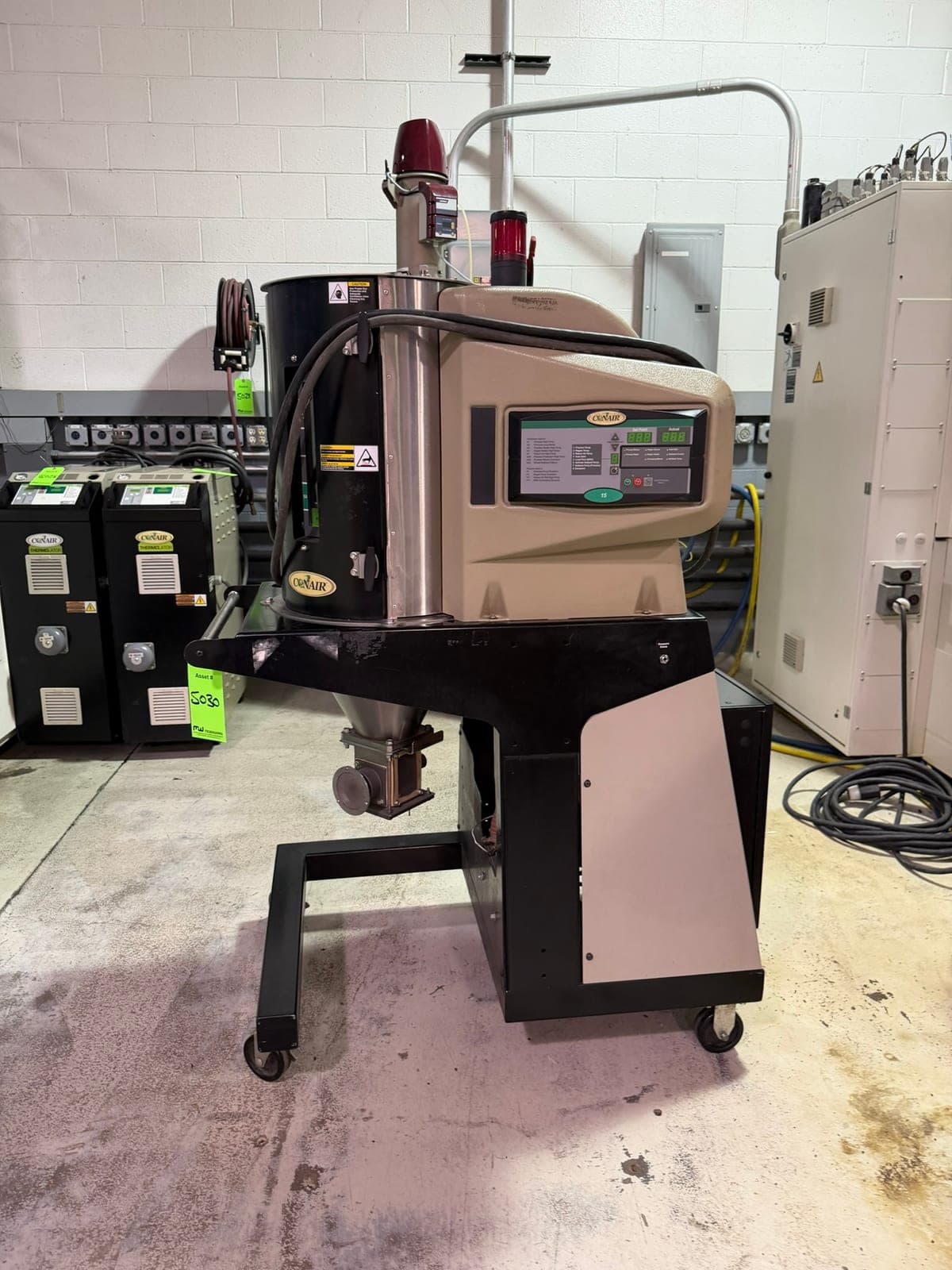
A portable dryer is a desiccant dryer and a drying hopper on one cart, rolled up to a single press. It makes its own dry air and holds the pellets long enough to use that air. A press-side dryer and a cart dryer are the same idea. It is not a central dryer feeding a manifold of hoppers, and it is not a hot-air gun on a drum. Two-bed carts in the Dri-Air APD class publish dew points down to about -49 F. A four-bed cart can go much lower, which matters in a humid room or on a resin that is hard to dry. The hopper, not the dew-point number alone, sets the hours the pellets can stay hot. The smallest APD pairs a 30 lb hopper with a published rate near 7.5 lb per hour. Divide hopper pounds by your press rate and you have residence time. If that time is shorter than the resin sheet, the pellets leave wet even when the air looks excellent.
Airflow has to heat the whole hopper, not just the sight glass. A spreader cone keeps dried pellets from sitting in a dead corner at the bottom. Hoses are short on purpose. A long bare hose gives the dry air back to the room before it reaches the cone. Voltage on these carts is three phase, commonly 208, 230, 400, 480 or 600. A cart on the wrong bus will not make temperature. Regeneration has to finish. On these dual-bed designs a slip of already-dry process air regenerates the offline bed, so a humid room does not reload the desiccant the way ambient air would. A closed-loop loader, when the cart has one, conveys with dry air so shop air does not wet the pellets on the way to the throat. Temperature setback drops the heat when material sits too long, which is how nylon gets brittle from over-drying.
The cart parks beside the press. A loader fills the hopper and the screw takes the bottom. A central dryer is the shared air source when several machines should dry one resin. A desiccant cabinet without a hopper on the same frame is a different mount. This cart does not blend and it does not chill. Keep the delivery hose short and insulated. One small hopper cannot feed five presses.
Press-side carts leave when a molder stops running nylon or PET on that machine. On a used portable dryer, bring the hopper to temperature and read dew point, then watch one regeneration cycle. A cart that only proves the steel gets warm has not shown the desiccant is alive. Confirm the hopper and the loader lid are in the sale. A bare air unit is not a dryer you can run tomorrow.
How to Choose a Used Portable Dryer
How to Size a Portable Dryer
Pick hopper pounds from the press rate times the hours the resin sheet demands. That is the residence time, and a portable dryer cannot invent hours it does not have volume for. Then match airflow and heater size so the core of that hopper actually reaches temperature, not only the outlet air. Dew point has to hold while the hopper is full. A cart that looks large and holds thirty pounds will not dry a fast PET press. Hose length has to stay short. Voltage has to be the cell voltage. If two presses need the same dry resin all day, stop sizing carts and look at a central dryer. One cart, one press, is the layout this machine is for.
Portable Dryer or Central Dryer
The cart carries desiccant and a hopper to one machine and leaves the rest of the plant alone. A central dryer makes dry air in one place and sends it to several hoppers. Choose the portable dryer when a single press runs the hygroscopic resin, the hopper pounds fit the cart, and you want to roll the setup away. Choose the central dryer when a bay shares one resin and you will maintain a manifold. A cart on every press duplicates filters, beds and heaters. That is fine for a job shop. It is a poor plan for ten machines on the same nylon. Both mounts still dry with desiccant. A cart dryer is the press-side name.
Portable Dryer Specs to Compare
| Spec | Typical range | Why it matters |
|---|---|---|
| Hopper capacity (lb) | Often about 30–150 lb on a cart | Pounds divided by press rate are the hours of drying you actually bought with the cart itself. |
| Dew point (F) | Often about -40 F | The air has to be dry at temperature, or the small hopper is only a warm storage bin. |
| Process airflow | Has to turn the hopper over so the core, not just the sight glass, reaches the drying temperature. | |
| Drying temperature (F) | Set from the resin, and the heater on the cart has to be able to hold it with the hopper full. | |
| Desiccant style | Beds or a wheel both work, and the valves or the drive are what you will actually service. | |
| Supply voltage | Often 460 V, 3 phase | A cart on the wrong voltage will not make heat, regardless of how good the desiccant media is. |
Hopper capacity (lb)
Typical range: Often about 30–150 lb on a cart
Pounds divided by press rate are the hours of drying you actually bought with the cart itself.
Dew point (F)
Typical range: Often about -40 F
The air has to be dry at temperature, or the small hopper is only a warm storage bin.
Process airflow
Has to turn the hopper over so the core, not just the sight glass, reaches the drying temperature.
Drying temperature (F)
Set from the resin, and the heater on the cart has to be able to hold it with the hopper full.
Desiccant style
Beds or a wheel both work, and the valves or the drive are what you will actually service.
Supply voltage
Typical range: Often 460 V, 3 phase
A cart on the wrong voltage will not make heat, regardless of how good the desiccant media is.
What to Inspect on a Used Portable Dryer
Read dew point hot
A portable dryer that only proves the hopper gets warm has not shown that the desiccant is still drying.
Watch regeneration
The offline bed has to heat and return, or the cart will miss dew point after the first hour of production.
Weigh the hopper logic
Confirm the pound rating and compare it with your rate, because a pretty cart can still be short on time.
Inspect hoses
Crushed or bare hose between the dryer and the cone throws away the dryness the beds just made.
Check bed valves
A valve that does not seat mixes wet regeneration air into the process and the dew point will not settle.
Look at the desiccant
Dust and broken beads channel the air, and the portable dryer will miss spec with new heaters.
Match the voltage
Read the plate against the press before the cart is wheeled in, or the heaters are the wrong machine.
Related Equipment
- Desiccant Dryers
Cabinets and carts that dry by desiccant
- Central Dryers
One dryer feeding several hoppers
- Resin Dryers
Portable, central and desiccant together
Portable Dryers Brands We've Sold
Common Applications
Frequently Asked Questions
How do I size a portable dryer hopper for residence time?
Multiply pounds per hour by the hours the resin must stay hot. That product is the hopper size the portable dryer needs, plus a little freeboard. A cart with a small hopper and a lovely dew point still releases wet pellets if they leave too soon. Match airflow so the core gets hot, not only the air at the outlet. Keep hoses short. If the number is larger than a cart can hold, you want a central dryer and a real hopper, not a bigger slogan on the same frame.
Portable dryer or central dryer, which dries one press?
The cart. It brings desiccant and a hopper to that machine and does not feed the bay. A central dryer is one air source and several hoppers, right when many presses share a resin. Use the portable dryer for a single engineering-resin job you may roll away. Use the central dryer when the manifold is justified and someone will maintain it. Buying a cart for every press duplicates beds and filters. That can be correct in a job shop and wasteful on a dedicated nylon bay.
What should I inspect on a used portable dryer?
Bring the hopper up to temperature and read dew point. A portable dryer that merely gets warm may have tired desiccant, a bad valve or a dead regeneration heater. Watch one regeneration cycle. Inspect hoses and the cone. Look for dust in the beds. Read volts and hopper pounds against your rate. A cart without its hopper is an air unit, not a dryer you can run tomorrow. Ask what resin it last dried so you know whether the setpoint hardware matches.
Does a portable dryer include its own desiccant?
Yes. That is the point of a portable dryer. The beds or the wheel ride on the cart with the hopper, so you are not tying into a plant air manifold. You still have to confirm the media is alive. Dew point under load is the test, not the presence of a canister. A central dryer also uses desiccant, but it shares that air across hoppers. If the sale is a hopper only, it is not a dryer you can run tomorrow.
Why is a portable dryer still wet at the feed throat?
Residence time is short, the hose is long and bare, the lid leaks, or the dew point has climbed because regeneration is not finishing. A portable dryer can show a good number at the bed and still deliver damp pellets if the cone never got hot. Check pounds versus rate before you condemn the desiccant. Insulate the hose. Seat the valves. A wet gaylord needs the hours on the resin sheet, not the hours you wish you had. The throat only reports what the hopper failed to finish.
Can a portable dryer run nylon and PET?
It can run either if the hopper pounds cover that resin's time and the heater reaches that resin's temperature. It should not be asked to hop between them every hour without a cleanout, because the setpoint and the dryness target differ and leftover pellets contaminate the next job. A portable dryer sized for a slow nylon press may be too small for a faster PET press. Read both sheets. When the bay runs one of them all week on several machines, a central dryer is the calmer layout.
