Used Roll Formers for Sale
Recently sold
Looking for Something Specific?
Most of our inventory sells before we can list it online. If you need a specific brand, model, or specification, tell us what you need—we have access to unlisted equipment and machines coming in from plant closures.
Browse Used Roll Formers by Brand
Browse Used Roll Formers by Country
Looking to Sell Your Roll Formers?
Meadoworks is an active cash buyer of used industrial equipment. Get a free valuation from our AMEA-certified appraisers.
About Used Roll Formers
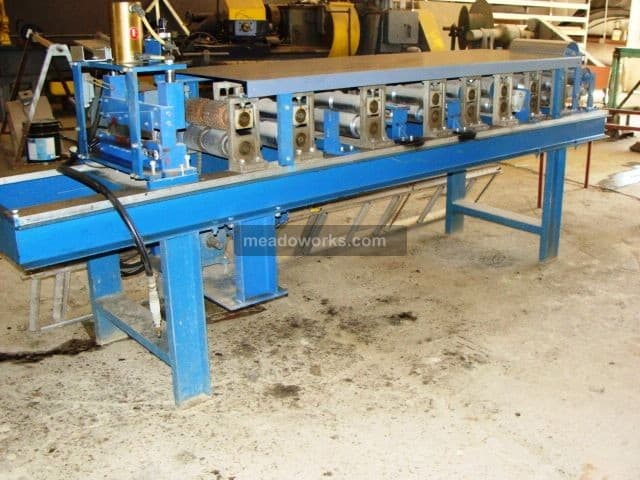
Roll forming machines continuously bend coil stock through a series of progressive roller dies to produce uniform cross-section profiles. Roll forming lines are used to manufacture metal roofing panels, wall panels, steel studs, door frames, highway guardrails, shelving, and countless other metal profiles at high production speeds.
Key specifications include material width and thickness capacity, number of forming stations, line speed, and cut-off type (flying shear or press). Complete roll forming lines include uncoilers, straighteners, forming stations, and cut-off systems. Custom tooling sets allow a single machine to produce multiple profiles.
Knudson Manufacturing roll formers have moved through Meadoworks. Contact us at 800-323-0307.
How to Choose a Used Roll Former
The Profile, the Stands and the Line
A roll former is bought for a profile. Start with the part: the shape, the coil width, the material and the gauge range. Count the forming stands the profile needs and check that the tooling on the machine makes your profile, or budget for new rolls, which can cost as much as the machine.
Then look at the line around it: decoiler, entry guide, pre-punch or notching, the cutoff (flying or stop-to-cut) and the run-out table. Line speed matters for long runs; quick-change rafts or side-by-side tooling matter if you run several profiles.
By Class: Typical Used Roll Formers Price Ranges
Single-profile roll formers for studs, trim and soffit: about $15,000–$75,000.
Complete panel and roofing lines with decoiler and cutoff: about $60,000–$250,000.
Heavy structural and multi-profile lines: about $150,000–$500,000.
What moves the price — whether the tooling makes a profile you sell, the number of stands, gauge range, line speed, the cutoff and punching, the decoiler and the controls.
These are typical used-market ranges, not a quote on any one machine. For a current figure on a specific machine, request a quote or call 800-323-0307.
By brand
Knudson Manufacturing roll formers have moved through Meadoworks, including a stud roll former and a K-Former tooled for soffit panels.
Meadoworks track record
Our roll forming record is Knudson machines for steel studs and soffit panels. Tell us the profile, gauge and coil width and we will look for a matching line.
Roll Former Specs to Compare
| Spec | Typical range | Why it matters |
|---|---|---|
| Coil width | Often 6–48 in | Sets the widest strip the stands accept. |
| Gauge range | Often 26–12 gauge | Sets the thinnest and thickest material the tooling forms. |
| Forming stands | Often 8–24 stands | Complex profiles need more passes. |
| Line speed | Often 50–200 ft/min | Sets output on long runs. |
| Cutoff | Flying or stop-to-cut | A flying cutoff keeps the line running; stop-to-cut is simpler. |
Coil width
Typical range: Often 6–48 in
Sets the widest strip the stands accept.
Gauge range
Typical range: Often 26–12 gauge
Sets the thinnest and thickest material the tooling forms.
Forming stands
Typical range: Often 8–24 stands
Complex profiles need more passes.
Line speed
Typical range: Often 50–200 ft/min
Sets output on long runs.
Cutoff
Typical range: Flying or stop-to-cut
A flying cutoff keeps the line running; stop-to-cut is simpler.
What to Inspect on a Used Roll Former
Run a part
Form your profile and check its dimensions, twist and flare at the cut.
Inspect the rolls
Look for scoring, chips and worn edges on the tooling.
Check the drive
Listen to the gearbox and chains and look for worn sprockets.
Test the cutoff
Cut to length at speed and check the length tolerance and burr.
Run the decoiler
Check the brake, mandrel and threading.
Confirm the tooling list
Get the profile drawings and every roll set included.
Related Equipment
- Used CNC Press Brakes
Brakes with a programmed backgauge
- Used Hydraulic Press Brakes
Hydraulic brakes by tonnage and length
- Used Plate Rolls
Roll plate into cylinders and cones
- Used Hydraulic Presses
Forming, punching and assembly presses
Types of Metal Forming & Presses
Common Applications
Frequently Asked Questions
What is roll forming?
Roll forming is a continuous bending process where coil stock passes through a series of roller dies, each progressively shaping the material until the desired cross-section profile is achieved. It's the most efficient method for producing long runs of uniform metal profiles such as roofing panels, steel studs, and structural channels.
How much does a used roll forming machine cost?
Typical used ranges run about $15,000–$75,000 for single-profile machines for studs, trim and soffit, about $60,000–$250,000 for complete panel and roofing lines with decoiler and cutoff, and more for heavy structural lines. Whether the tooling makes a profile you sell is the biggest factor; call 800-323-0307 for a current figure.
Can I change the profile on a used roll former?
Yes, by changing the roll tooling, but new rolls for a complex profile can cost as much as a used machine. Check the shaft diameter, stand spacing and number of stands to see whether a new profile fits, and ask a tooling designer to confirm before buying a machine for a profile it was not built for.
What should I check on a used roll former?
Run your profile and check its dimensions, twist and flare at the cut. Inspect the rolls for scoring and chipped edges, listen to the drive and gearbox, and test the cutoff at speed for length and burr. Run the decoiler, and get the profile drawings and a list of every roll set included.
What is the difference between roll forming and press brake bending?
A press brake bends one part at a time between a punch and die and suits short runs and varied parts. A roll former bends coil continuously through a row of roll stands into one profile, which suits long runs of the same shape such as studs, panels and channels at a far lower cost per foot.
Related Resources
Need Help Finding the Right Equipment?
Contact our team with your specifications and we'll help you find the right machine.
