Used Cooling Towers for Sale
See all 6 Chillers & Cooling Towers →
Nothing is listed right now — these are machines we've recently sold. or tell us what you need.
Recently sold
 SOLD
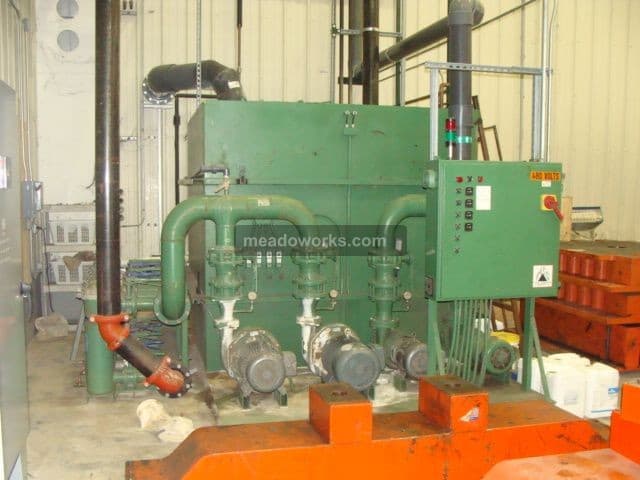
SOLDMarley 144002-1/B221584/4871 / Cooling Tower and Pump Tank
USA
 SOLD
SOLD1987 Baltimore Aircoil VXTW3100
USA
 SOLD
SOLD1992 Baltimore Aircoil VXT470
USA
 SOLD
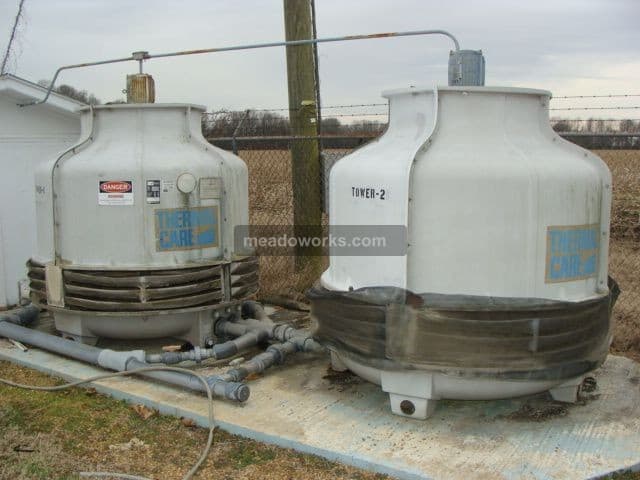
SOLDThermal Care FT8220
USA
 SOLD
SOLD2000 Thermal Care FC740/PT3500
USA
Looking for Something Specific?
Most of our inventory sells before we can list it online. If you need a specific brand, model, or specification, tell us what you need—we have access to unlisted equipment and machines coming in from plant closures.
Looking to Sell?
Meadoworks is an active cash buyer of used industrial equipment. Get a free valuation from our AMEA-certified appraisers.
About Used Cooling Towers
A cooling tower rejects heat from plant water by evaporating a little of that water into outdoor air. It is not a chiller and it has no refrigerant circuit. Fill, a fan, a basin and a distribution header do the work. Warm water meets air, leaves cooler, and returns to water-cooled chillers, hydraulics or other process loads. Approach is how close the leaving water gets to the wet-bulb temperature of the entering air. That weather number is the ceiling. Leaving water cannot beat the wet bulb. Baltimore Aircoil's nominal ton, an HVAC reference point, is 3 gpm cooled from 95 F to 85 F at a 78 F wet bulb. That is a 10 degree range and a 7 degree approach. Your weather and your chiller setpoint may not match those numbers, so a nominal ton copied off a chiller plate is not a selection.
Induced-draft axial fans usually sit on the top deck and pull air through the fill. A centrifugal fan can overcome a little external static pressure and is the one that can live indoors. Crossflow sends water down while air moves across. Counterflow sends air up against the falling water. Gravity basins on a crossflow cell need little extra pump head and can be looked at while the fan runs. Spray nozzles on a counterflow cell want about 2 to 7 psi at the inlet, and you shut the cell down to inspect them. Clogged or collapsed fill is lost capacity. Drift eliminators keep droplets in the basin instead of on the lot. Standard fill on these cells is generally rated for entering water up to about 120 F. Hotter water wants a different fill. Blowdown and treatment decide whether the fill stays open or scales shut. Gallons per minute have to match the pumps and the machines on the loop. Size a cooling tower on flow, range and wet bulb together.
The cell sits outdoors, upstream of the water-cooled machines and apart from any cabinet that carries its own air coil. An air-cooled chiller rejects heat at that coil and needs no basin. A portable chiller that is water-cooled needs this loop. One that is air-cooled does not. A thermolator can borrow tower water on a mild day and still does not hold a mold setpoint by itself. Do not buy a tower to replace a chiller. The chiller makes cold water. The tower only gives that heat somewhere to go. An evaporative tower, the process cooling tower on a plant loop, is the center of a tower water system.
A yard move is how one of these changes hands, basin and fan still paired with a pump tank. On a used cooling tower, open the casing and look at the fill, the fan, the basin and the drift eliminators. Paint on the skin does not cool water. Read the plate for flow and temperatures, and ask the design wet bulb. Without that weather number you cannot tell whether the cell fits your site.
How to Choose a Used Cooling Tower
How to Size a Cooling Tower
Match flow and the temperatures you need, not a single ton number copied from a chiller. A cooling tower is selected for gallons per minute cooled across a range, at a wet-bulb temperature your weather actually hits. Leaving water cannot be colder than that wet bulb plus the approach the fill can manage. If the chiller wants 85 F water and your design wet bulb is already 80 F, the tower has very little room. Add the loads that will run together, including water-cooled chillers and any machine on tower water. Fan horsepower and cell count follow that duty. Treatment, blowdown and freeze protection are part of the size, because a tower that scales up is no longer the tower you calculated.
Cooling Tower or an Air-Cooled Chiller
The cell rejects heat by evaporation and wants a water circuit, treatment and a basin. An air-cooled chiller rejects heat at a coil on the cabinet and needs none of that, and it leaves warmer air and fan noise indoors or beside the wall. Choose the cooling tower when the load is large, several machines share water, and someone will maintain chemistry. Choose the air-cooled cabinet when you will not own a tower. A water-cooled chiller without a tower has nowhere to send condenser heat. A tower without a chiller can still cool hydraulics and some process loops, and it still is not a refrigerant machine. Portable air-cooled cabinets are the no-tower option at the press. An evaporative cell is a process cooling loop and the center of a tower water system.
Cooling Tower Specs to Compare
| Spec | Why it matters |
|---|---|
| Flow (gpm) | Has to match the pumps and the chillers on the loop, or the tower is either starved or flooding. |
| Range (F) | The drop from entering water to leaving water is the heat the fill is actually taking out per hour. |
| Approach to wet bulb (F) | Leaving water can only get so close to the weather, and a tighter approach needs more tower. |
| Fan (hp) | Air across the fill is the other half of capacity, and a dead fan is a warm basin. |
| Fill and drift eliminators | Clogged fill and missing eliminators cut performance and throw water out of the casing onto the pad. |
| Basin and connections | The cold-water basin, the makeup and the outlet have to match the pump tank you will actually pipe. |
Flow (gpm)
Has to match the pumps and the chillers on the loop, or the tower is either starved or flooding.
Range (F)
The drop from entering water to leaving water is the heat the fill is actually taking out per hour.
Approach to wet bulb (F)
Leaving water can only get so close to the weather, and a tighter approach needs more tower.
Fan (hp)
Air across the fill is the other half of capacity, and a dead fan is a warm basin.
Fill and drift eliminators
Clogged fill and missing eliminators cut performance and throw water out of the casing onto the pad.
Basin and connections
The cold-water basin, the makeup and the outlet have to match the pump tank you will actually pipe.
What to Inspect on a Used Cooling Tower
Inspect the fill
Crushed, scaled or slime-covered fill is lost capacity, and it is the first rebuild to plan before a restart.
Spin the fan
A cooling tower fan with bad bearings, a cracked stack or a backward rotation will not hold leaving temperature.
Look at the basin
Sludge, a rusted outlet or a heater that does not work becomes a freeze or a pump problem in season.
Check drift eliminators
Missing eliminators throw treated water off the tower and onto the roof or the lot.
Read the plate
Flow, temperatures and fan data on the plate are the duty, and a missing plate means you must measure.
Confirm makeup and blowdown
A tower with no makeup control or no blowdown plan will scale the fill you just cleaned.
Match the pumps
Gpm and head have to agree with the loop, or the cooling tower you bought is hydraulically the wrong cell.
Related Equipment
- Air-Cooled Chillers
Cabinet condensers when you will not run a tower
- Portable Chillers
Press cabinets that may need tower water
- Chillers & Cooling Towers
Towers, portable cabinets and air-cooled units
Cooling Towers Brands We've Sold
Common Applications
Frequently Asked Questions
How do I size a cooling tower for plant heat?
Write down gallons per minute, the entering and leaving temperatures, and the wet-bulb air your site actually sees. A cooling tower is picked on that set, not on a chiller ton number alone. Leaving water has to stay warmer than the wet bulb by whatever approach the fill can do. Add every load that runs together. Fan horsepower follows. If the weather and the chiller setpoint leave almost no gap, you need more tower or a different water temperature. Treatment and freeze protection belong in the same decision.
Cooling tower or chiller, which one rejects heat to the air?
Both can, in different ways. A cooling tower rejects heat by evaporation to outdoor air and does not contain a refrigerant compressor. An air-cooled chiller rejects heat at a dry coil and makes cold water by refrigeration. A water-cooled chiller needs the tower. The tower does not replace the chiller when you need water colder than the weather allows. Heat rejection outdoors is the basin and the fan. The air-coil cabinet is the choice when you will not maintain that basin.
What should I inspect on a used cooling tower?
Open it. Fill, fan, basin and drift eliminators tell you whether a cooling tower will perform, and the casing paint does not. Turn the fan and listen. Look for scale, slime and a rusted cold-water outlet. Read the plate for flow and temperatures. Find makeup and blowdown. A tower with collapsed fill is a reconstruction, not a bargain fan. Ask the design wet bulb. Without it you cannot tell whether the cell fits your weather.
What does approach mean on a cooling tower?
Approach is how many degrees the leaving water sits above the entering wet-bulb temperature. A cooling tower cannot cool below the wet bulb, and a smaller approach means a larger, more capable tower. A nameplate that shows water from 95 F to 85 F at a 78 F wet bulb is a 7 degree approach. Your weather may not be 78 F. If your chiller needs colder water than the tower can approach, no fan setting fixes the physics. Size to your wet bulb, not to someone else's city.
Why does a cooling tower run warm in humid weather?
The wet bulb rose, so the same approach lands at a warmer leaving temperature. A cooling tower is an evaporative machine and humidity is the limit. Dirty fill, a slow fan or a starved water distribution make it worse and should be fixed, but they are not the only limit on a muggy afternoon. Do not expect winter water temperatures in July. If the process cannot accept the summer leaving water, you need more tower, a chiller setpoint change, or an air-cooled path that you have already rejected.
Does a cooling tower replace an air-cooled chiller?
No. A cooling tower is heat rejection for a water loop. An air-cooled chiller is a refrigerant machine with its own coil. You can choose the tower plus a water-cooled chiller, or you can choose the air-cooled chiller and skip the basin. The tower does not make chilled water by itself. It can cool a hydraulic loop or condenser water. If the goal is mold water at a controlled cold setpoint, you still need a chiller, and the tower only helps the water-cooled kind.
