Used Servo Robots for Sale
See all 19 Robots & Sprue Pickers →
2 results
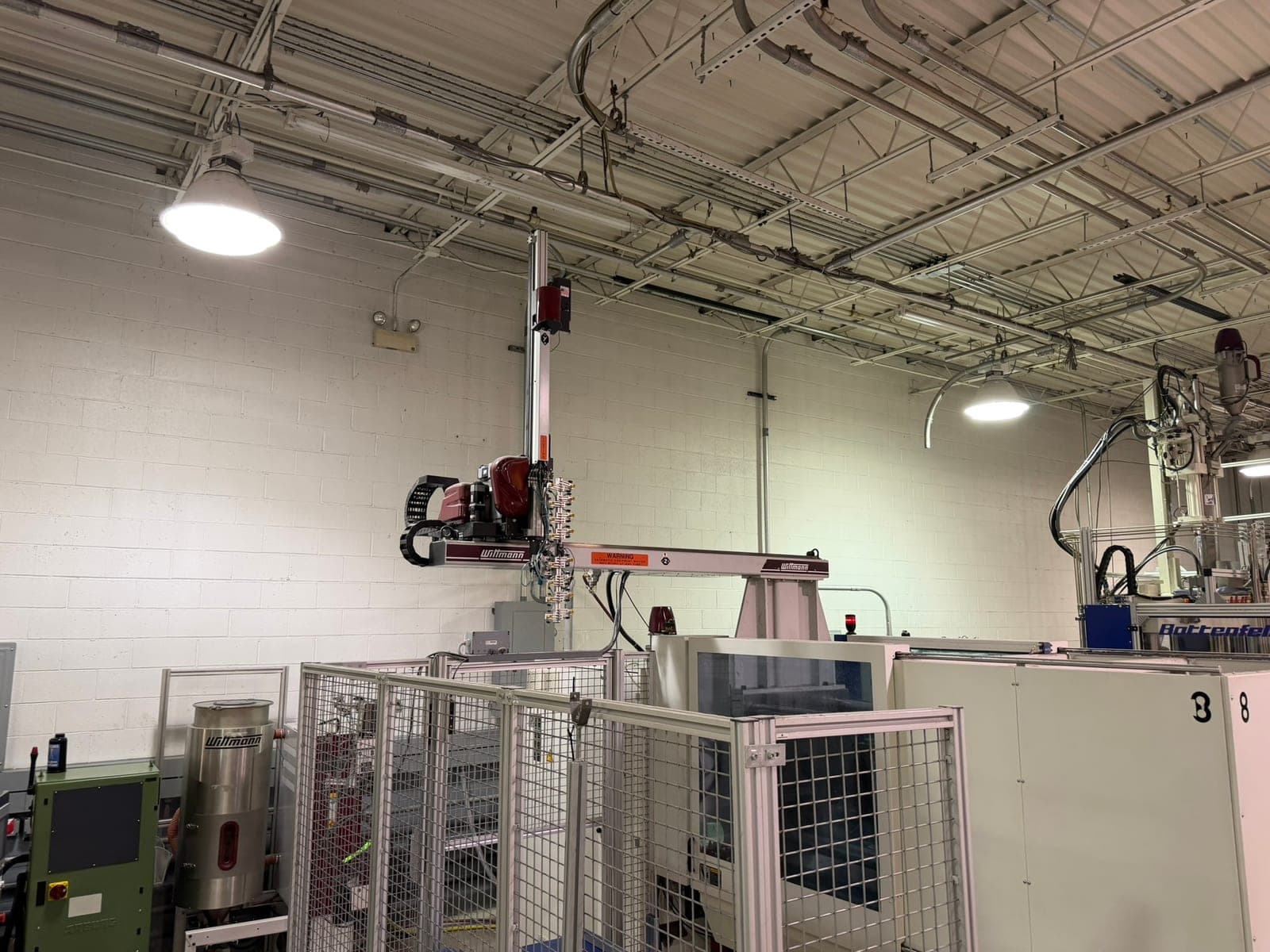
Lot 80
2015 Wittmann CNC Traverse Robot w/Safety Guard Cell
Naperville, IL
Live auction · Tue, Oct 27, 10:00 AM CT

Sepro SR 3600 S7 Trans DB Servo Robot (2013)
USA
Looking for Something Specific?
Most of our inventory sells before we can list it online. If you need a specific brand, model, or specification, tell us what you need—we have access to unlisted equipment and machines coming in from plant closures.
Looking to Sell?
Meadoworks is an active cash buyer of used industrial equipment. Get a free valuation from our AMEA-certified appraisers.
About Used Servo Robots
A servo robot is a Cartesian beam that rides above the injection clamp, reaches into the open mold and sets the part down on a programmed path. Servo motors drive the three main axes, so the hand returns to the same point every cycle. A pneumatic swing cannot do that. The same machine is also called a traverse robot, a cartesian robot or a beam robot. It is not a sprue picker, and it is not an articulated arm standing on the floor. Vertical travel, the demold move out of the tool, and the traverse along the beam are the three moves a basic takeout has to finish inside mold-open time. Payload is the part plus the end-of-arm tool, the cups, the nippers and the hoses on the hand.
Wittmann treats clamp tonnage as a first cut, then checks stroke. A fixed demold axis suits smaller presses, about 20 to 300 tons. A movable demold axis, from about 300 to 1,200 tons, leaves room for a heavier gripper and keeps overall height down. Those frames are still a servo robot. A telescopic vertical arm fits a low ceiling. A single-stage arm is simpler and taller. On a horizontal stroke of about 3 m or more, the drive is often rack and pinion rather than a belt, so the belt cannot stretch and lose position. A pneumatic wrist flips the part through a right angle. A servo wrist adds rotation when the part must turn inside the mold, and an extra rotary axis can take a kilogram or two off the published payload. Sepro prints capacity as parts plus tooling: about 6 kg on a small five-axis Success, 10 kg on the next size, and 15 to 20 kg on a mid-size frame, with horizontal stroke growing in 500 mm steps. Dual arms serve a three-plate tool, one hand for the part and one for the runner.
The unit bolts to the fixed platen or across the tiebars. A sprue picker is the right takeout when only the runner must leave and the part can drop. A six-axis arm is the right machine when the path is insert loading, a box on the floor or a reach the beam cannot make. A five-axis wrist on a Cartesian frame can cover some of those motions and still enter the mold on a straight line, which is faster than an articulated path. Do not hang a traverse on a press whose tie-bar spacing is wider than the beam can clear.
Presses that leave a closed plant often still carry the beam that ran on them. On a used servo robot, home every axis, watch a full traverse and test vacuum at the cups. A pendant that lights up is not a homing cycle. Glazed belts, dry rails or a dry rack will walk the gripper into the steel even when the numbers on the teach box look right. Ask whether the program and the end-of-arm tool come with the arm before you plan the first mold. Record strokes against your tie bars, not against the press it left.
How to Choose a Used Servo Robot
How to Size a Servo Robot
Measure tie-bar spacing, mold width and the vertical distance from the beam to the part. Those three numbers pick the servo robot, not the marketing tonnage band alone. Traverse stroke has to clear the mold and reach the drop or the conveyor. Payload has to include the tooling. A 5 kilogram part with a 8 kilogram gripper is a 13 kilogram job. Vacuum cups, nippers and cooling tubes count. If the ceiling is low, you need a telescoping vertical axis. Mold-open time has to fit the slowest move you will teach. Controls should be something your technicians will actually edit. A robot that fits the press and cannot be retooled for the next mold is a one-job machine.
Servo Robot or Sprue Picker
The beam takes the part and can place it, degate it or set it in a nest. A sprue picker swings in for the runner and gets out. Choose the servo robot when the part must not drop, when you load inserts, or when the cycle includes a second motion. Choose the picker when the part falls free and you only need the sprue gone. The beam asks for more teach time and more guarding. It earns that when dropped parts or a slow operator are the problem you are solving. A six-axis arm is the next step when the path leaves the top of the press. Do not buy the beam for a runner. A beam robot is this same traverse.
Servo Robot Specs to Compare
| Spec | Typical range | Why it matters |
|---|---|---|
| Traverse stroke (mm) | Has to span the clamp and still reach a conveyor or a chute parked outside the mold face. | |
| Vertical stroke (mm) | Has to reach the part at mold open and retract above the tool before the clamp closes again. | |
| Payload (kg) | Includes the end-of-arm tool, cups and nippers, not only the part weight printed on the drawing. | |
| Axes | Often 3, plus an optional wrist | Three axes take a part out, and a servo wrist is what rotates it inside a complicated mold. |
| Wrist | A flip is enough for many drops, and a servo wrist is for insert work and odd orientations. | |
| Supply voltage | The cabinet has to match the press bus, and the air supply has to feed the gripper every cycle. |
Traverse stroke (mm)
Has to span the clamp and still reach a conveyor or a chute parked outside the mold face.
Vertical stroke (mm)
Has to reach the part at mold open and retract above the tool before the clamp closes again.
Payload (kg)
Includes the end-of-arm tool, cups and nippers, not only the part weight printed on the drawing.
Axes
Typical range: Often 3, plus an optional wrist
Three axes take a part out, and a servo wrist is what rotates it inside a complicated mold.
Wrist
A flip is enough for many drops, and a servo wrist is for insert work and odd orientations.
Supply voltage
The cabinet has to match the press bus, and the air supply has to feed the gripper every cycle.
What to Inspect on a Used Servo Robot
Home every axis
A servo robot that will not home, or that faults on the first traverse, has an encoder, a belt or a drive problem.
Inspect belts and rails
Glazed belts and dry rails lose position, so the gripper hits the mold even when the program looks right.
Test vacuum and grip
Cups that do not hold and fingers that do not close will drop the part on the first cycle.
Check the end-of-arm tool
Missing tooling, cracked plates or unlabeled air lines mean you are buying an arm, not a working takeout.
Read strokes against the press
Traverse and vertical numbers have to clear your tie bars and your mold, not the press it was removed from.
Power the pendant
A dead teach box or a control you cannot unlock leaves a mechanically good servo robot idle.
Review the guarding
The beam and the drop zone need a guard that matches this stroke, or the press will not be safe to run.
Meadoworks Track Record
21
Sold through Meadoworks
2
Listed now
Makes we have handled most
Wittmann, Yushin, Sepro, Ranger Automation Systems, Star Automation
Common models
Wittmann W818 - 3-Axis Servo, Sepro PIP-3031 BZ 3-Axis Servo, Star Automation TW-1400VII-520A, Yushin RAII-a-150 - 3-Axis Servo
Related Equipment
- Sprue Pickers
Swing-arm takeout when only the runner must leave
- 6-Axis Robots
Floor arms when the path leaves the beam
- Robots & Sprue Pickers
Pickers, traverse robots and articulated arms
Servo Robots Brands We've Sold
Common Applications
Frequently Asked Questions
How do I size a servo robot for tie-bar spacing?
Measure the horizontal span the beam must travel, the vertical reach down to the part, and the demold stroke out of the tool. A frame sized only by press tonnage often misses a wide platen or a tall mold. Add the end-of-arm tool to the part weight before you read payload. Telescoping vertical arms matter when the ceiling is low. Mold-open time has to contain the slowest move. If the traverse cannot park outside your tie bars, the servo robot does not fit, whatever the tonnage band says.
When does a cell need a servo robot instead of a sprue picker?
When the part itself must be taken, placed, degated or kept from dropping. A sprue picker only swings out with the runner. The traverse over the clamp has a real path and a real payload. Choose the picker if the part falls free and the cycle is only about clearing a sprue. Choose the servo robot for inserts, stacking or a conveyor. A six-axis arm comes later, when the path cannot live on the beam. Do not buy the traverse for a runner.
What should I inspect on a used servo robot?
Home the axes, watch a traverse and listen for a belt slap. A servo robot with glazed belts, dry rails or a drive fault will not repeat, and it will hit a mold. Test vacuum and the gripper. Confirm the end-of-arm tool is present and labeled. Read strokes against your tie bars, not against the press it left. Power the pendant and make sure you can edit a line. Ask whether the last program and the tooling are included. An arm that only lights up is not inspected.
What payload should a servo robot carry with tooling?
Add the part, the plate, the cups, the nippers and any cooling or sensors on the hand. A plate that says 10 kilograms is not a 10 kilogram part if the tool weighs 6. Vacuum circuits and a sprue nipper count. If you will add a second arm for a three-plate mold, add that mass too. Leave margin so the vertical axis is not at its stop on every cycle. An overloaded servo robot loses repeat and wears belts. Weigh the hand you intend to bolt on.
Can a servo robot load inserts?
Yes, if the wrist and the end-of-arm tool are built for it and the mold-open time allows the extra motion. A simple flip wrist on a servo robot can place a straightforward insert. A complicated orientation wants a servo wrist and a fixture. The beam still has to reach the cavity. If the insert path leaves the top of the press or shares space with a box, a six-axis arm may be the better machine. Do not assume a takeout gripper can pick an insert without a redesign.
Why does a servo robot lose position after a belt change?
The new belt was tensioned wrong, the home offset was not set, or the pulley was installed a tooth off. A servo robot will then traverse to a number that is no longer the mold. Re-home, confirm tension and re-teach the critical points rather than nudging one line. Dry rails and a loose encoder coupling cause the same drift without a belt change. If it lost position before anyone touched a belt, look at the drive alarm and the rail lube first.
