Used 6-Axis Robots for Sale
See all 19 Robots & Sprue Pickers →
Nothing is listed right now — these are machines we've recently sold. or tell us what you need.
Recently sold
 SOLD
SOLD2017 Universal Robots UR10 6-Axis Robot
USA
 SOLD
SOLD2017 Universal Robots UR10 6-Axis Robot
USA
 SOLD
SOLDFanuc 6-Axis Robot, New in 2020
USA
 SOLD
SOLDFanuc 6-Axis Robot, New in 2020
USA
 SOLD
SOLDFanuc 6-Axis Robot, New in 2020
USA
 SOLD
SOLDFanuc 6-Axis Robot, New in 2020
USA
 SOLD
SOLDFanuc 6-Axis Robot, New in 2020
USA
 SOLD
SOLDKawasaki - UX120 - 6-Axis
USA
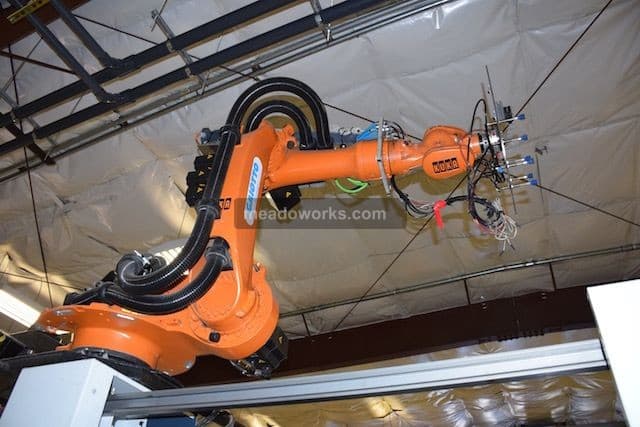 SOLD
SOLD2006 KUKA KR 16 KS - 6 Axis
USA
 SOLD
SOLD2006 KUKA KR 16 KS - 6 Axis
USA
Looking for Something Specific?
Most of our inventory sells before we can list it online. If you need a specific brand, model, or specification, tell us what you need—we have access to unlisted equipment and machines coming in from plant closures.
Looking to Sell?
Meadoworks is an active cash buyer of used industrial equipment. Get a free valuation from our AMEA-certified appraisers.
About Used 6-Axis Robots
A 6-axis robot is an articulated arm with six rotary joints, so the hand can approach a mold, a box or a fixture from angles a straight beam cannot. It stands on the floor, on a riser or on the machine, and it is programmed as a path rather than as three linear strokes. A sprue picker is not this arm. A Cartesian servo over the clamp is not this arm either. Reach on the plate is measured to the wrist, and a long gripper eats that radius. Payload includes the tool and the dress pack, not only the part. Demolding, insert loading and packing are the jobs the arm does in a molding cell. An articulated robot and a floor-mounted robot are shop names for the same six-joint machine.
Joint speed, and the postures where the arm loses a clean path, explain why a pretty reach number can still miss the cycle. The hand has to enter the press guard, take or place a part, and get out before the mold closes or the next box moves. A collaborative arm and a fenced industrial arm are different safety stories. Universal Robots' UR10e, one common collaborative size, is rated about 12.5 kg and about 1300 mm of reach, with pose repeatability around 0.05 mm. It is built to work near people only when the safety setup is real. Fanuc's heavy six-joint frames run to several hundred kilograms and reaches past 2.8 m, which is a packing or machine-tending envelope, not a sprue pull. Dress packs and cable life are the wear you will actually buy parts for. The wrist has to carry the tool without rubbing the mold.
The base sits beside the press or at the end of a conveyor, not across the tiebars the way a traverse does. A servo beam is the faster top-entry takeout when the part only needs to come out and drop. A sprue picker is enough when the only goal is the runner. This arm earns the floor space when the path includes inserts, a trim fixture or a box the beam cannot reach. Guarding and the press interface belong in the plan. An arm with no signals to the press is a mechanism, not a finished cell. Buying a 6-axis robot for a runner you could swing out is extra joints you still have to master.
Cells that added packing or insert work unbolt the arm and leave the fence behind. On a used 6-axis robot, master it, jog every joint and feel the wrist for play. A dead encoder or a loose wrist will hit a mold. Flex the dress pack through the real path. Read hours and alarms if the controller still shows them. Ask whether the gripper and the press signals are included before you draw a guard around a reach you have not taped out on the floor.
How to Choose a Used 6-Axis Robot
How to Size a 6-Axis Robot
Draw the points the hand must reach, including the mold, the nest and the box, and compare that envelope with the arm. A 6-axis robot reach number is to the wrist, not to the tip of a long gripper, so subtract the tool. Payload is the same story. Add the gripper, the cups and the dress pack. Cycle time has to fit mold open or the packing beat, and a longer path may need a faster arm or a shorter fixture. Floor space and the fence are part of the size. Collaborative arms and fenced industrial arms are not interchangeable just because both have six joints. Controller brand matters because your people have to edit it.
6-Axis Robot or a Sprue Picker
A sprue picker swings in for a runner and leaves. A 6-axis robot can take a part, load an insert, move to a trim stand and drop into a box, because the wrist is not stuck on a beam. Choose the picker when the part drops and the sprue is the whole problem. Choose the arm when the path is not a straight reach into the mold. A Cartesian servo is the middle case, fast top-entry takeout without six rotary joints. Do not put an articulated arm on a press that only needed a runner pulled. Do not ask a picker to pack a carton. The joints you are not using are still joints you must master and guard. An articulated robot standing on the floor is a floor-mounted robot.
6-Axis Robot Specs to Compare
| Spec | Why it matters |
|---|---|
| Reach (mm) | Measured to the wrist, and a long gripper shortens the envelope you can actually use inside the guard. |
| Payload (kg) | Must include the tool and the dress pack, not only the part shown on the print. |
| Repeatability | Insert and demold work needs the wrist to return to the same point, or the mold gets hit. |
| Mount | The base has to see every point in the path without a joint parked against a limit. |
| Controller | Your technicians have to be able to edit the brand of control that arrives with the arm itself. |
| Safety category | A collaborative arm and a fenced industrial arm are different layouts, and the press guard has to match. |
Reach (mm)
Measured to the wrist, and a long gripper shortens the envelope you can actually use inside the guard.
Payload (kg)
Must include the tool and the dress pack, not only the part shown on the print.
Repeatability
Insert and demold work needs the wrist to return to the same point, or the mold gets hit.
Mount
The base has to see every point in the path without a joint parked against a limit.
Controller
Your technicians have to be able to edit the brand of control that arrives with the arm itself.
Safety category
A collaborative arm and a fenced industrial arm are different layouts, and the press guard has to match.
What to Inspect on a Used 6-Axis Robot
Master the arm
A 6-axis robot that will not master, or that faults a joint, is not a programming exercise.
Check wrist backlash
Play at the wrist means a gripper that kisses the mold or misses an insert nest.
Flex the dress pack
Broken cables and a packed hose bundle are the wear that stops an otherwise healthy arm.
Read hours and alarms
Controller hours and a repeating alarm tell you whether this 6-axis robot was maintained or limped.
Fit the reach in the cell
Walk the real points with a tape before you trust the brochure radius inside your fence.
Weigh the gripper
Add the tool to the part and compare with the plate, or the wrist is overloaded on day one.
Confirm signals and fence
Press interface, gripper valves and a guard that matches this arm have to be in the plan.
Meadoworks Track Record
10
Sold through Meadoworks
Makes we have handled most
Common models
Fanuc 6-Axis Robot, KUKA KR 16 KS - 6 Axis, Universal Robots UR10
Related Equipment
- Servo Robots
Top-entry traverse when the path stays on a beam
- Sprue Pickers
Swing arms when only the runner must leave
- Robots & Sprue Pickers
Pickers, traverse robots and articulated arms
6-Axis Robots Brands We've Sold
Common Applications
Frequently Asked Questions
How do I size a 6-axis robot for reach inside the guard?
Plot every point the hand must touch, then remember a 6-axis robot reach figure stops at the wrist. A long gripper eats that radius. Payload has to include the tool. The path has to finish inside mold-open time or the packing beat. Floor space for the base and the fence is part of the size. A collaborative arm and a fenced industrial arm can both have six joints and still be the wrong safety layout. If a point sits behind the press, no brochure radius fixes the base location.
6-axis robot or sprue picker, which loads inserts?
The articulated arm loads inserts, takes parts and can pack, because the wrist is free of a beam. A sprue picker pulls a runner and gets out. Use the picker when the part drops. Use the 6-axis robot when the path includes a nest, a fixture or a box. A Cartesian servo is the faster top-entry choice when the part only needs to leave the mold and land on a belt. Do not buy six joints to remove a sprue.
What should I inspect on a used 6-axis robot?
Master it, jog every joint and feel the wrist for play. A 6-axis robot with a dead encoder or a sloppy wrist will hit a mold. Flex the dress pack and look for broken conductors. Read hours and alarms on the controller. Weigh the gripper you plan to use against the payload plate. Tape the reach inside the fence you actually have. Ask whether gripper valves and press signals are included. An arm that only jogs in a clear floor is not proven in a press.
What payload remains on a 6-axis robot after the tooling?
The plate payload minus the gripper, the cups, the sensors and the dress-pack load at the wrist. A 6-axis robot rated at 10 kilograms may have only a few kilograms left for the part. Insert tooling is often heavier than the insert. Leave margin so the wrist is not on its stop. If the tool is not built yet, estimate high. An overloaded wrist loses repeat and wears brakes. Weigh a similar hand before you promise the cycle.
Can a 6-axis robot pack parts into a box?
Yes, that is a normal second job once the part is out of the mold, if the reach includes the box and the cycle time includes the place. A 6-axis robot can also drop onto a conveyor and let a separate machine pack. The press interface and the box location have to be taught, and the fence has to cover both. A sprue picker cannot do this. A top-entry servo sometimes can place on a belt and still cannot reach a gaylord on the floor. Draw the box first.
Why does a 6-axis robot fault on a dress pack?
A cable or an air line in the bundle has fatigued, or the pack is binding and pulling a connector. A 6-axis robot will then lose a signal at one posture and run fine at another, which looks like a random fault. Flex the pack through the real path. Replace tired cables before they strand a shift. A pack that was rubbed through on the old fence will fail again if the new fence hits the same spot. Dress-pack life is a maintenance item, not a surprise.
