Used Drill Presses for Sale
1 result
Looking for Something Specific?
Most of our inventory sells before we can list it online. If you need a specific brand, model, or specification, tell us what you need—we have access to unlisted equipment and machines coming in from plant closures.
Looking to Sell?
Meadoworks is an active cash buyer of used industrial equipment. Get a free valuation from our AMEA-certified appraisers.
About Used Drill Presses
A drill press feeds a rotating tool straight down into the work. The head or the table sets the height. The quill does the stroke. It is for holes. Side-loading that quill with an end mill is how the spindle bearings die, which is why a slot or a face belongs on a knee mill instead. Floor machines have a swing, a table and a Morse taper. Bench machines are the small version of the same idea. A radial drill moves the head along an arm so a large plate can stay put while the spindle comes to the hole.
Swing is twice the throat, the distance from the column to the spindle center. A hole outside that reach needs a bigger swing or a radial arm. Quill travel is the depth you can drill in one stroke before you stop and reset. Spindle taper, commonly a Morse taper, has to hold the chuck or the drill you use. Speed ranges, from a belt or a gear head, have to cover the small drill and the large drill. A single speed is a machine for one size. Power and a coolant pump matter once the holes are in steel rather than in a thin plate.
The table has to support the part and, on many machines, tilt or slide. A table that rocks on its lock will walk a hole. Quill return springs and the feed handle are simple and still worth a stroke. Belt machines need the belt and the pulleys. Gear-head machines need oil and a range that actually shifts. Runout at the chuck is the test. A drill that wanders before it cuts is a bearing or a bent spindle, not a dull bit.
A used drill press should be spun through its speeds and fed through a stroke. Measure swing against the hole pattern, not against a wish. Confirm the taper and whether the chuck is included. A radial arm adds reach and a way to lock the head. If the only cut is a hole and the plate fits the throat, this is the machine. If you need to mill the face around the hole, buy the knee mill and leave the quill alone. A screaming belt at the top step is a bearing, and it will not be fixed with a sharper bit.
How to Choose a Used Drill Press
Floor Drill Press, Not a Radial
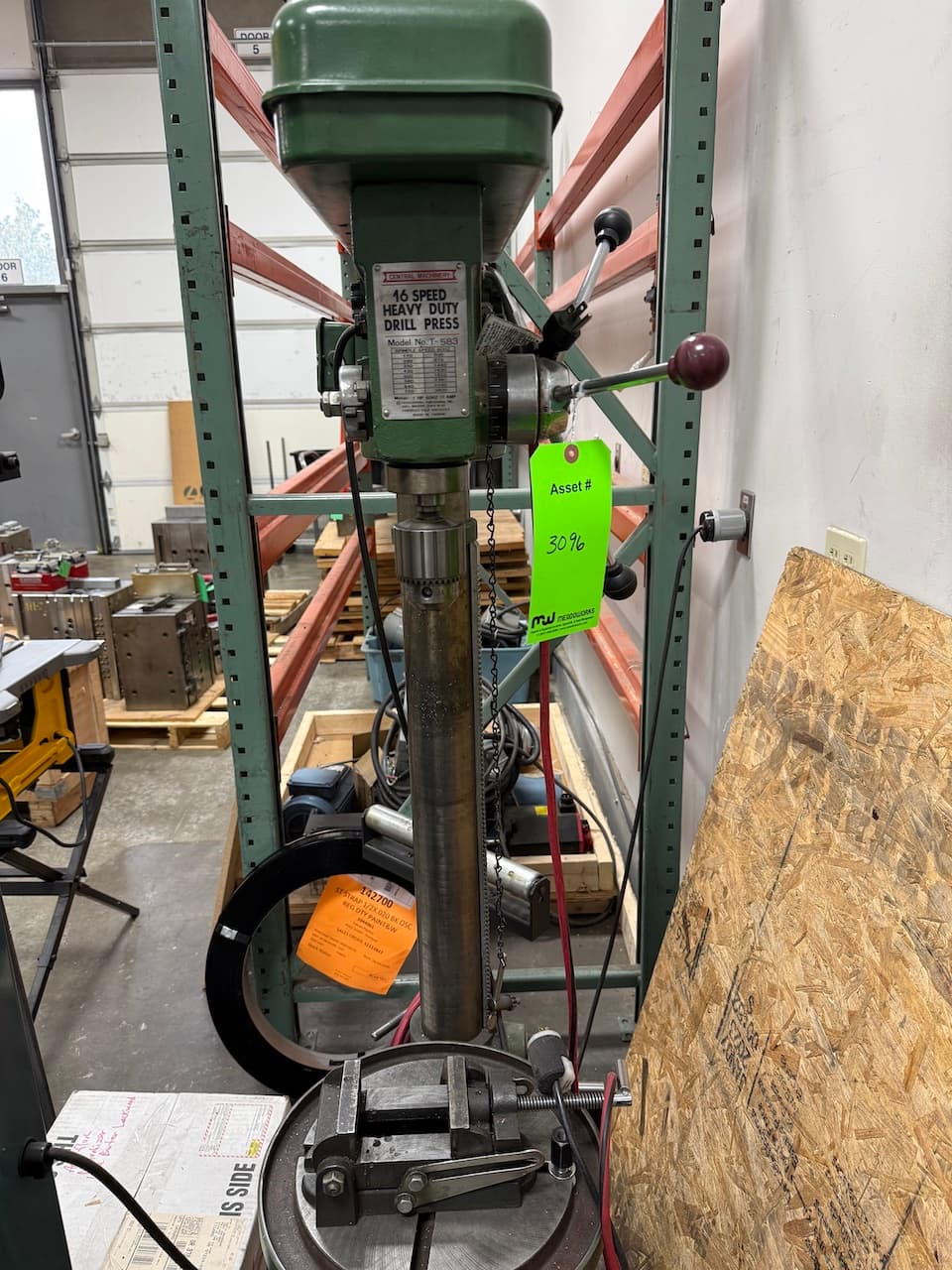
This group is a floor machine with a fixed column. You bring the work to the spindle. A radial drill brings the spindle to a large plate with an arm. If the plate is bigger than the swing, you want the radial, not a taller floor drill.
Sensitive light machines and heavy gear-driven machines are both floor drills. Match the weight of the column to the drill diameter. A light frame with a large drill is a grab waiting to happen. Match the column weight to the drill you push.
How to Size a Drill Press
Size swing to the largest plate, quill travel to the deepest hole in one stroke, and Morse taper to the chucks and taper-shank drills you own. Speeds have to include a slow range for large drills in steel.
Horsepower follows the drill, not the color of the head. A cross-slide table is worth it when you locate a pattern of holes. It does not turn the machine into a mill. Power and a solid floor are part of the size. Bring the largest drill you will push, and stand at the column.
Drill Press Specs to Compare
| Spec | Why it matters |
|---|---|
| Swing | Swing decides the largest plate you can drill at the center. A short throat will not reach the hole. |
| Quill travel | Travel is how deep you can go before you reset. A short quill makes a deep hole a second setup. |
| Speed range | Large drills in steel need a slow speed. A head with only high speeds will burn the tool. |
| Spindle taper | The chuck or the taper-shank drill has to fit. The wrong Morse size is a holder you do not own. |
| Horsepower | A small motor stalls in a large drill. The column has to be heavy enough to match that motor. |
| Table | A cross-slide locates holes without unclamping. It still is not a milling table for side cuts. |
Swing
Swing decides the largest plate you can drill at the center. A short throat will not reach the hole.
Quill travel
Travel is how deep you can go before you reset. A short quill makes a deep hole a second setup.
Speed range
Large drills in steel need a slow speed. A head with only high speeds will burn the tool.
Spindle taper
The chuck or the taper-shank drill has to fit. The wrong Morse size is a holder you do not own.
Horsepower
A small motor stalls in a large drill. The column has to be heavy enough to match that motor.
Table
A cross-slide locates holes without unclamping. It still is not a milling table for side cuts.
What to Inspect on a Used Drill Press
Feel the quill
Feed the quill by hand. A grab or a loose return drills a rough, oversized hole.
Run the speeds
Shift through the range and listen. A growl is bearings. Missing speeds mean a belt or a gear.
Check the column
The column should be straight and the table lock solid. A bent column throws every hole off square.
Read the Morse taper
The chuck and your taper-shank drills have to match. Do not assume a sleeve is in the drawer.
Lock the table
The table should clamp without creeping. A table that sinks during a hole ruins the depth.
Drill a test hole
In a scrap of the material you run. Burn marks and a wander mean speed, a dull tool or a loose quill.
Confirm power
Voltage has to match the shop. A three-phase head on a single-phase wall is a different project.
Related Equipment
- Mills & Drills
Knee mills and engine lathes in the same family
- Knee Mills
Mill a feature a drill press should not
- Engine Lathes
Turn a part the drill press cannot
Common Applications
Frequently Asked Questions
How do I size a drill press for hole diameter?
Match horsepower and the low end of the speed range to the largest drill in the material you cut. A large drill in steel needs a slow speed and a column that does not flex. Swing has to reach the hole on the plate. Quill travel has to cover the depth in a stroke you can live with. Morse taper has to fit the chuck. A cross-slide table helps a pattern of holes and does not make the machine a mill.
What should I inspect on a used drill press?
Feed the quill and run the speeds. A grab in the quill and a growl in the spindle are the faults that ruin a hole. Lock the table and see that it stays. Sight the column. Read the Morse taper against your chucks. Drill a hole in scrap and look for wander or burn. A cross-slide, if there is one, should move and lock. Voltage has to match the shop. A shiny chuck on a bent column is the wrong thing to admire. The hole is the test.
Is a floor drill press the machine on this group?
Yes. The listings are floor machines you stand at, with a column and a table. A bench-top toy and a radial arm are different tools. Sensitive light heads and heavier gear-driven heads can both be floor drills. Match the frame to the drill diameter. This group is not a machining center and not a gun drill. If the hole is a deep, precise bore, look at deep-hole equipment. If the hole is an ordinary shop hole in a plate that fits the swing, you are in the right place.
How is a drill press different from a radial drill?
A floor drill press keeps the spindle fixed on the column and you move the work. Swing is the limit. A radial drill puts the spindle on an arm so it can reach across a large plate that you would not want to shove around. If your plate fits the throat, the floor machine is simpler and enough. If the hole is out past the swing, no amount of table tilt fixes it. Buy the radial for reach. Buy the floor drill for the toolroom hole.
What Morse taper should a drill press spindle have?
The taper your chucks and taper-shank drills already are. Many shop machines are a common Morse size, and a sleeve can step one size, with a joint you should not forget. Read the spindle. A drawer of the wrong taper is a second purchase on day one. The quill and the column still matter after the taper matches. A correct chuck in a grabbing quill still drills a bad hole. Bring one tool with you and see it seat.
Can a drill press do milling work?
No. Side load on a drill-press quill and spindle is how those parts wear out, and the machine was not built to take a milling cut. A cross-slide table only locates a hole. It does not make an end mill safe. Pocketing and facing belong on a knee mill or a machining center. Use the drill press for the hole it was built to make, square to the table, with the right speed.
