Used Roller Conveyors for Sale
1 result
Looking for Something Specific?
Most of our inventory sells before we can list it online. If you need a specific brand, model, or specification, tell us what you need—we have access to unlisted equipment and machines coming in from plant closures.
Looking to Sell?
Meadoworks is an active cash buyer of used industrial equipment. Get a free valuation from our AMEA-certified appraisers.
About Used Roller Conveyors
A roller conveyor moves cartons, totes or pallets on a bed of rollers. Gravity rollers slope and the load rolls. Powered rollers, or a belt under the rollers, move a load that will not roll on its own, or move it up a slight grade. It is not a parts belt that carries sprues away from a press. Those belts are a different conveyor. Rollers are for a box or a tote with a flat, stiff bottom. A soft bag will not ride them.
Width has to be wider than the carton. Roller spacing has to be close enough that the shortest box always sits on several rollers, or the box drops between them. A 3-inch spacing and a 6-inch spacing are different conveyors. Frame height has to meet the machine or the belt upstream. A roller bed that is an inch low becomes a manual lift at every transfer. Curves, when you need one, have a tapered roller or a guard so the carton does not hang on the outside. Straight sections are the easy part.
Powered beds add a motor, a chain or a belt, and a way to accumulate. Zero-pressure accumulation lets cartons stop without touching. A simple live roller does not. Brakes and photoeyes are what make accumulation real. Gravity needs a slope you can live with and a stop at the end so the last carton does not leave the building. Rollers that do not spin are a seized bearing, and a bed of them is a slide, not a conveyor.
A used roller conveyor should be stood in a line long enough to run your carton. Spin the rollers by hand. Measure width, spacing and frame height against the box and the machine it must meet. Decide gravity or powered before you count sections. A pile of mixed frames from a warehouse will not become a line until the heights and the widths agree. Curves and stops are the pieces that go missing, and they are the pieces the line needs. Guard the curves. An unguarded outside rail is where cartons hang up and where hands meet a roller.
How to Choose a Used Roller Conveyor
How to Size a Roller Conveyor
Start with the carton. Between-frame width has to clear it. Roller centers have to be close enough that the shortest box does not fall through. Roller diameter follows the weight. Then decide gravity or powered. A gravity roller conveyor needs slope and will not move a load on a level floor. A powered roller conveyor needs a motor and a voltage that matches the cell. Frame height has to meet the belt or the table it joins. If the listing is a belt line with a gravity roller tail, buy the roller section only if that tail is what you need. There is no brand list here to hide behind.
Gravity Rollers and Powered Rollers
Gravity rollers are free-turning tubes. The load moves because the frame is sloped. They are simple, and they stall when the floor is flat or the carton is light. Powered rollers are driven by a belt or a chain and will move a load on the level. Both are a roller conveyor. A line in this catalog can be a belt with a gravity roller section on the end, so read the listing before you assume a whole powered bed. Side rails, roller condition and the drive, if there is one, are the inspection. Do not invent a roster of makes. The rollers, the width and the centers are the purchase.
Roller Conveyor Specs to Compare
| Spec | Why it matters |
|---|---|
| Drive | Gravity needs slope. Powered needs a motor. They are not the same section. |
| Between-frame width | The load has to sit between the frames with a little room for guidance. |
| Roller centers | Wide centers let a short carton drop between the rollers. |
| Roller diameter | A light tube and a heavier roller are different duties. |
| Frame height | A section that does not meet the line will not transfer the carton. |
| Motor and voltage | Gravity has no motor. A powered bed has to match the cell electrically. |
Drive
Gravity needs slope. Powered needs a motor. They are not the same section.
Between-frame width
The load has to sit between the frames with a little room for guidance.
Roller centers
Wide centers let a short carton drop between the rollers.
Roller diameter
A light tube and a heavier roller are different duties.
Frame height
A section that does not meet the line will not transfer the carton.
Motor and voltage
Gravity has no motor. A powered bed has to match the cell electrically.
What to Inspect on a Used Roller Conveyor
Gravity or powered
See whether there is a motor. A gravity section will not run on a level floor.
Measure between the frames
Width has to clear the carton. Write the number, not a guess from the photo.
Check roller centers
The shortest box has to bridge the gap. Spin a few rollers by hand.
Look at the rollers
Bent, seized or missing rollers are the condition. They are the machine.
Note frame height
It has to meet the belt or the table you will join.
Read the drive if powered
Belt-driven or chain-driven rollers, and the voltage, if a motor is present.
See if it is only a tail
A belt line can include a gravity roller section. Confirm which piece is for sale.
Related Equipment
- Conveyors
Belt, roller and incline sections together
- Belt Conveyors
Level belts, including a line that ends in rollers
- Incline Conveyors
A cleated climb when rollers cannot lift
More in Plant & Material Handling
Common Applications
Frequently Asked Questions
What is a roller conveyor if the photo shows a belt?
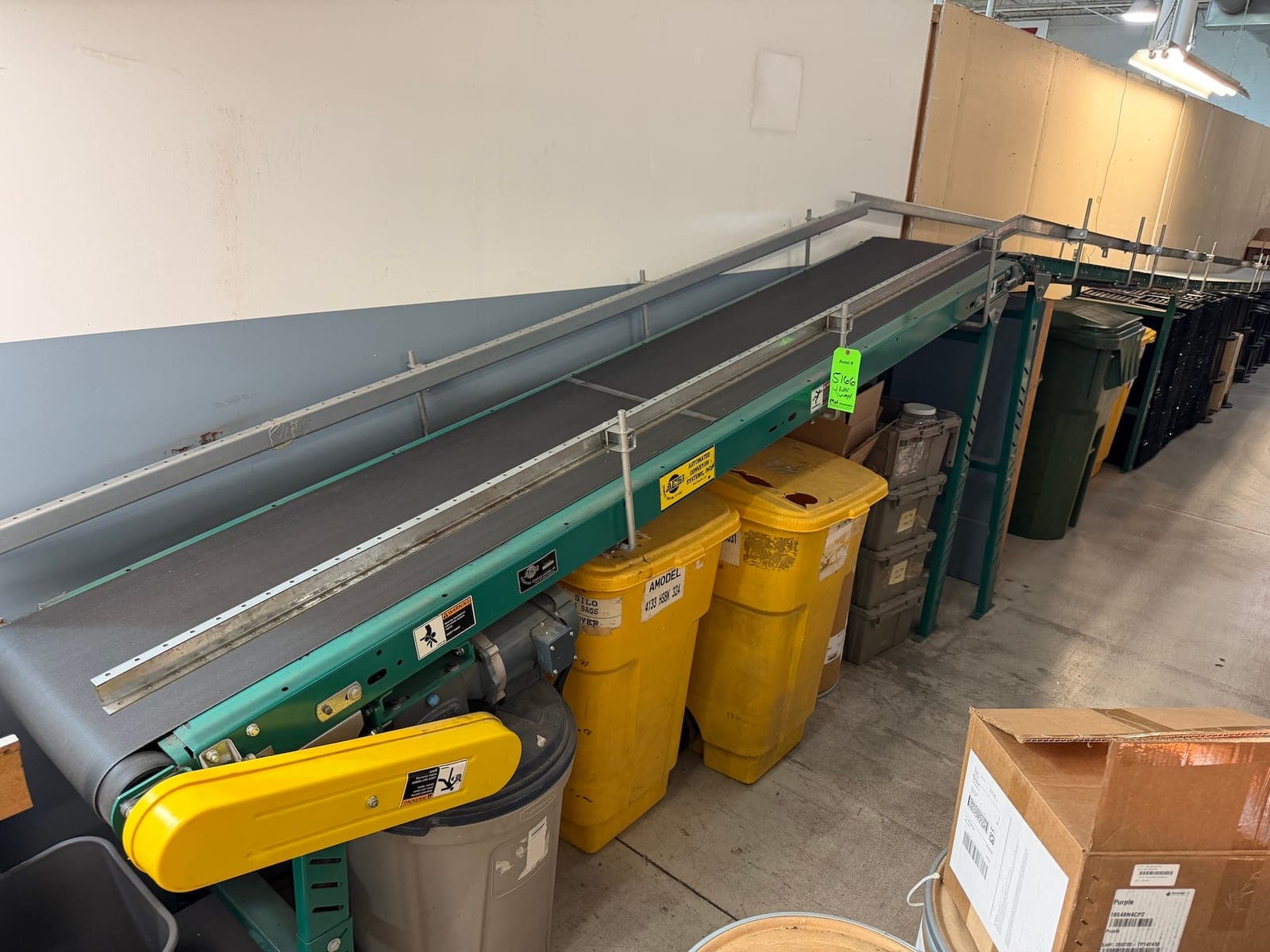
Sometimes the listing is a belt line that includes a gravity roller section. This group is about the rollers: gravity or powered, width and centers. It is not a wide brand catalog, and it is not the press-side belt group. If you need the belt, use that group. If you need the roller tail or a roller bed, wait and confirm which piece is actually included. A motor means powered rollers. No motor and a slope means gravity.
How do I size width and roller centers?
Between-frame width has to clear the carton. Roller centers have to be close enough that the shortest box does not fall through. Diameter follows the weight. Frame height has to meet the upstream belt or the table. Those four numbers beat a brand, and this group does not offer a brand list to shop instead. Measure your carton before you compare two sections that look similar in a photo. Side rails are useful and still do not fix a center that is too wide.
Gravity roller or powered roller?
Gravity rollers move a load because the frame slopes. They have no motor and they stop on a level floor. Powered rollers use a belt or a chain and a motor, and they move a load on the level. A mixed line can be both, a belt and then a gravity roller tail. Voltage matters only on the powered piece. Do not buy a gravity section and expect it to climb, and do not buy powered rollers if a slope and a free roller will do.
What should I inspect on a roller bed?
The rollers themselves: bent tubes, seized bearings, missing rollers. Then the frames, the width, the centers and the height. If it is powered, read the motor and see whether the drive is a belt or a chain. If it is gravity, confirm you have slope. Photos should show the roller surface, not only the side rail. A section that was the tail of a belt line may be shorter than the photo suggests. Ask which piece is in the lot.
Why is there no brand list for a roller conveyor?
Because the makes do not repeat often enough to name, and one sample is a belt line with a gravity roller section rather than a catalog of roller brands. Shop the rollers. Width, centers, gravity or powered, and height are the match. A brand printed on a frame does not change whether a short carton falls through. If you need a cleated climb, that is the incline group. If you need a flat belt, that is the belt group.
Can a roller conveyor lift a carton?
A gravity roller conveyor cannot. It only rolls downhill. A powered roller conveyor can move a load on the level and is a poor substitute for a cleated incline when the carton has to climb. Use the incline group for a rise. Use this group for rollers at one height or on a slope. Between-frame width and roller centers still decide whether the carton stays on the bed. The drive, if any, has to match the weight.
