Used Power Shears for Sale
Recently sold
 SOLD
Item #6029
Cincinnati 1010
USA
 SOLD
Item #6213
Pexto 137-L 16 Gauge Foot Shear
USA
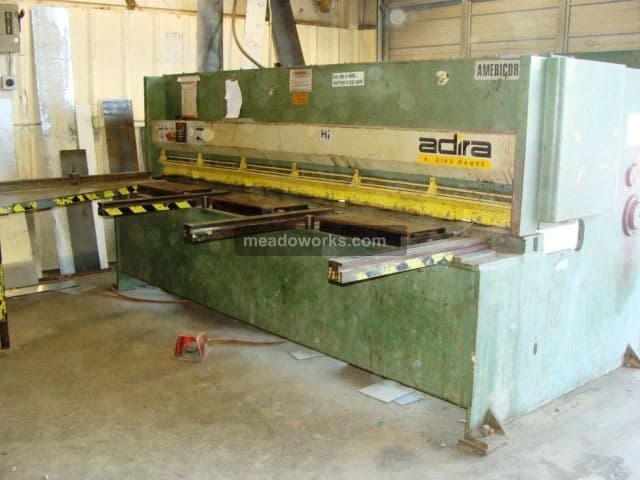 SOLD
Item #1759
1994 Adira GHR-0630 Hydraulic Shear
USA
Power Shears by the numbers
From our own catalog: machines listed now and machines we have sold. Updated every few minutes.
By brand
| Brand | In stock now | Sold by Meadoworks | Model years |
|---|---|---|---|
| Accurshear | 1 | 0 | 1999 |
| Amada | 1 | 0 | 2002 |
| Hydra-Tool | 1 | 0 | — |
Looking for Something Specific?
Most of our inventory sells before we can list it online. If you need a specific brand, model, or specification, tell us what you need—we have access to unlisted equipment and machines coming in from plant closures.
Browse Used Power Shears by Brand
Browse Used Power Shears by Country
Looking to Sell Your Power Shears?
Meadoworks is an active cash buyer of used industrial equipment. Get a free valuation from our AMEA-certified appraisers.
About Used Power Shears
Power shears (also called plate shears or guillotine shears) use a straight blade to cut sheet metal and plate to length. Hydraulic shears dominate the market for their smooth cutting action, adjustable stroke speed, and programmable back gauge systems. Capacities range from light gauge sheet metal to 1-inch plate in lengths up to 20 feet or more.
Key specifications include cutting capacity (thickness × length), rake angle, blade gap adjustment, hold-down system, and back gauge configuration. CNC back gauges enable precise cut-to-length operations with minimal operator setup. Swing beam shears offer advantages for thinner materials, while guillotine-style shears handle heavier plate.
Power shears from Cincinnati, Accurshear, Amada, Adira and Hydra-Tool have moved through Meadoworks. Contact us at 800-323-0307.
How to Choose a Used Power Shear
Length, Thickness and Rake
A shear is rated by the longest cut and the thickest mild steel it can make — a 10 ft x 1/4 in shear and a 10 ft x 1/2 in shear are very different machines. Size it to your widest sheet and thickest plate, and remember stainless cuts at roughly two-thirds of the mild steel rating.
A variable-rake hydraulic shear cuts thicker plate with less force and adjusts to reduce twist on narrow strips. A powered backgauge with a digital readout or CNC sets cut length quickly. Foot shears suit thin gauge only.
By Capacity: Typical Used Power Shears Price Ranges
Foot and manual shears, 16 gauge and lighter: about $1,000–$5,000.
Hydraulic shears, 10 ft x 1/4 in: about $10,000–$30,000.
Hydraulic shears, 10–12 ft x 3/8–1/2 in: about $20,000–$60,000.
Heavy plate shears, 1 in and up or long beds: about $50,000–$150,000.
What moves the price — the length and thickness rating, a powered or CNC backgauge, blade condition, variable rake, hold-downs, the hydraulics and the squaring arm and front supports.
These are typical used-market ranges, not a quote on any one machine. For a current figure on a specific machine, request a quote or call 800-323-0307.
By brand
Power shears from Cincinnati, Accurshear, Amada, Adira, Hydra-Tool and Pexto have moved through Meadoworks, from 16 gauge foot shears to 10 ft x 1/2 in hydraulic shears.
Meadoworks track record
We have sold an Adira 10 ft x 1/4 in hydraulic shear, a Cincinnati shear and a Pexto foot shear, and our catalog has carried Accurshear 10 ft x 3/8 in, Hydra-Tool 10 ft x 1/2 in and Amada hydraulic shears.
Power Shear Specs to Compare
| Spec | Typical range | Why it matters |
|---|---|---|
| Cutting length | Often 8–12 ft | Sets the widest sheet you can cut in one stroke. |
| Mild steel capacity | Often 1/4–1/2 in | Stainless and high-strength steel cut thinner than the rating. |
| Backgauge travel | Often 24–36 in | Sets the longest blank you can gauge from the back. |
| Rake angle | Often 0.5–3 degrees | Lower rake reduces twist; higher rake lowers the force. |
| Strokes per minute | Often 10–30 SPM | Speed matters on high-volume blanking. |
Cutting length
Typical range: Often 8–12 ft
Sets the widest sheet you can cut in one stroke.
Mild steel capacity
Typical range: Often 1/4–1/2 in
Stainless and high-strength steel cut thinner than the rating.
Backgauge travel
Typical range: Often 24–36 in
Sets the longest blank you can gauge from the back.
Rake angle
Typical range: Often 0.5–3 degrees
Lower rake reduces twist; higher rake lowers the force.
Strokes per minute
Typical range: Often 10–30 SPM
Speed matters on high-volume blanking.
What to Inspect on a Used Power Shear
Cut full length
Shear a full-length strip at rated thickness and check squareness and bow.
Check the blades
Look for chips and rounded edges and ask whether they can be turned or reground.
Set the blade gap
Confirm the gap adjusts and holds across the length.
Run the backgauge
Check that it moves, locks and repeats to the readout.
Look at the hydraulics
Check cylinders, pump noise and leaks.
Test the hold-downs
All hold-downs should clamp evenly before the blade moves.
Related Equipment
- Used Fiber Lasers
Fast sheet cutting on thin and mid-gauge steel
- Used Hydraulic Shears
Square blanks before the laser, brake or punch
- Used Turret Punches
Holes and forms in sheet without a laser
- Used CNC Press Brakes
Bend what the cutting table makes
Types of Metal Cutting & Fabrication
Common Applications
Frequently Asked Questions
What is a power shear used for?
A power shear uses a straight blade driven by hydraulic or mechanical force to cut sheet metal and plate to length. Power shears produce clean, straight cuts across the full width of the material in a single stroke. They are used in fabrication shops, steel service centers, and manufacturing facilities for blanking and cut-to-length operations.
How much does a used hydraulic shear cost?
Typical used ranges run about $10,000–$30,000 for a 10 ft x 1/4 in hydraulic shear and about $20,000–$60,000 for 10 to 12 ft machines rated 3/8 to 1/2 in. Heavy plate shears and long beds run higher. Blade condition, the backgauge, rake and hydraulics move the price. For a current figure on a machine, request a quote or call 800-323-0307.
What thickness can a 10 foot shear cut?
It depends on the rating. Common 10 ft hydraulic shears are rated for 1/4, 3/8 or 1/2 in mild steel. Stainless and high-strength steel cut at about two-thirds of the mild steel rating, so a 1/4 in shear handles roughly 10 gauge stainless. Running a shear above its rating chips blades and strains the frame.
What should I check on a used power shear?
Shear a full-length strip at rated thickness and check that it is square and straight. Look at the blades for chips and wear, confirm the blade gap adjusts across the length, and run the backgauge to its stops. Check the cylinders and pump for leaks or noise and make sure every hold-down clamps before the blade comes down.
What is the difference between a swing beam and a guillotine shear?
A swing beam shear pivots its upper blade on an arc, which keeps it simple and suits thinner plate. A guillotine shear drives the upper blade straight down in guides, usually with variable rake and adjustable blade gap, which suits thicker plate and more precise cuts. Both are hydraulic in most used machines.
Related Resources
Need Help Finding the Right Equipment?
Contact our team with your specifications and we'll help you find the right machine.
