Used Optical Comparators for Sale
See all 22 Inspection & Lab Equipment →
2 results
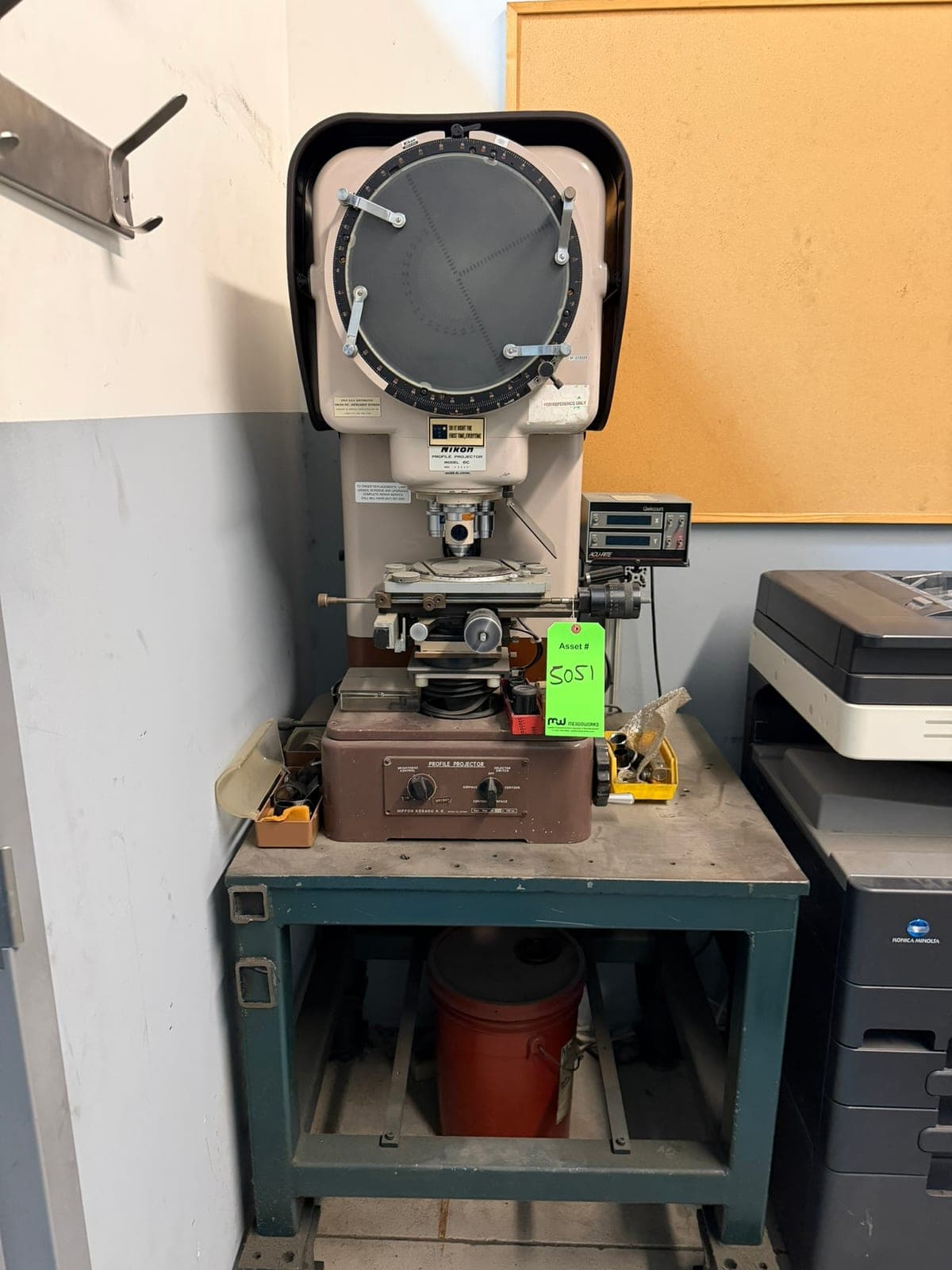
Lot 68
Nikon Optical Profile Projector w/DRO
Naperville, IL
Live auction · Tue, Oct 27, 10:00 AM CT
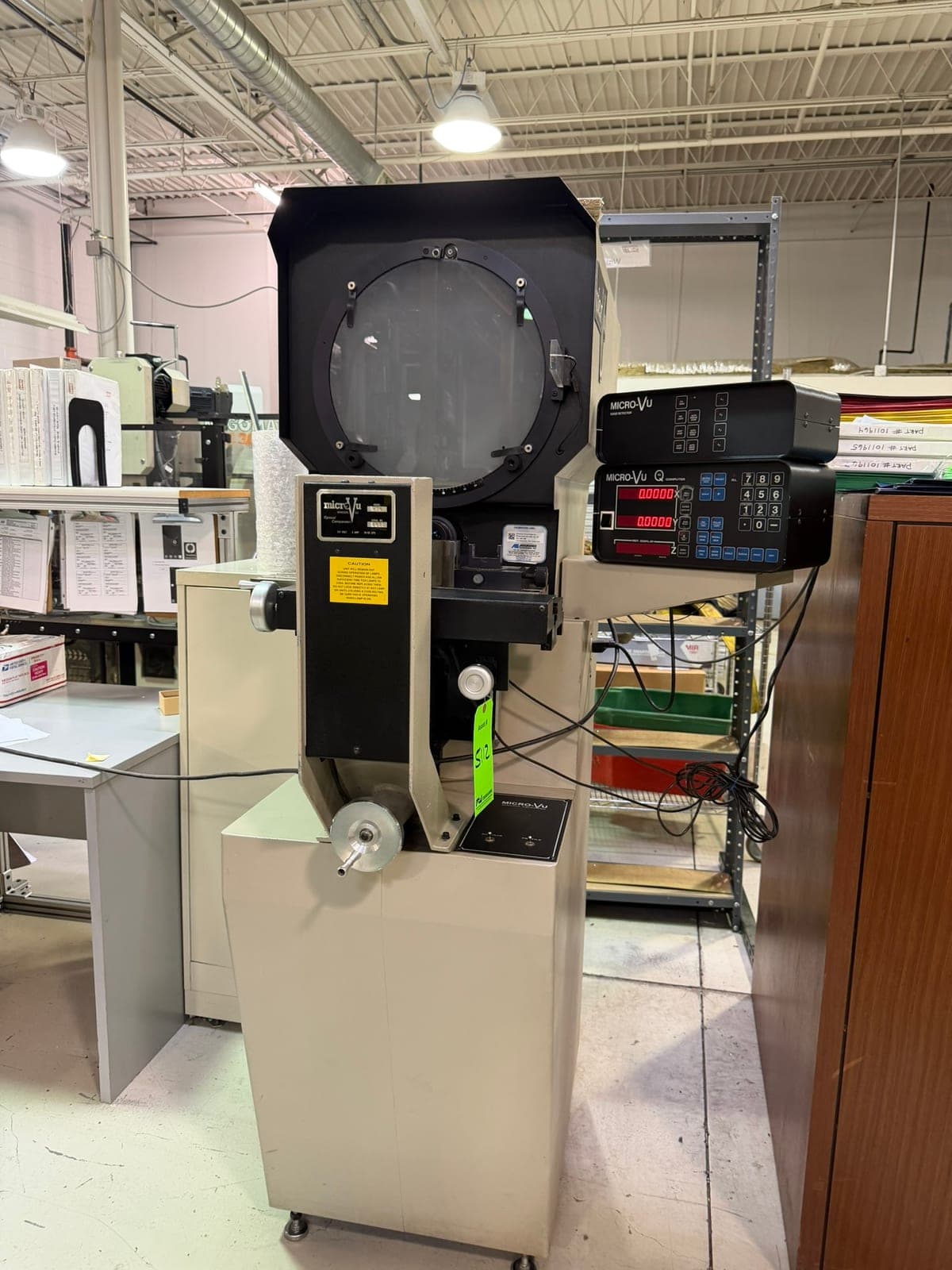
Lot 48
MicroVu Optical Comparator
Naperville, IL
Live auction · Tue, Oct 27, 10:00 AM CT
Looking for Something Specific?
Most of our inventory sells before we can list it online. If you need a specific brand, model, or specification, tell us what you need—we have access to unlisted equipment and machines coming in from plant closures.
Looking to Sell?
Meadoworks is an active cash buyer of used industrial equipment. Get a free valuation from our AMEA-certified appraisers.
About Used Optical Comparators
An optical comparator projects a magnified silhouette of a part onto a glass screen so you can compare it to a drawing, a overlay or a digital readout. It is a shop-floor measuring tool for turned parts, stampings and profiles, not a coordinate measuring machine and not a microscope for a surface finish number. Light comes from behind the part for a profile, or from the front for a surface view. Both lamps have to work if you do both jobs.
Screen diameter is the spec people quote, often 14 inches and up. A larger screen shows more of the part at a given magnification, or the same part at a higher magnification. Magnification lenses, 10x, 20x, 50x, are tooling. A machine with only one lens measures only at that scale. Stage travel, X and Y, has to cover the feature you need to measure, and a digital readout on the stage is how you get a number instead of a guess against a chart. Helix adjustment swings the work so a thread or an angled edge projects true. Focus travel has to reach the surface you are looking at.
The optics and the screen are the condition. A cloudy mirror, a scratched screen or a lamp that is dim makes a soft edge, and a soft edge is a wrong measurement. The stage ways should move without a hitch and lock without a jump. Chart rings and overlays, if you use them, are often missing from a used machine. A computer and an edge-detection option, on later machines, are only useful if they still run.
A used optical comparator should be focused on a known pin or a gage block. Check profile light and surface light. Move the stage through its travel and read the display. Confirm the lenses that come with it, because the screen size alone does not measure a small radius. Ask whether the overlays for your threads are in the drawer. A pretty screen with a dead lamp is a cabinet. Surface illumination that flickers, or a helix that will not lock, is a measurement you should not trust on a thread.
How to Choose a Used Optical Comparator
How to Size a Profile Projector
Start with screen diameter, then stage travel, then the lenses. The screen has to show the feature you care about at the magnification you will use. A larger screen is not useful if the stage cannot move the part across that view. Travel in X and Y is the measuring range. Magnification, often ten or twenty times, trades field of view for detail. A readout turns that travel into a number, and a missing readout means you are reading screws or a scale. Lamp, surface light and profile light have to work. Helix adjustment matters for threads. Write screen size, travels and which lenses are actually in the box before you compare two projectors.
Screen, Stage and Lenses
A profile projector is an optical comparator. The shadow is the measurement. Screen diameter is the glass you look at. Stage travel is how far the part can move while you measure. Lenses decide the magnification, and a turret without the lens you need is an incomplete machine. Surface illumination lets you see a face, and profile illumination makes the outline. A fogged mirror or a cracked screen ends both. This is not a coordinate measuring machine and not a pin gage. It is the right tool when a magnified outline, compared with a chart or a readout, answers the drawing. No make repeats often enough here to shop by brand.
Optical Comparator Specs to Compare
| Spec | Typical range | Why it matters |
|---|---|---|
| Screen diameter | The feature has to fit on the screen at the magnification you use. | |
| Stage travel | Travel is the measuring range. A large screen with a short stage still cannot cover a long part. | |
| Magnification | Often 10x or 20x lenses | Higher magnification shows less of the part in more detail. Confirm the lenses are included. |
| Readout | A readout reports the travel. Without it you are reading a scale or a screw. | |
| Illumination | Profile light makes the shadow. Surface light shows a face. A dead lamp measures nothing. | |
| Helix and focus | Threads need helix adjustment. Focus travel has to cover the part height. |
Screen diameter
The feature has to fit on the screen at the magnification you use.
Stage travel
Travel is the measuring range. A large screen with a short stage still cannot cover a long part.
Magnification
Typical range: Often 10x or 20x lenses
Higher magnification shows less of the part in more detail. Confirm the lenses are included.
Readout
A readout reports the travel. Without it you are reading a scale or a screw.
Illumination
Profile light makes the shadow. Surface light shows a face. A dead lamp measures nothing.
Helix and focus
Threads need helix adjustment. Focus travel has to cover the part height.
What to Inspect on a Used Optical Comparator
Measure the screen
Write the screen diameter. Confirm the glass is not cracked and the image is usable.
Write stage travels
X and Y travel are the measuring range. Do not infer them from the screen size.
List the lenses
Note each magnification that is actually present. An empty turret is not a 20x machine.
Test both lamps
Profile light and surface light should both come on. A spare lamp is worth asking about.
Check the readout
The display should track stage movement. A dead readout is a repair before the machine is useful.
Look at mirrors and glass
Fog, cracks and a loose mirror ruin the shadow even when the mechanics feel smooth.
Try helix and focus
Helix should swing if you inspect threads. Focus should cover the height of your part.
Related Equipment
- Inspection & Lab Equipment
The lab and inspection family around the projector
- CMMs
Bridge machines and arms when you need a volume
- Gages & Instruments
Pins, blocks and indicators for a single dimension
More in Plant & Material Handling
Common Applications
Frequently Asked Questions
What does an optical comparator show that a gage does not?
A magnified shadow of the profile, on a screen, so you can compare an edge to a chart or read stage travel. People also call it a profile projector. Screen diameter, stage travel and the lenses are the size. It is not a pin gage and not a coordinate measuring machine. Use it when the drawing is an outline. Use pins, blocks and indicators when the check is a single dimension you can feel or clock. The lamp and the glass have to be intact or there is no shadow.
How do I size screen diameter and stage travel?
Screen diameter is the glass. Stage travel is how far you can move the part while measuring, and that travel is the range. A big screen with a short stage still cannot cover a long part. Magnification changes how much of the part fills the glass. Ten times and twenty times are common, and a higher power shows a smaller area. Write all three before you compare listings. A readout, if fitted, is what turns the travel into a number you can record.
Which lenses should be with the projector?
The magnifications you will actually use. A turret can be empty even when the screen looks complete. Ask for the list, and look at the photos for the lens mounts. Higher magnification is not always better, because the field of view shrinks. If you inspect threads, helix adjustment matters as much as the lens. A single lens can be enough if it matches the parts. Do not assume a second magnification is in the drawer.
What should I inspect on a profile projector?
The screen, the mirrors, both lamps, the stage travel, the readout and the lenses. A cracked screen or a fogged mirror ends the measurement. A lamp that will not light is a wear item, and a spare is worth knowing about. Move the stage through its travel and see that the readout follows. Focus should cover your part height. This is a bench or floor machine, and the glass tells you more than the paint.
Is surface light different from profile light?
Yes. Profile light throws the outline, which is the classic shadow. Surface light lets you see a face that is not a pure edge. A complete optical comparator has both, and you should test both. A machine with only one working lamp is a narrower tool. Charts and overlays sit on the screen for either light. If your parts are threads or turned profiles, profile light and helix adjustment are the pair to confirm first.
When should I look at a measuring machine instead?
When you need a cloud of points or a CAD compare in a volume, that is a coordinate measuring machine, bridge or arm. When you need a hole checked by feel, that is a pin gage. An optical comparator stays the right tool for a magnified profile on a screen. Do not buy a projector to replace a volume machine, and do not buy a volume machine to look at a thread shadow. Screen, stage and lenses are the decision on this group.
