Used Pipe & Profile Extrusion Lines for Sale
All used plastic extruders & extrusion equipment (14) →
See all 14 Extruders & Extrusion Lines →
2 results

Item #6325
2022 Lima Extrusion P 90/28 Pipe & Profile Extrusion Line
USA
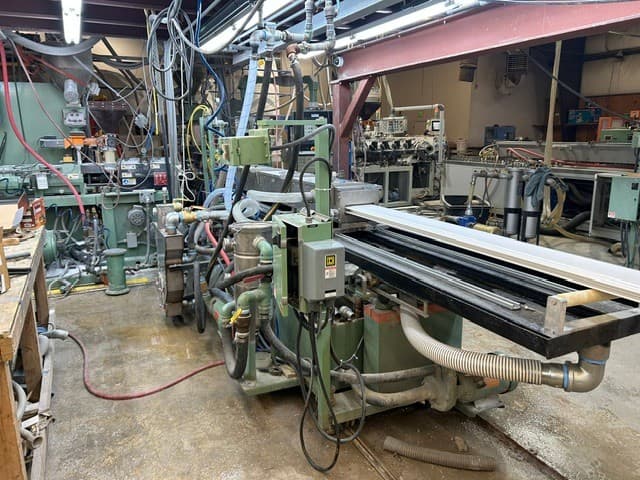
Item #6448
2007 Davis-Standard GC 65 / GC 40 Pipe & Profile Co-Extrusion Line
USA
Pipe & Profile Extrusion Lines by the numbers
From our own catalog: machines listed now and machines we have sold. Updated every few minutes.
By brand
| Brand | In stock now | Sold by Meadoworks | Model years |
|---|---|---|---|
| Davis-Standard | 1 | 0 | 2007 |
| Lima Extrusion | 1 | 0 | 2022 |
| Krauss Maffei | 0 | 3 | 1987–2015 |
Looking for Something Specific?
Most of our inventory sells before we can list it online. If you need a specific brand, model, or specification, tell us what you need—we have access to unlisted equipment and machines coming in from plant closures.
Looking to Sell?
Meadoworks is an active cash buyer of used industrial equipment. Get a free valuation from our AMEA-certified appraisers.
About Used Pipe & Profile Extrusion Lines
A pipe extrusion line turns pellets or powder into a continuous tube, and a profile line does the same for window frames, trim, channel and tubing shapes. The extruder melts and pumps the resin, the die sets the shape, and the downstream train decides whether the part comes out round, straight and to size. That train is a vacuum sizing tank or calibrator, a spray or immersion cooling tank, a belt or caterpillar puller, and a saw or cutter at the end.
Single screw machines run most polyolefin pipe and tubing. Counter-rotating twin screw extruders are the usual choice for rigid PVC pipe and profile, because they take powder dry blend and hold a steady melt at low shear. Co-extrusion adds a second, smaller extruder for a stripe, a cap layer or a soft seal on a rigid profile.
Buying a used pipe extrusion line is mostly a question of what you will run. Pipe diameter range, wall thickness and resin decide the screw, the die and the length of the cooling tanks. A line built for small medical tubing will not make four inch drain pipe, and a PVC line will not run polyethylene well without a different screw. The die and the sizing tooling are product-specific and often worth as much as the extruder.
The lines we have handled include a Lima Extrusion P 90/28 pipe and profile line, a Davis-Standard GC 65 and GC 40 co-extrusion line, Krauss Maffei KMD 2-40 and KMD 2-50 counter-rotating twin screw extruders, a Krauss Maffei KME 60 line, a Cincinnati Milacron PAK 600 and a Genca medical tubing line. Screw sizes run from 40 mm twins to a 90 mm single screw.
Meadoworks sells these lines from plant closures and consolidations, often with the dies, sizing sleeves and spare screws that ran with them. Ask which tooling comes with a line, whether it ran up to the day it shut down, and whether you can see it run before it is taken apart. Rigging a full line is a planned move: the tanks, puller and cutter ship with the extruder, and we coordinate the load so the line arrives as one project.
How to Choose Used Pipe & Profile Extrusion Lines
Start From the Product, Then Size the Line
Write down the diameter range, wall thickness, resin and output in pounds or kilograms per hour. The extruder has to deliver that output with margin, and the cooling tanks have to be long enough to set the wall at your line speed. Thick-wall pipe needs far more cooling length than thin tubing.
Then look at the die and sizing tooling. If the line comes with tooling for your sizes, it is close to a running process. If it does not, budget for new dies and sleeves before you compare prices.
By Line: Used Price Ranges
Small tubing and profile lines (single screw up to about 2.5 in, short downstream): about $30,000–$100,000.
Mid-size pipe and profile lines (about 2.5–4.5 in single screw or 50–65 mm twin): about $75,000–$250,000.
Large pipe lines and co-extrusion lines with full downstream: about $150,000–$400,000+.
What moves the price: model year, screw and barrel wear, gearbox condition, the control, and above all which dies, calibrators and cutters come with it. These are typical used-market ranges, not a quote on any one line. For a current price, request a quote or call 800-323-0307.
Pipe & Profile Extrusion Lines Specs to Compare
| Spec | Typical range | Why it matters |
|---|---|---|
| Screw diameter | About 40–90 mm on the lines we have handled | Sets output. Twin screws are sized per screw (40 mm x 2). |
| Single or twin screw | Counter-rotating twins suit rigid PVC dry blend; single screws suit polyolefins. | |
| L/D ratio | Usually 24:1–32:1 for pipe and profile | Longer barrels melt and mix more evenly at higher output. |
| Pipe or profile size range | The die, calibrator and puller all have a minimum and maximum size. | |
| Cooling tank length | Has to set the wall at your line speed; thick wall needs more length. | |
| Voltage | Usually 460V three-phase | Match it to your plant service before you buy. |
Screw diameter
Typical range: About 40–90 mm on the lines we have handled
Sets output. Twin screws are sized per screw (40 mm x 2).
Single or twin screw
Counter-rotating twins suit rigid PVC dry blend; single screws suit polyolefins.
L/D ratio
Typical range: Usually 24:1–32:1 for pipe and profile
Longer barrels melt and mix more evenly at higher output.
Pipe or profile size range
The die, calibrator and puller all have a minimum and maximum size.
Cooling tank length
Has to set the wall at your line speed; thick wall needs more length.
Voltage
Typical range: Usually 460V three-phase
Match it to your plant service before you buy.
What to Inspect on Used Pipe & Profile Extrusion Lines
Measure the screw and barrel
Ask for flight clearance readings; a worn screw cuts output and raises melt temperature.
Listen to the gearbox under load
A gearbox or thrust bearing rebuild is the most expensive repair on an extruder.
Heat every zone
Check heaters, thermocouples and blowers along the barrel and the die.
Run the puller and cutter
Belts or pads, speed control and cut accuracy at line speed.
Check the vacuum sizing tank
Vacuum pump, spray nozzles and seals; leaks show as out-of-round pipe.
List the tooling
Dies, sizing sleeves and spare screws that come with the line, by size.
Confirm the controls
Line speed sync between extruder, puller and cutter, and parts support for the drive.
Related Equipment
- Twin Screw Extruders
Counter-rotating twins for PVC pipe and profile
- Single Screw Extruders
Extruders for polyolefin pipe and tubing
- Downstream Extrusion Equipment
Pullers, cutters, sizing and cooling tanks
- Water Treatment Systems
Pump and tank systems for the cooling tanks
More Extruders & Extrusion Lines types
Pipe & Profile Extrusion Lines Brands We've Sold
Krauss Maffei
KMD counter-rotating twin screw and KME lines
Davis-Standard
GC co-extrusion lines
Lima Extrusion
Pipe and profile lines
Cincinnati Milacron
Large single screw extruders
Genca
Medical tubing lines
Common Applications
Frequently Asked Questions
What makes up a complete pipe extrusion line?
An extruder with its die head, a vacuum sizing tank or calibrator, one or more cooling tanks, a belt or caterpillar puller, and a saw or cutter, often with a printer or a coiler at the end. A profile line swaps the round die and sleeve for a profile die and calibration table. When a used line is sold complete, those pieces were set up to run together. When it is sold as parts, matching them to each other is your job.
Can a PVC profile line run polyethylene?
Not well without changes. Rigid PVC lines usually run counter-rotating twin screws designed for powder dry blend at low shear. Polyethylene runs best on a single screw with a different screw design and a longer cooling train, because polyolefins shrink more and set more slowly. The downstream puller and cutter can often be reused, but plan on a different extruder or screw before you switch resins on the same line.
How much is the tooling worth on a used extrusion line?
Often a large share of the line. Dies, sizing sleeves and calibrators are made for one product size, and a new set can cost as much as a used extruder. A line that comes with tooling for the sizes you plan to run is much closer to production than one without it. Ask for a list of the tooling by size, and check the die lands and sleeves for wear or damage before you count them as value.
How long does it take to move and restart a pipe line?
Plan on several weeks from teardown to first good pipe for a mid-size line. The extruder, tanks, puller and cutter have to be disconnected, rigged and shipped, then set back up in a line with water, vacuum and power at each station. Most of the time goes into alignment, water and electrical hookup, and dialing in the die and sizing. Seeing the line run before teardown, and marking every connection, saves days.
Single screw or twin screw for profile extrusion?
Use a counter-rotating twin screw for rigid PVC profiles made from powder dry blend, which is the most common profile material. Use a single screw for pellets such as polyolefins, TPE and many engineering resins, and for small tubing. Co-extruded profiles often pair a twin screw for the rigid body with a small single screw for a soft seal. The resin and its form, powder or pellets, decide the screw before anything else does.
