Used High Speed Presses for Sale
All used stamping presses (4) →
Nothing is listed right now — these are machines we've recently sold. or tell us what you need.
Recently sold
 SOLD
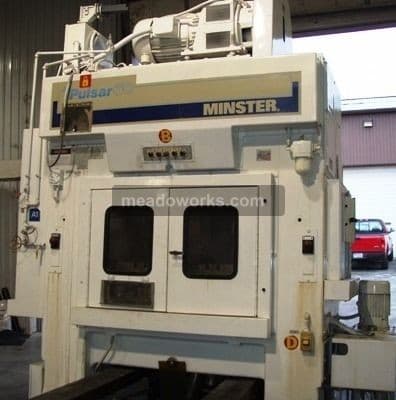
Item #1212
1988 Minster TR2-60 "Pulsar" High Speed Press
USA
 SOLD
Item #1082
1972 Minster P2-100-48 High Speed Press
USA
 SOLD
Item #2390
Bruderer BSTA-30 3-Post
USA
 SOLD
Item #1218
1977 Bruderer BSTA-30 Precision (3) Pillar Type High Speed Press
USA
 SOLD
Item #1221
1978 Bruderer BSTA-30 Precision High Speed (4) Pillar-Type Press
USA
 SOLD
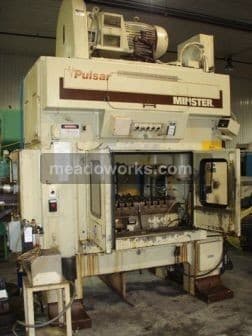
Item #1213
1984 Minster TR2-60 "Pulsar" High Speed Speed
USA
 SOLD
Item #1217
1977 Minster P2-150-54 Straight-Side Geared Design High Speed Press
USA
 SOLD
Item #1216
1979 Minster P2-150-60 "Piece-Maker" High Speed Press
USA
 SOLD
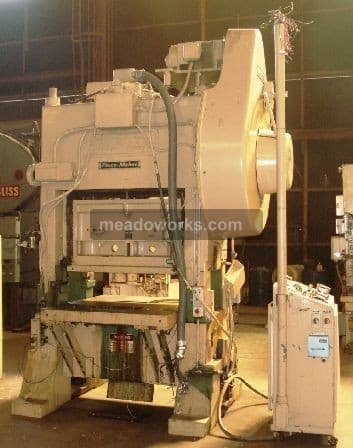
Item #1211
1984 Minster P2-100-48-31 "Piece-Maker" High Speed Press
USA
 SOLD
Item #1220
1986 Bruderer BSTA-22E Precision (4) Pillar-Type High Speed Press
USA
 SOLD
Item #1219
1985 Bruderer BSTA-20 High Speed Precision (4) Pillar Type Punch Press
USA
 SOLD
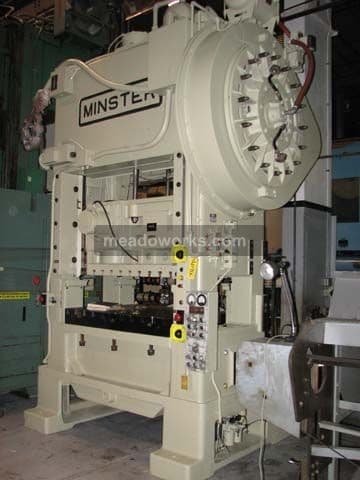
Item #1215
1979 Minster P2-150-54 Straight-Side Geared Design High Speed
USA
 SOLD
Item #1081
2000 Minster P2-100-48 High Speed Press
USA
High Speed Presses by the numbers
From our own catalog: machines listed now and machines we have sold. Updated every few minutes.
Our track record
13 machines sold · model years 1972–2000
Looking for Something Specific?
Most of our inventory sells before we can list it online. If you need a specific brand, model, or specification, tell us what you need—we have access to unlisted equipment and machines coming in from plant closures.
Browse Used High Speed Presses by Brand
Looking to Sell Your High Speed Presses?
Meadoworks is an active cash buyer of used industrial equipment. Get a free valuation from our AMEA-certified appraisers.
About Used High Speed Presses
High speed stamping presses operate at speeds from 200 to 1,600+ strokes per minute (SPM) for maximum production output. These precision machines feature short strokes, rigid frames, dynamic balancing systems, and advanced lubrication for sustained high-speed operation. High speed presses are essential for producing electrical connectors, terminals, lead frames, battery tabs, and other small precision parts in very high volumes.
Key specifications include tonnage, strokes per minute (SPM), stroke length, bed size, slide parallelism, and dynamic balance system. Precision high speed presses from Bruderer and Minster maintain die alignment within microns at full speed for consistent part quality.
Bruderer and Minster high speed presses have moved through Meadoworks. Contact us at 800-323-0307 for high speed press pricing.
How to Choose a Used High Speed Press
Speed, Stroke and Precision
A high-speed press is bought for strokes per minute at a given stroke length: a short-stroke precision press runs hundreds of strokes a minute for connectors and lead frames, while a longer-stroke press runs slower for deeper parts. Size the tonnage and bed to the progressive die, then check the speed the press holds with that die, not its catalog maximum.
Dynamic balancing, slide guidance (pillar or roller gibs) and bottom dead center accuracy decide part quality. A matched servo feed, a tonnage monitor and die protection are part of a working cell.
By Tonnage: Typical Used High Speed Presses Price Ranges
20–30 ton precision high-speed presses: about $30,000–$150,000.
60–100 ton high-speed presses: about $40,000–$200,000.
150 ton high-speed presses: about $80,000–$300,000.
What moves the price — the speed range and stroke, tonnage and bed size, dynamic balancing, slide guidance and bottom dead center accuracy, the feed and coil handling, hours, and the condition of the bearings and lubrication system.
These are typical used-market ranges, not a quote on any one machine. For a current figure on a specific machine, request a quote or call 800-323-0307.
By brand
Minster and Bruderer are the high-speed presses we have handled — Minster TR2-60 Pulsar and P2 Piece-Maker presses and Bruderer BSTA-20, BSTA-22E and BSTA-30 pillar-type precision presses.
We have sold 11 high-speed presses: Bruderer BSTA machines from 22 to 30 tons and Minster high-speed presses from 60 to 150 tons.
High Speed Press Specs to Compare
| Spec | Typical range | Why it matters |
|---|---|---|
| Tonnage | Often 20–150 tons | Size to the progressive die load. |
| Speed range | Often 100–1,000+ SPM | Check the speed at your stroke and die, not the maximum. |
| Stroke | Often 0.3–2 in; up to 6 in on larger presses | Short strokes run fastest. |
| Bolster area | Often 24 x 18 to 60 x 30 in | Must carry the progressive die. |
| Bottom dead center accuracy | Often within a few thousandths of an inch | Holds coining and forming depth at speed. |
Tonnage
Typical range: Often 20–150 tons
Size to the progressive die load.
Speed range
Typical range: Often 100–1,000+ SPM
Check the speed at your stroke and die, not the maximum.
Stroke
Typical range: Often 0.3–2 in; up to 6 in on larger presses
Short strokes run fastest.
Bolster area
Typical range: Often 24 x 18 to 60 x 30 in
Must carry the progressive die.
Bottom dead center accuracy
Typical range: Often within a few thousandths of an inch
Holds coining and forming depth at speed.
What to Inspect on a Used High Speed Press
Run it at speed
Run the press at production speed and listen for knocks and bearing noise.
Check BDC repeatability
Measure bottom dead center drift from cold to warm.
Inspect the guidance
Check pillar bushings or roller gibs for play.
Look at the lube system
Confirm the circulating oil system, filters and cooler work.
Test the clutch and brake
Measure stopping time and confirm the brake monitor.
Ask for hours and history
Get the stroke count, rebuild history and the feed that ran with it.
Related Equipment
- Used Hydraulic Presses
Full tonnage anywhere in the stroke
- Used Hydraulic Gap Frame Presses
Open-throat presses for assembly and light forming
- Used Straight Side Hydraulic Presses
Box frames for off-center loads
- Used CNC Press Brakes
Bend sheet that a press would otherwise form
Types of Stamping Equipment
Common Applications
Frequently Asked Questions
What is a high speed stamping press?
A high speed stamping press operates at 200 to 1,600+ strokes per minute for maximum production throughput. These machines feature short stroke lengths, rigid frames, dynamic balancing, and precision slide guidance to maintain die alignment at high speeds. They're used to produce electrical connectors, terminals, lead frames, and other small precision parts in very high volumes.
How much does a used high speed stamping press cost?
Typical used ranges run about $30,000–$150,000 for 20 to 30 ton precision presses, about $40,000–$200,000 for 60 to 100 ton presses and about $80,000–$300,000 for 150 ton high-speed presses. Speed, bed size, balancing, the feed and the condition of the bearings move the price; call 800-323-0307 for a current figure.
What should I check on a used high speed press?
Run the press at production speed and listen for knocks and bearing noise. Measure bottom dead center drift from cold to warm, check the pillar bushings or roller gibs for play, and confirm the circulating lube system, filters and cooler work. Test the clutch and brake and ask for the stroke count and rebuild history.
What is the difference between a Bruderer and a Minster high speed press?
Both build high-speed stamping presses, with different designs. Bruderer presses use a pillar-guided slide and a compact frame built for very high speeds on small precision parts such as connectors. Minster builds a wide range of straight side high-speed presses, including the Pulsar and Piece-Maker lines, with larger beds and tonnages for bigger progressive dies.
How fast does a high speed press run?
It depends on the press, the stroke and the die. Small precision presses with short strokes run several hundred to over 1,000 strokes per minute, while larger high-speed presses run 100 to 600 strokes per minute. The usable speed is set by the die, the feed and the part, not just the press's top rating.
Related Resources
Need Help Finding the Right Equipment?
Contact our team with your specifications and we'll help you find the right machine.
