Used Straight Side Presses for Sale
All used stamping presses (4) →
Recently sold
 SOLD
Item #1082
1972 Minster P2-100-48 High Speed Press
USA
 SOLD
Item #2467
1992 Minster P2-100-48
USA
 SOLD
Item #2459
1977 Minster P2-100-48
USA
 SOLD
Item #1079
Oak Industries LP60
USA
 SOLD
Item #1214
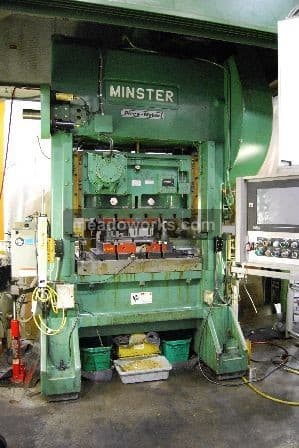
2000 Minster P2-100-48 Straight-Side Mechanical Press
USA
 SOLD
Item #1076
1975 Oak Industries LP60
USA
 SOLD
Item #1081
2000 Minster P2-100-48 High Speed Press
USA
Looking for Something Specific?
Most of our inventory sells before we can list it online. If you need a specific brand, model, or specification, tell us what you need—we have access to unlisted equipment and machines coming in from plant closures.
Browse Used Straight Side Presses by Brand
Browse Used Straight Side Presses by Country
Looking to Sell Your Straight Side Presses?
Meadoworks is an active cash buyer of used industrial equipment. Get a free valuation from our AMEA-certified appraisers.
About Used Straight Side Presses
Straight side presses (also called column presses) feature a rigid frame design with vertical columns on each side of the bed, providing superior rigidity and accuracy compared to gap frame (OBI) presses. This frame design handles off-center loads without deflection, making straight side presses essential for progressive die stamping, transfer press operations, and heavy-duty forming. Tonnages range from 100 tons to 4,000+ tons.
Key specifications include tonnage, bed size, stroke length, shut height, strokes per minute, slide adjustment, and number of points of connection (single, two, or four point). Double-crank and four-point presses distribute force evenly across the slide for uniform pressure on large dies.
Straight side presses from Minster, Oak Industries, Verson and Thunder Bay have moved through Meadoworks. Contact us at 800-323-0307.
How to Choose a Used Straight Side Press
Tonnage, Bed Area and Points of Connection
A straight side press is chosen for its bed and its rigidity: size the bolster to the progressive or transfer die, then the tonnage to the die load with margin. Single-point presses suit centered loads; two- and four-point slides spread off-center loads across a large bed.
Stroke, shut height and slide adjustment must fit the die set. A geared press delivers tonnage higher in the stroke for drawing; a flywheel press runs faster for blanking. Check the clutch and brake, the counterbalance and any cushion, which add capability and cost to repair.
By Tonnage: Typical Used Straight Side Presses Price Ranges
60–150 ton straight side presses: about $25,000–$120,000.
200–400 ton presses: about $80,000–$300,000.
600 tons and up, and transfer presses: about $250,000–$1,000,000.
What moves the price — tonnage and bed area, points of connection, geared or flywheel drive, strokes per minute, die cushions, feeds and coil line, the clutch, brake and gibs, and the controls and tonnage monitor.
These are typical used-market ranges, not a quote on any one machine. For a current figure on a specific machine, request a quote or call 800-323-0307.
By brand
Minster is the straight side make we have handled most, including P2-100-48 presses, along with Oak Industries LP60 high-speed presses and Verson and Thunder Bay straight side stamping presses.
Meadoworks track record
We have sold straight side presses from 60 to 100 tons — Minster P2-100-48 and Oak LP60 machines — and our catalog has carried a 400 ton Thunder Bay with a 48 x 84 in bed and a Verson straight side press.
Straight Side Press Specs to Compare
| Spec | Typical range | Why it matters |
|---|---|---|
| Tonnage | Often 100–600 tons | Size to the die load plus margin. |
| Bolster area | Often 48 x 30 to 144 x 60 in | Must carry the progressive or transfer die. |
| Stroke | Often 3–12 in | Short strokes run faster; drawing needs more. |
| Shut height | Often 18–40 in | Must fit the closed die set. |
| Points of connection | One, two or four | More points resist off-center loads. |
Tonnage
Typical range: Often 100–600 tons
Size to the die load plus margin.
Bolster area
Typical range: Often 48 x 30 to 144 x 60 in
Must carry the progressive or transfer die.
Stroke
Typical range: Often 3–12 in
Short strokes run faster; drawing needs more.
Shut height
Typical range: Often 18–40 in
Must fit the closed die set.
Points of connection
Typical range: One, two or four
More points resist off-center loads.
What to Inspect on a Used Straight Side Press
Run it under power
Cycle the press in inch, single stroke and continuous and listen to the clutch, brake and gearing.
Check the brake and clutch
Measure stopping time and confirm the brake monitor and dual valve work.
Measure gib clearance
Check slide-to-gib play and look for scoring on the ways.
Inspect the bed and bolster
Look for cracks, dished areas and damaged T-slots.
Check the slide adjustment
Run the shut height adjustment through its range and confirm the readout.
Ask for the paperwork
Get the tonnage monitor history, the last rebuild and any frame repairs.
Related Equipment
- Used Hydraulic Presses
Full tonnage anywhere in the stroke
- Used Hydraulic Gap Frame Presses
Open-throat presses for assembly and light forming
- Used Straight Side Hydraulic Presses
Box frames for off-center loads
- Used CNC Press Brakes
Bend sheet that a press would otherwise form
Types of Stamping Equipment
Common Applications
Frequently Asked Questions
What is the difference between a straight side press and an OBI press?
A straight side press has vertical columns on both sides creating a rigid box-like frame that resists deflection under off-center loads. An OBI (gap frame) press has a C-shaped frame with an open back. Straight side presses offer superior rigidity, accuracy, and tonnage capacity, making them preferred for progressive die stamping and heavy-duty forming operations.
How much does a used straight side press cost?
Typical used ranges run about $25,000–$120,000 for 60 to 150 ton straight side presses and about $80,000–$300,000 for 200 to 400 ton machines. Presses of 600 tons and up and transfer presses run higher. Bed size, drive, cushions and the condition of the clutch, brake and gibs move the price; call 800-323-0307 for a current figure.
What should I check on a used straight side press?
Run the press in every mode and listen to the gearing and bearings. Check the clutch and brake stopping time, measure gib clearance on all corners, inspect the bolster and bed for cracks, and test the counterbalance and any die cushion. Ask for the tonnage monitor history, the last rebuild and any frame repairs.
What does single, double or four point mean on a press?
It is the number of connections between the crank or eccentric and the slide. A single-point press pushes the slide in the center and suits centered loads on smaller beds. Two- and four-point presses push at the corners, so the slide stays level under off-center loads on wide progressive and transfer dies.
When do I need a straight side press instead of a gap press?
When the die is wide, the load is off-center, or the part needs tight tolerances over a long run. A gap frame opens under load, which tips the slide and wears the die. A straight side frame stays square, so progressive and transfer dies last longer and parts stay in tolerance.
Related Resources
Need Help Finding the Right Equipment?
Contact our team with your specifications and we'll help you find the right machine.
